About Professor Oops and Game Tailors
About this source
Game Tailors
Source: About Professor Oops and Game Tailors
The drawing app where the paper is real. No ads. No accounts. No personal data: only anonymous counts, which you can switch off.
Game Tailors · Schieweg 15Y-40, 2627 AN Delft (NL)
KvK 92437702 · VAT NL866044474B01
info@gametailors.com · +31 6 4227 5919
© 2026 Game Tailors
About us
Paper that does what real paper does
Professor Oops is a drawing and painting app for children aged about 4 to 10 in which the paper behaves like the real thing: paint bleeds, ketchup splats, pages bake and freeze, and real kitchen science happens on screen. It's made by Game Tailors in the Netherlands.
Who makes it
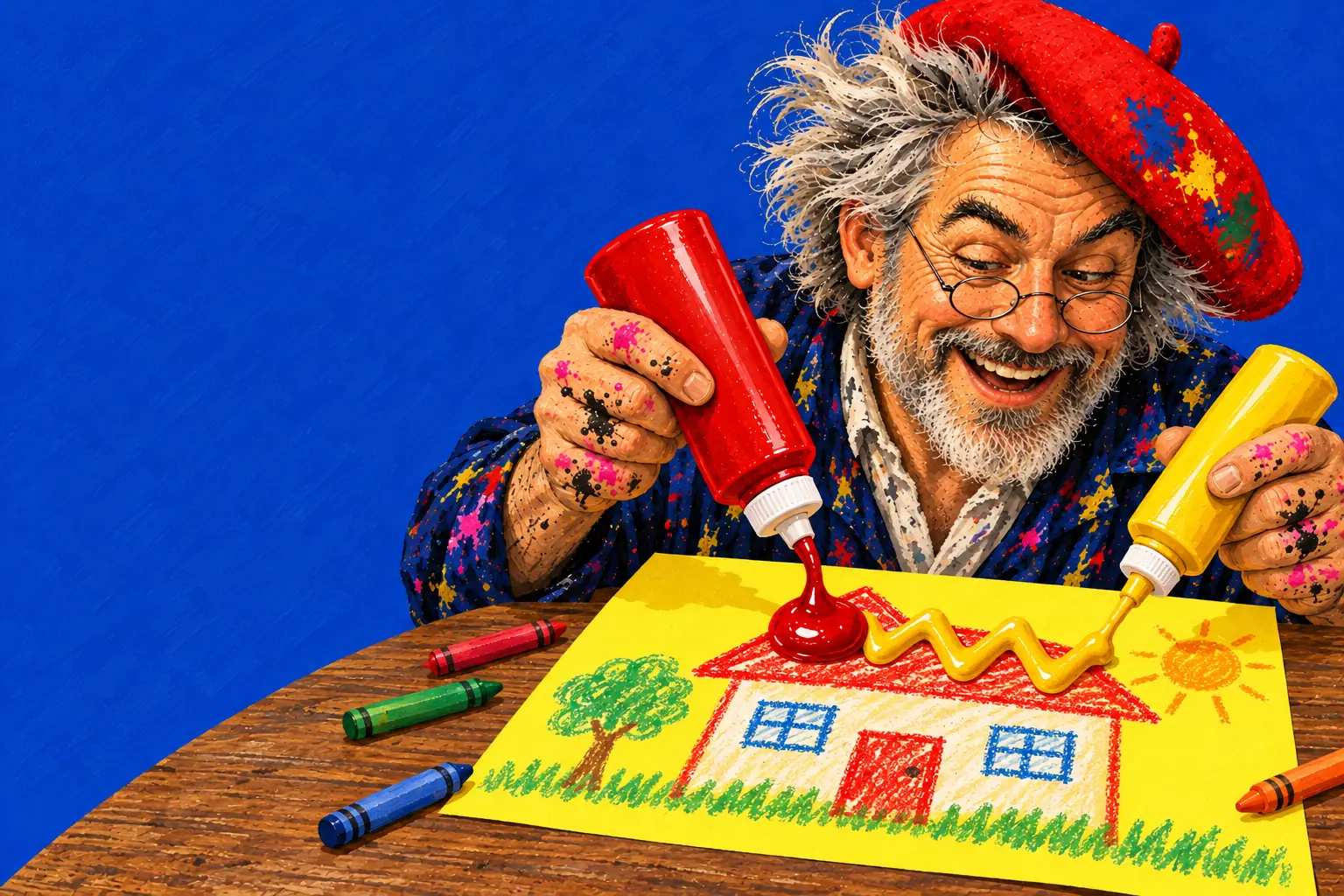
Professor Oops is made by Game Tailors, a game studio in the Netherlands (gametailors.com). We make it for children who want to do the things you can't do to a real drawing (squirt ketchup on it, bake it, take a hammer to the pens) and for the grown-ups who'd rather that happened on a screen than on the kitchen table.
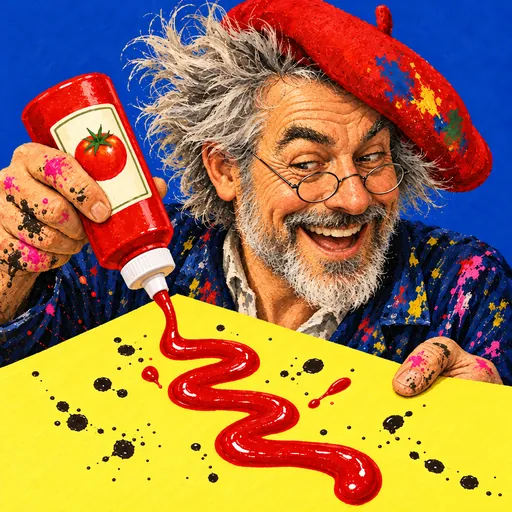
The app has one name in every language: Professor Oops, after the painter in the red beret who hosts it and this site. Oops is the moment it's built on: the spill, the splat, the thing you weren't supposed to do, and nobody gets told off.
- Website
- gametailors.com
- Contact
- info@gametailors.com
- Chamber of Commerce (KvK)
- 92437702
Why the paper behaves like the real thing
The paper in Professor Oops isn't a picture. It's a sheet made of up to about 200,000 tiny cells, each about half a millimetre across. Every cell knows a few things: how much colour has soaked into it, how wet it is, how hot it is, whether something is lying on top, whether it's dented, scorched or frozen.
Every tool only changes those things. Water makes cells wet. Fire makes them hot. The oven heats the whole sheet to 180 °C for twenty minutes. And every material (ketchup, honey, paint, dough, oil) is described by its properties: how runny it is, how thick a blob it holds, whether it melts, browns, stains or floats on water.
Emergence, explained simply
Nobody wrote "if ketchup meets fire"
Most apps script each trick by hand: when this touches that, play this animation. We do it the other way round. Things in Professor Oops react through shared physical rules: one scale of heat for everything, one kind of wetness, one measure of acid and alkali, one clock for mould and time.
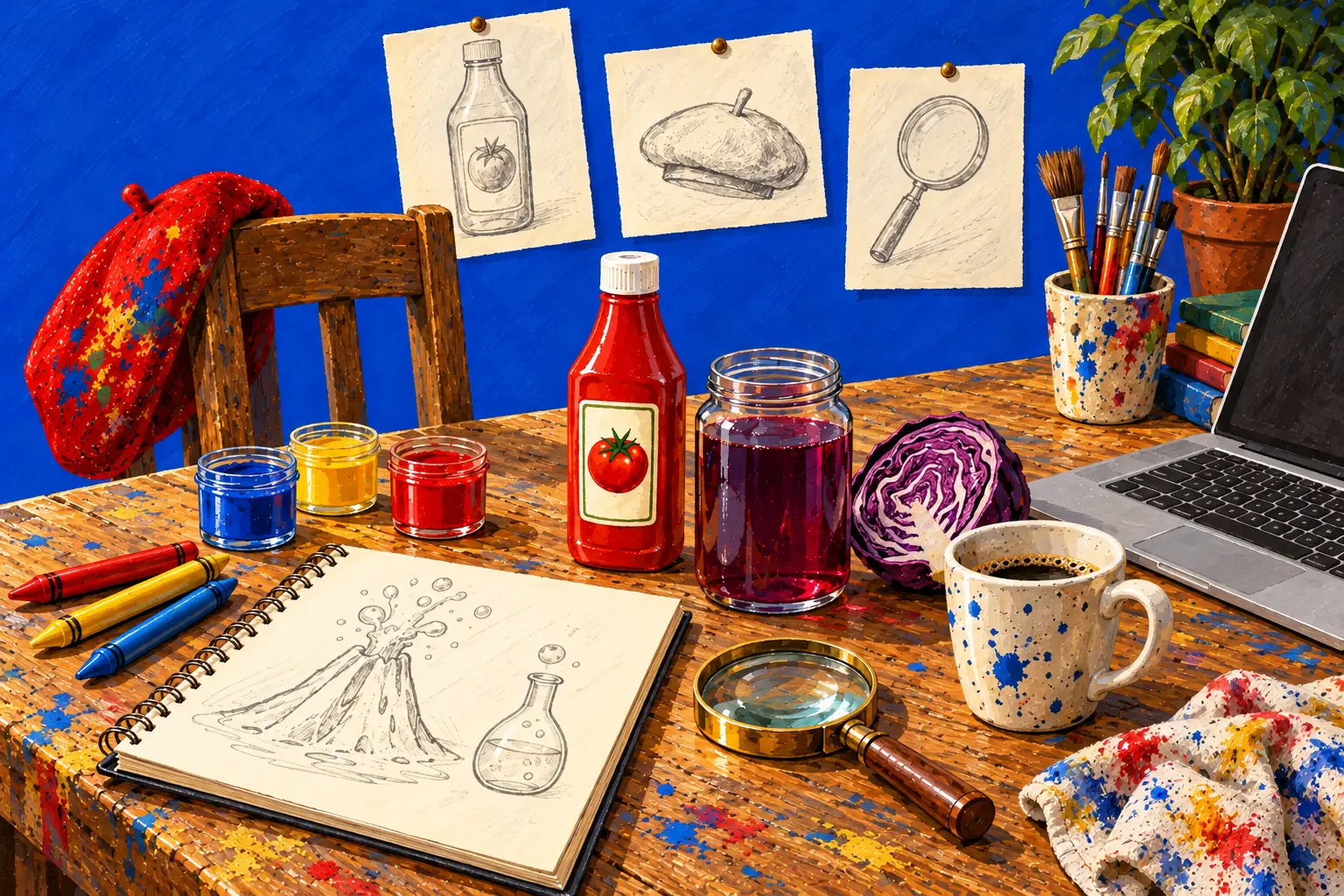
So combinations nobody planned simply happen. A line of water stops a fire, because wet paper won't burn until the water has boiled off. A crayon drawing survives bleach, because the wax keeps the bleach off the colour. Red cabbage juice turns pink on lemon and blue on egg white, because both carry their own acidity into the paper. When we add a new material, it joins all of that just by having its properties filled in.
Scientists call this emergence: lots of simple rules, together, giving behaviour that looks complicated. For a child, it just means: try it and see.
How we write this site
Every experiment and technique page has two halves. The first says what really happens in the app, checked against the game itself rather than written from memory. If the app doesn't do something, we don't say it does.
The second half is how to do the safe version for real, at home or in class, with the adult steps marked. Some things are never safe to try: mixing bleach with vinegar, water on a pan of burning oil, fire, focusing the sun with a magnifying glass. Those pages give no instructions at all, only what to do if it happens and who to call.
We don't claim the app makes children smarter. We say what it shows, and where it fits a school topic.
Who makes Professor Oops?
Game Tailors, a game studio in the Netherlands (gametailors.com).
Who is Professor Oops?
The painter in the red beret on the app's icon and all over this site. He tries everything (ketchup on a painting, a page in the oven) just to see what happens, and the app lets children do the same. His name is the app's name, the same in every language.
Why does it look like real paper and not a cartoon?
Because the paper is simulated cell by cell, so paint, water and food behave the way they do on a real sheet.