Things that push things
About this source
Game Tailors
Source: Things that push things
The drawing app where the paper is real. No ads. No accounts. No personal data: only anonymous counts, which you can switch off.
Game Tailors · Schieweg 15Y-40, 2627 AN Delft (NL)
KvK 92437702 · VAT NL866044474B01
info@gametailors.com · +31 6 4227 5919
© 2026 Game Tailors
Things that push things
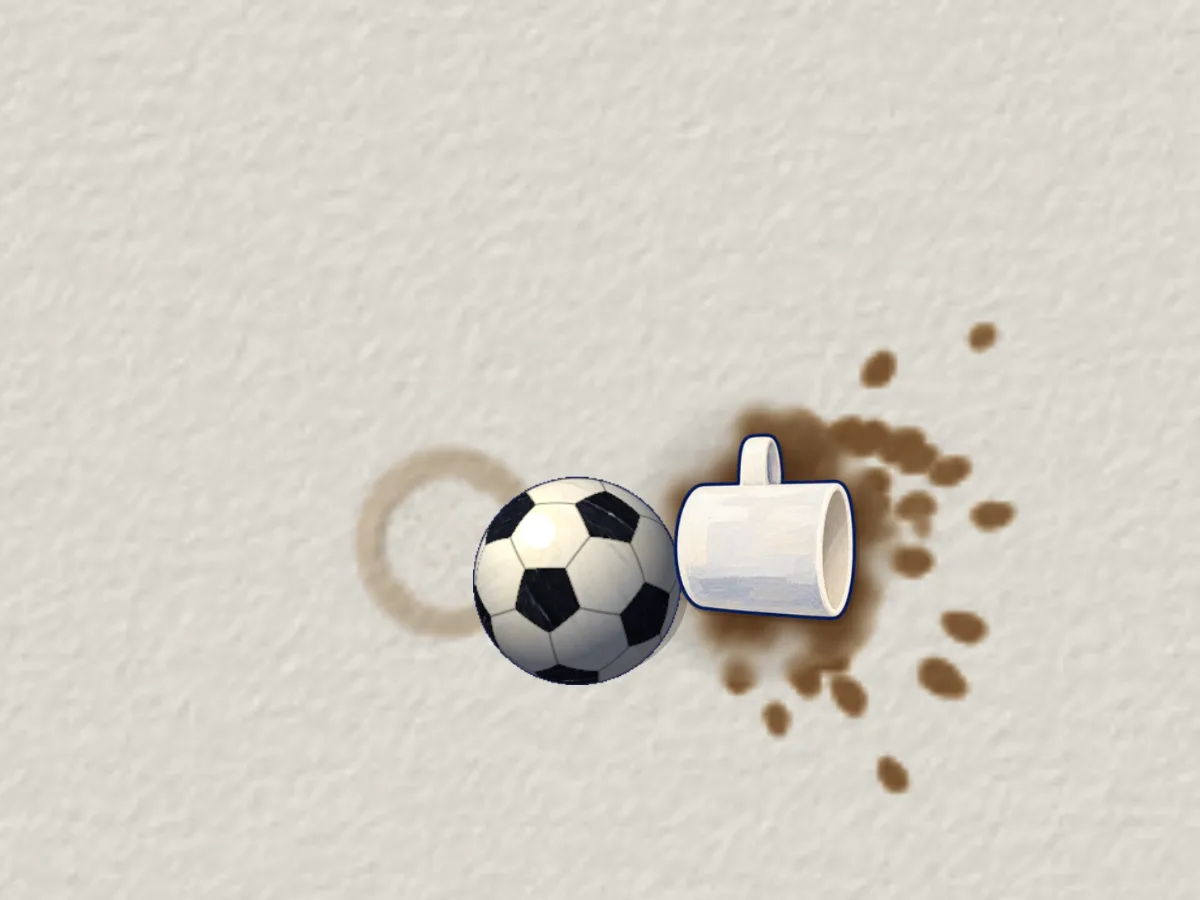
A football topples a mug, a marble doesn't, and no rule says so
Everything on the paper that isn't paint has a weight, a size and a height. A marble weighs 5 grams, a football 430, a full mug 450. When two things meet, the game works out the bump from those numbers. Tilt the tablet and balls, toy cars, string and cups all feel the same downhill, each held back by its own grip. Roll a ball through paint and it prints the paint again exactly one turn of the ball later.
Weight, size and where it's hit decide whether a mug goes over
Roll a football at a full mug and the mug goes over, spilling the way the ball was rolling. Roll a marble at it, even fast, and the mug only rattles. There's no line in the code that says "football tips mug". There is one rule for anything standing on its foot, and every ball brings its own weight, bounciness and size to it.
The rule asks one question. Does the blow swing the mug round its far edge hard enough to lift its middle over that edge? A heavier ball gives a harder blow. A bigger ball hits higher up, where the same blow turns the mug more. A taller, narrower thing goes over more easily, and a wider, squatter one resists. In the released game every cup stands by this sum. next update Bottles and flasks stand by it too, each with its own numbers.
Drag a mug with your finger and stop dead, and it goes over. Slow down gently and it stays up. Swing it round a sharp corner too fast and it goes over as well. The mug wants to keep going while your finger has stopped or turned, and the same sum decides both. Nothing in the code knows about corners. Push a mug slowly, even at its rim, and it slides instead, because the paper's grip gives way before the mug's foot does.
Fruit, pens, pebbles and stamped cards are different again. They are painted straight into the same grid of squares as the paint. When you push one, the game reads all the squares of that fruit as one solid piece, moves it, and lays it down again from its original shape, so it never crumbles or loses a drop. Shove a pen at one end and it swings round, because the game measures how its weight is spread from its own squares.
A football topples a mug, a marble doesn't, and no rule says so
Under the hood
Weight, size and where it's hit decide whether a mug goes over
A side view. The ball rolls in at the speed you set and meets the mug with the game's bump and tipping rule, using each ball's mass, bounciness and size from the game. What to look for: the football tips the mug at 160 cells/s, as in the game's test. Switch to the tennis ball or the marble at the same speed and the mug only rattles. Then find the slowest speed that still tips it. The demo shows the rattle as a short shove.
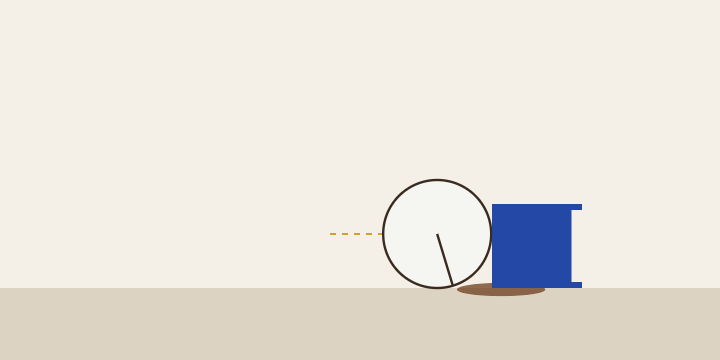
- marble · 5 g
- tennis ball · 58 g
- beach ball · 100 g
- football · 430 g
- hits the mug 3.2 cells up (dashed)
- hits the mug 7.0 cells up (dashed)
- hits the mug 22.0 cells up (dashed)
- hits the mug 18.0 cells up (dashed)
This part of the page could not start.
- mug
- —
- blow × height
- —
- mug needs
- —
- this ball needs
- —
- outcome
- —
A football must roll at 98 cells/s, a beach ball 220, a tennis ball 1,061, a bouncy ball 3,905 and a marble 23,402.
Data table
| the ball rolled at the mug | speed needed |
|---|---|
| Football | 97.5 |
| Beach ball | 219.5 |
| Tennis ball | 1061.3 |
| Bouncy ball | 3905.4 |
| Marble | 23 402.4 |
Source: Worked out from the game's own tipping rule and each ball's mass, size and bounciness; a ball hits the mug at the height of its centre.
One tap bursts a yolk, pops a bubble and sends a fly darting, because a dozen systems feel the same touch
When a hand, a hammer, a rolling pin, a rolling ball, a toy car's wheels or a monster truck's tyre touches the page, it describes a press: how big its foot is, how hard it presses, how hard its face is, how sharp, how fast and how heavy. Then the game hands that one description to a dozen systems in turn. The paint and paper underneath, flames, soap bubbles, foam, confetti, creatures, loose things, plants, sticks and mould all read the same press and decide for themselves.
So one tap can burst a yolk, pop a bubble, send a fly darting off and slide a cup. Whether something breaks goes by its own strength. A yolk gives way to almost anything, then a strawberry, a tomato and an orange, and an apple holds out longest. A rolling football presses hard enough to burst a strawberry, and a marble rolls over it. A rolling pin slammed down lands between the orange and the apple, so it bursts the orange and leaves the apple whole.
Hardness matters too. What breaks by a blow feels it through a soft face much less than through a hard one. What tips takes all of it. That's why a palm swept slowly past a toothpick leans it over instead of snapping it, and a palm flicked at a mug knocks the mug flat. A hammer brought down on a toothpick drives it into the paper without breaking it, because the hard face holds its top straight.
The press also reaches the creatures. They feel it as danger: a small one is slid clear, and the others dodge. No creature is ever hurt, by design, and that rule runs through the same channel as everything else.
Under the hood
One tap bursts a yolk, pops a bubble and sends a fly darting
One press, read twelve times
flames under it
soap bubbles
foam
confetti and bits
creatures
sealed vessels
loose things
plants
balls in the air
sticks
mould
One press, read twelve times. The order is fixed. Each listener reads the same description (foot · how hard · how firm · how sharp · how heavy · how fast · slip · warmth · plough) and decides by its own numbers.
| On one log scale | Gives way at | Presses at |
|---|---|---|
| 0.3 | yolk | toy car wheel |
| 0.4 | · | marble rolling |
| 0.8 | strawberry | · |
| 1 | · | football rolling |
| 1.5 | tomato | · |
| 2 | banana | · |
| 2.5 | · | rolling pin |
| 3 | passion fruit | · |
| 4 | orange | · |
| 5.05 | · | rolling pin slammed |
| 6 | apple | · |
| 22 | · | hammer blow |
| 50 | · | monster-truck lug |
What gives way to what. How much each thing can take before it bursts, and how hard each thing presses, on one scale. A press bursts whatever sits below it in the gives-way column.
Tilt the tablet and balls, cars, fruit, string and cups feel the same downhill
Tip a phone or tablet and the page tips with it. Balls, toy cars, fruit, string, cups, confetti and stickers all read the same downhill pull. Each one only starts moving when that pull beats its own grip on the paper. A marble goes almost at once. Confetti needs a clear tip. String and a mug need a steep one. A sticker stuck down on dry paper never slides at all, until heat or water has loosened its glue.
A marble and a tennis ball tipped together don't speed up alike. The marble is solid, the tennis ball hollow, and a rolling ball keeps some of its energy in its spin. The game uses the same two fractions you'd find in a physics book, 5/7 and 3/5, so the marble pulls ahead.
The tablet also learns how you hold it. Rest it at an angle in your lap and your drawing doesn't drain to the bottom. A small tip is soon treated as the new level. A clear tip keeps things pouring, and fades only slowly. Water, goop and the air read the same downhill through their own flows.
The shake button bumps the table: a quick run of short jolts in random directions. Loose things lag behind each jolt, so they jump about, each by its own grip.
Under the hood
Tilt the tablet and everything feels the same downhill
Six loose things on the same tipped page, downhill to the right. Each reads the game's downhill rule with its own grip. The balls speed up by 5/7 and 3/5 of it, the car's speed drifts back towards stopped as a let-go car's does, and the mug creeps as it does in the released game. Things are drawn bigger than their size. What to look for: raise the tilt slowly and watch each one start at its own angle. Press "Shake the table" at a low tilt and see the light things jump.
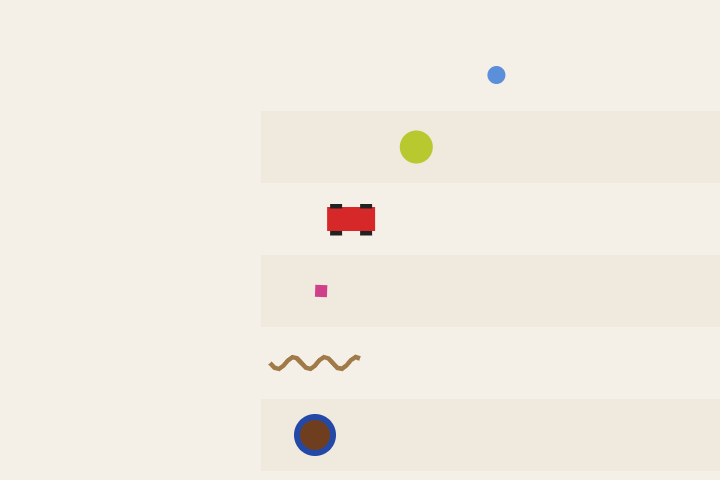
- downhill →
- Marble
- Tennis ball
- Toy car
- Confetti
- String
- Mug
- starts 2.3°
- starts 2.3°
- starts 2.9°
- starts 6.8°
- starts 19.3°
- starts 21.8°
This part of the page could not start.
- slope
- —
- pulled past its grip
- —
A 0.1 g tip fades below a marble’s start (0.04 g) within a second; a 0.3 g tip takes about 29 s and a 0.5 g tip about 44 s.
- tipped 0.1 g (about 6°)
- tipped 0.3 g (about 17°)
- tipped 0.5 g (30°)
- a marble starts rolling
Data table
| seconds held | tipped 0.1 g (about 6°) | tipped 0.3 g (about 17°) | tipped 0.5 g (30°) | a marble starts rolling |
|---|---|---|---|---|
| 0 | 0.07 | 0.27 | 0.47 | 0.04 |
| 0.5 | 0.0479 | 0.265 | 0.4617 | |
| 1 | 0.0307 | 0.2602 | 0.4536 | |
| 1.5 | 0.0172 | 0.2554 | 0.4456 | |
| 2 | 0.0068 | 0.2507 | 0.4378 | |
| 2.5 | 0 | 0.246 | 0.43 | |
| 3 | 0 | 0.2415 | 0.4224 | |
| 3.5 | 0 | 0.237 | 0.4149 | |
| 4 | 0 | 0.2326 | 0.4076 | |
| 4.5 | 0 | 0.2282 | 0.4004 | |
| 5 | 0 | 0.2239 | 0.3932 | |
| 5.5 | 0 | 0.2197 | 0.3862 | |
| 6 | 0 | 0.2156 | 0.3794 | |
| 6.5 | 0 | 0.2116 | 0.3726 | |
| 7 | 0 | 0.2076 | 0.3659 | |
| 7.5 | 0 | 0.2036 | 0.3594 | |
| 8 | 0 | 0.1998 | 0.353 | |
| 8.5 | 0 | 0.196 | 0.3466 | |
| 9 | 0 | 0.1922 | 0.3404 | |
| 9.5 | 0 | 0.1886 | 0.3343 | |
| 10 | 0 | 0.185 | 0.3283 | |
| 10.5 | 0 | 0.1814 | 0.3223 | |
| 11 | 0 | 0.1779 | 0.3165 | |
| 11.5 | 0 | 0.1745 | 0.3108 | |
| 12 | 0 | 0.1711 | 0.3052 | |
| 12.5 | 0 | 0.1678 | 0.2996 | |
| 13 | 0 | 0.1645 | 0.2942 | |
| 13.5 | 0 | 0.1613 | 0.2888 | |
| 14 | 0 | 0.1581 | 0.2835 | |
| 14.5 | 0 | 0.155 | 0.2784 | |
| 15 | 0 | 0.152 | 0.2733 | |
| 15.5 | 0 | 0.149 | 0.2683 | |
| 16 | 0 | 0.146 | 0.2633 | |
| 16.5 | 0 | 0.1431 | 0.2585 | |
| 17 | 0 | 0.1402 | 0.2537 | |
| 17.5 | 0 | 0.1374 | 0.249 | |
| 18 | 0 | 0.1346 | 0.2444 | |
| 18.5 | 0 | 0.1319 | 0.2399 | |
| 19 | 0 | 0.1292 | 0.2354 | |
| 19.5 | 0 | 0.1266 | 0.231 | |
| 20 | 0 | 0.124 | 0.2267 | |
| 20.5 | 0 | 0.1215 | 0.2225 | |
| 21 | 0 | 0.119 | 0.2183 | |
| 21.5 | 0 | 0.1165 | 0.2142 | |
| 22 | 0 | 0.1141 | 0.2102 | |
| 22.5 | 0 | 0.1117 | 0.2062 | |
| 23 | 0 | 0.1094 | 0.2023 | |
| 23.5 | 0 | 0.1071 | 0.1984 | |
| 24 | 0 | 0.1048 | 0.1947 | |
| 24.5 | 0 | 0.1026 | 0.191 | |
| 25 | 0 | 0.1004 | 0.1873 | |
| 25.5 | 0 | 0.0982 | 0.1837 | |
| 26 | 0 | 0.0961 | 0.1802 | |
| 26.5 | 0 | 0.094 | 0.1767 | |
| 27 | 0 | 0.092 | 0.1733 | |
| 27.5 | 0 | 0.09 | 0.1699 | |
| 28 | 0 | 0.0634 | 0.1666 | |
| 28.5 | 0 | 0.0428 | 0.1634 | |
| 29 | 0 | 0.0267 | 0.1602 | |
| 29.5 | 0 | 0.0141 | 0.157 | |
| 30 | 0 | 0.0044 | 0.1539 | |
| 30.5 | 0 | 0 | 0.1509 | |
| 31 | 0 | 0 | 0.1479 | |
| 31.5 | 0 | 0 | 0.145 | |
| 32 | 0 | 0 | 0.1421 | |
| 32.5 | 0 | 0 | 0.1392 | |
| 33 | 0 | 0 | 0.1364 | |
| 33.5 | 0 | 0 | 0.1337 | |
| 34 | 0 | 0 | 0.131 | |
| 34.5 | 0 | 0 | 0.1283 | |
| 35 | 0 | 0 | 0.1257 | |
| 35.5 | 0 | 0 | 0.1231 | |
| 36 | 0 | 0 | 0.1206 | |
| 36.5 | 0 | 0 | 0.1181 | |
| 37 | 0 | 0 | 0.1157 | |
| 37.5 | 0 | 0 | 0.1133 | |
| 38 | 0 | 0 | 0.1109 | |
| 38.5 | 0 | 0 | 0.1086 | |
| 39 | 0 | 0 | 0.1063 | |
| 39.5 | 0 | 0 | 0.104 | |
| 40 | 0 | 0 | 0.1018 | |
| 40.5 | 0 | 0 | 0.0996 | |
| 41 | 0 | 0 | 0.0975 | |
| 41.5 | 0 | 0 | 0.0954 | |
| 42 | 0 | 0 | 0.0933 | |
| 42.5 | 0 | 0 | 0.0913 | |
| 43 | 0 | 0 | 0.0795 | |
| 43.5 | 0 | 0 | 0.0553 | |
| 44 | 0 | 0 | 0.0364 | |
| 44.5 | 0 | 0 | 0.0217 | |
| 45 | 0 | 0 | 0.0103 | |
| 45.5 | 0 | 0 | 0.0014 | |
| 46 | 0 | 0 | 0 | |
| 46.5 | 0 | 0 | 0 | |
| 47 | 0 | 0 | 0 | |
| 47.5 | 0 | 0 | 0 | |
| 48 | 0 | 0 | 0 | |
| 48.5 | 0 | 0 | 0 | |
| 49 | 0 | 0 | 0 | |
| 49.5 | 0 | 0 | 0 | |
| 50 | 0 | 0 | 0 | 0.04 |
Source: Computed with the game's own rest-pose rule: it follows a small tip quickly and a clear tip slowly, with a small dead zone.
A ball rolled through paint prints it again one turn later
Each ball is a sphere that turns as it rolls. Its skin is split into 512 small patches, and each patch carries whatever paint it has touched. Roll a ball through a stripe of paint and the patch that touched it comes round to the bottom again after exactly one turn of the ball. There it prints the stripe again, fainter, and again one turn later. Rolling it back and forth only moves the paint about. Paint comes off the paper onto the ball and back, and none is made or lost.
A tennis ball is fuzzy, so it soaks up a lot and prints grainy. A marble takes up little. Paint under a ball slows it down, and wet soapy paper lets it roll much further. Slam a ball down and it squashes for a moment, splats what's under it and bounces off a little sideways, because no hit is quite straight.
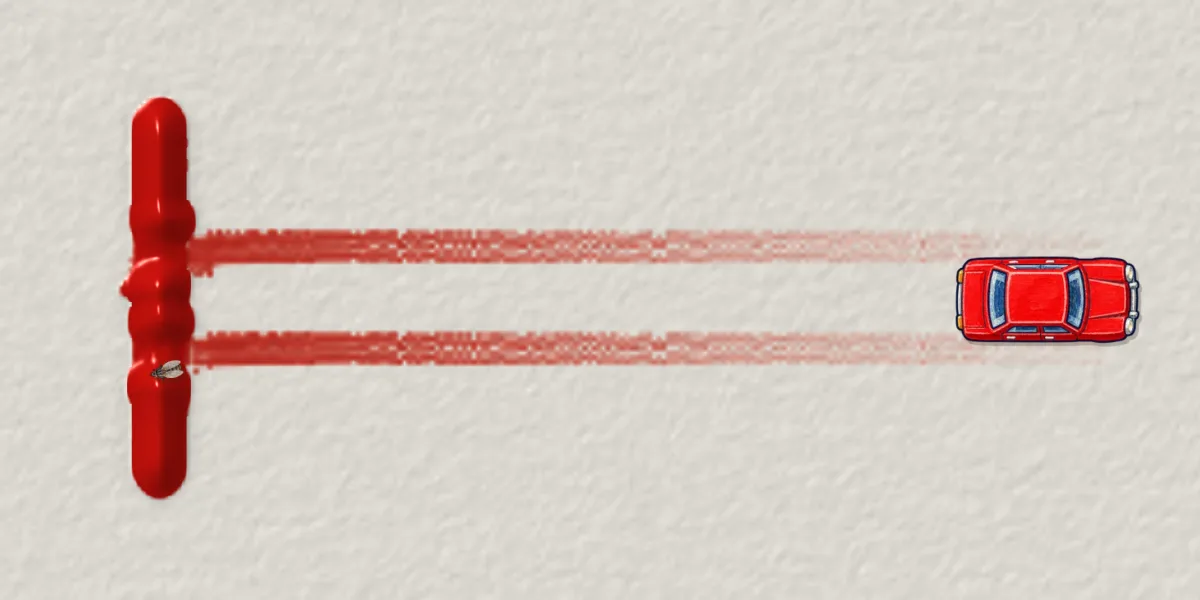
Toy cars are steered towards your finger, the way a child steers one, and they can only turn sharply while rolling. Their four tyres carry paint the same way the ball's skin does, so a car driven through ketchup leaves red tracks that fade over a long way. Deep in mud, honey or glue, the wheels sink and crawl through. A car that drives into a tomato bumps it and leaves it whole, because a wheel presses more lightly than a tomato can take.
The monster truck's tyre is a spectacle: nearly two-fifths as long as the page is high. It's simulated as one line of cells where it touches the paper, with chevron lugs that press hard, dent the paper and squeeze paint out sideways.
Moving things push the page back. A ball or a hand dragged through paint ploughs it aside with a bow wave, heavier balls more. Balls, cars and the hand stir the air as they go, so a football rolled fast past a candle blows it out without touching it. A slap on the paper puffs air out that blows nearby confetti. The air is the same coarse stable-fluids grid the fan and hair dryer blow, after Stam 1999.
Under the hood
A ball rolled through paint prints it again one turn later
Seen from above. The ball turns by the game's quaternion rule, and its 512 skin patches pick up and print paint by the shares in the game's carry rule (one paint, simplified). Drag on the paper to roll it yourself, or press Roll it back. What to look for: the faint copies of the red stripe land on the yellow marks, each one turn of the ball apart. The marble's marks are close together, the football's far apart. "Paint in all" never changes: the ball only moves paint about.
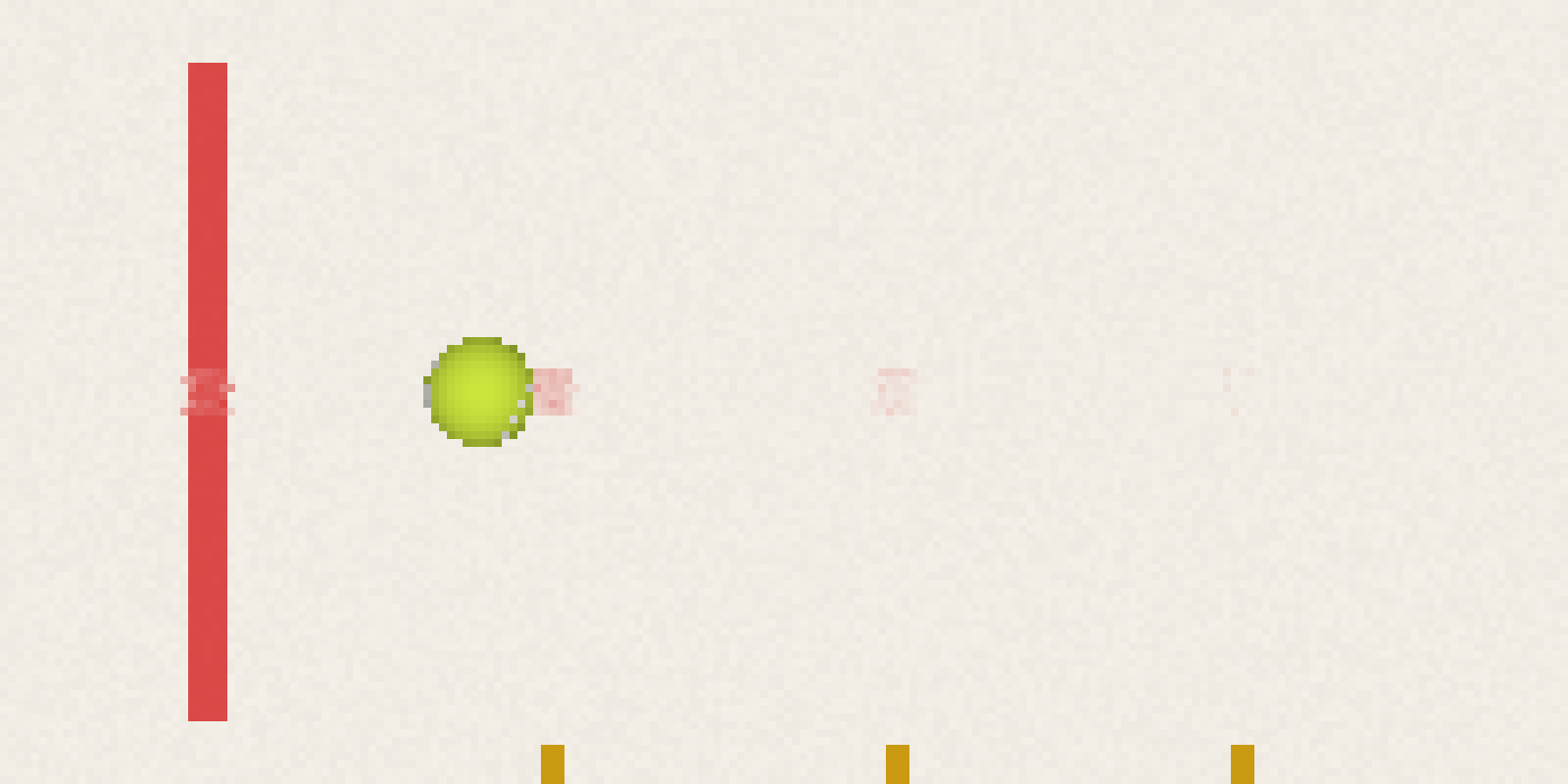
This part of the page could not start.
- one turn
- —
- rolled
- —
- paint on the ball
- —
- paint in all
- —
The hand touches as much paper as its painting covers, and tells a slap from a smear
The hand is free and always on screen. Turn its size slider all the way down and only the tip of the index finger touches, for fine finger painting. From a little below the middle of the slider up it's the whole palm, which squeezes a palm's worth out of a puddle and ploughs a broad trench through thick paint. With a mouse you see the painted hand, and the disc it presses has the area of the skin in that painting, to within half a percent. An earlier version pressed less than half the skin it showed. That was fixed before the release.
A touch screen can't tell how fast a finger came down. So the hand presses at once and decides afterwards. Lift quickly without sliding and it was a slap, and paint splashes. Slide, or stay, and it was put down, so smearing paint never sprays it. Even the painted cuff of the sleeve is part of the simulation. It shoves aside a cup the palm missed, and lifts over it when you tip onto a fingertip.
Every finger on the glass is its own hand. One can hold a piece of string while another smears paint, and lifting one never drops what the other holds. If the system steals a finger mid-gesture, say for a notification, the hand lets go cleanly and finishes nothing.
Throws read the finger's real speed. Each touch event carries the time it happened, so a fling is measured the same on a busy old tablet as on a fast one. A thrown thing leaves at a share of the finger's speed, and a solid one skids to a stop on landing.
Under the hood
The hand touches as much paper as its painting covers
At the default size (0.4) the hand now touches a radius of 10.1 cells, where the earlier rule touched 6.6; at full size 22 against 18.2.
- now: a disc with the painted skin's area
- earlier: a rule of its own
Data table
| size slider | now: a disc with the painted skin's area | earlier: a rule of its own |
|---|---|---|
| 0 | 1.65 | 2.1 |
| 0.02 | 1.711 | 2.167 |
| 0.04 | 1.887 | 2.278 |
| 0.06 | 2.165 | 2.414 |
| 0.08 | 2.531 | 2.569 |
| 0.1 | 2.973 | 2.741 |
| 0.12 | 3.48 | 2.927 |
| 0.14 | 4.036 | 3.127 |
| 0.16 | 4.631 | 3.338 |
| 0.18 | 5.252 | 3.56 |
| 0.2 | 5.885 | 3.791 |
| 0.22 | 6.518 | 4.033 |
| 0.24 | 7.139 | 4.283 |
| 0.26 | 7.734 | 4.542 |
| 0.28 | 8.29 | 4.809 |
| 0.3 | 8.797 | 5.084 |
| 0.32 | 9.239 | 5.366 |
| 0.34 | 9.605 | 5.655 |
| 0.36 | 9.883 | 5.952 |
| 0.38 | 10.059 | 6.255 |
| 0.4 | 10.12 | 6.564 |
| 0.42 | 10.402 | 6.879 |
| 0.44 | 10.724 | 7.201 |
| 0.46 | 11.064 | 7.529 |
| 0.48 | 11.415 | 7.862 |
| 0.5 | 11.775 | 8.201 |
| 0.52 | 12.143 | 8.545 |
| 0.54 | 12.517 | 8.895 |
| 0.56 | 12.896 | 9.25 |
| 0.58 | 13.28 | 9.61 |
| 0.6 | 13.668 | 9.975 |
| 0.62 | 14.06 | 10.345 |
| 0.64 | 14.456 | 10.719 |
| 0.66 | 14.855 | 11.099 |
| 0.68 | 15.257 | 11.483 |
| 0.7 | 15.662 | 11.872 |
| 0.72 | 16.07 | 12.265 |
| 0.74 | 16.48 | 12.662 |
| 0.76 | 16.893 | 13.064 |
| 0.78 | 17.308 | 13.47 |
| 0.8 | 17.725 | 13.88 |
| 0.82 | 18.145 | 14.295 |
| 0.84 | 18.566 | 14.713 |
| 0.86 | 18.989 | 15.135 |
| 0.88 | 19.414 | 15.562 |
| 0.9 | 19.841 | 15.992 |
| 0.92 | 20.27 | 16.426 |
| 0.94 | 20.7 | 16.864 |
| 0.96 | 21.132 | 17.306 |
| 0.98 | 21.565 | 17.751 |
| 1 | 22 | 18.2 |
Source: From the game's hand-size rule and the rule it replaced.
Strings stretch out of melted cheese, thin and snap
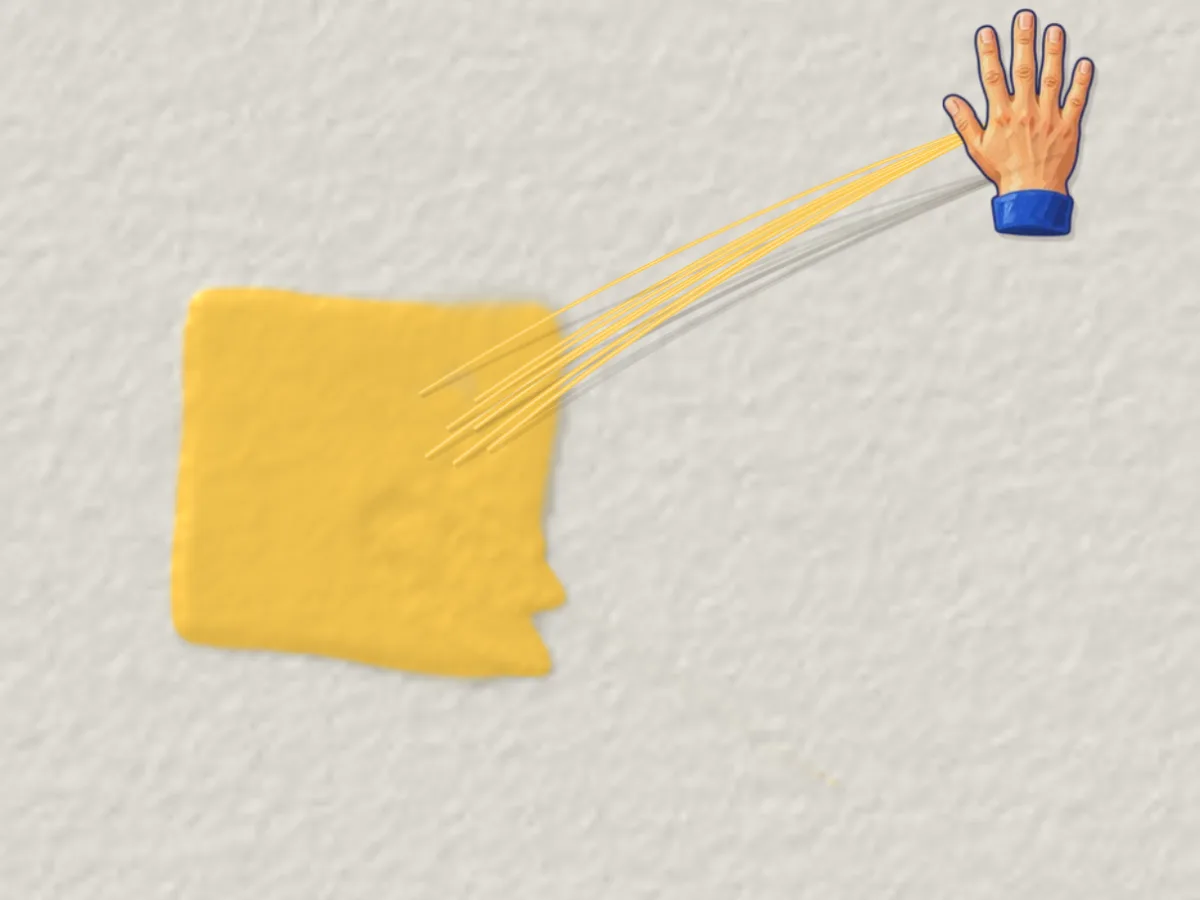
Press the hand into melted cheese, honey or glue and pull away, and strings stretch off your fingers. As you pull, each string thins and draws a little more out of the goop where it's stuck. When it's too thin it snaps somewhere along its length. By the code, the part near the paper falls back as a thread and the rest drops in a blob under your hand, and every drop is accounted for. On the page a child sees the strings stretch and snap; the fallen threads don't show.
How stringy something is depends on its state, not its name. Cold cheese doesn't string at all. Melt it and it strings as much as anything in the game. Honey and glue string a bit, peanut butter and chocolate hardly. Dust dough with flour and the hand hardly sticks to it, through the same rule that every pick-up reads.
The String tool is a different thing: a length of string you lay on the paper. It's a chain of points that can't stretch. The paper's friction is so heavy that it slides and doesn't swing. Drag one end and the rest follows, wrapping round cups in its way, picking up wet paint and printing it further on. Tilt the page past its grip and it slides downhill like the balls and cups.
One small fix shows the approach. Strings used to be drawn out of the single square under their anchor, and every string pulled out of thick peanut butter left a tiny pit. A hand stroke came out dotted with pinpricks. Now a string draws from a little foot around its anchor, more from nearby and deeper squares, as the goop would flow in towards it. The pinpricks are gone, and the total amount of goop over a stroke changes by less than a millionth.
Under the hood
Strings stretch out of melted cheese, thin and snap
The circle is the hand at its default size. It comes down in a pool of goop and pulls away, catching, stretching, topping up and snapping strings by the game's rule. Drag on the paper to pull with your own hand, or press Pull again. What to look for: melted cheese stretches all the way across, honey snaps late, peanut butter and chocolate snap early and lie as threads (in the game the fallen threads don't show on the paper). Slide "melted" well down and nothing strings at all. The rule counts moves, not seconds: it tops a string up once per move, so pull in smaller steps and even honey holds on.
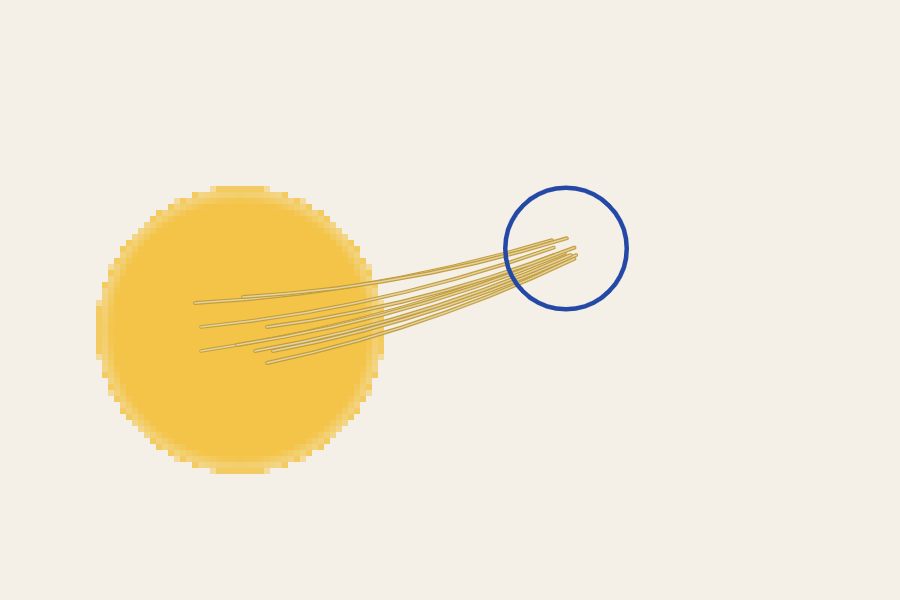
This part of the page could not start.
- hand
- —
- strings held
- —
- longest now
- —
- snapped
- —
- longest snapped
- —
- stringiness in the pool
- —
A mug fizzes and a bottle sprays because of the size of its mouth
Cups, the cola bottle and the flask are all one kind of thing: a container with contents. What's inside is a well-mixed amount with its colour, what it's made of, its fizz and its temperature. Its opening is a door, and anything that lands there goes in, the way it lands anywhere else.
There's no geyser code and no toothpaste code. When gas forms inside, it has to leave through the opening. Through a wide mug the gas leaves slowly and the drink just fizzes and froths over the rim. Through the narrow neck of a bottle the same gas has to rush out fast, and above a set speed it throws the liquid up with it. Soap in the mix traps the gas as foam that lasts far longer. Change the numbers and you have a different eruption.
Knock a mug over and it spills the way it fell. In the released game the spill is a shortcut: a puddle and a splash. next update Bottles and flasks stand and fall by their own build. A full cola bottle on a narrow foot goes over on a tilt before it slides, and a squat flask slides. Empty the bottle and it weighs less than half as much, so it tips at a knock a full one only rattles at. What pours out is set by geometry: a mug empties almost at once, a bottle pours for seconds, and what's below the neck stays inside.
Under the hood
A mug fizzes and a bottle sprays because of the size of its mouth
Full or empty, the bottle tips at 18.8°, and up to 22.9° at 40 % full; it slides at 21.8°, so from about 20 to 65 % full it would slide first.
- cola bottle tips at
- it slides at
Data table
| how full (%) | cola bottle tips at | it slides at |
|---|---|---|
| 0 | 18.753 | 21.801 |
| 2.5 | 19.27 | |
| 5 | 19.756 | |
| 7.5 | 20.209 | |
| 10 | 20.626 | |
| 12.5 | 21.009 | |
| 15 | 21.355 | |
| 17.5 | 21.666 | |
| 20 | 21.94 | |
| 22.5 | 22.178 | |
| 25 | 22.381 | |
| 27.5 | 22.55 | |
| 30 | 22.685 | |
| 32.5 | 22.789 | |
| 35 | 22.861 | |
| 37.5 | 22.904 | |
| 40 | 22.919 | |
| 42.5 | 22.908 | |
| 45 | 22.872 | |
| 47.5 | 22.812 | |
| 50 | 22.732 | |
| 52.5 | 22.632 | |
| 55 | 22.513 | |
| 57.5 | 22.378 | |
| 60 | 22.228 | |
| 62.5 | 22.064 | |
| 65 | 21.888 | |
| 67.5 | 21.701 | |
| 70 | 21.505 | |
| 72.5 | 21.3 | |
| 75 | 21.087 | |
| 77.5 | 20.868 | |
| 80 | 20.644 | |
| 82.5 | 20.416 | |
| 85 | 20.184 | |
| 87.5 | 19.948 | |
| 90 | 19.711 | |
| 92.5 | 19.472 | |
| 95 | 19.233 | |
| 97.5 | 18.993 | |
| 100 | 18.753 | 21.801 |
Source: next update Computed from the game's own balance rule for a part-full bottle.
A football rolled past a candle blows it out, and a toy car driven through ketchup leaves red tracks
Each of these happens because two systems share a layer of the page, and neither one names the other.
Shared: the ball's wake → air speed at the flame
Roll a football fast past a lit candle
The candle blows out without being touched. Rolled slowly, it stays lit. Pinned by a test · Air that really moves
Shared: a slap → a puff of air
Slap the paper beside some confetti
The gust from the slap blows the confetti away. Pinned by a test · Air that really moves
Shared: paint carried on its tyres
Drive the toy car through ketchup
Red tyre tracks run on beyond the ketchup, fading as the tyres give up what they took. Pinned by a test · Runny, sticky and oily
Shared: the page's heat → each toy's material
Bake a toy car and a beach ball in the oven
The car slumps into a puddle of its own plastic. The ball shrivels into a patch with just the plastic of its skin, stripes and all. The marble comes through. Pinned by a test · Heat and fire
Shared: how set each square of goop is
Melt cheese with the hair dryer, then pull it with the hand
Strings stretch out of it. Let it cool and set, and it won't string. Pinned by a test · Heat and fire
Shared: the press → danger
Sweep the hand across the paper where creatures are
Each one gets out of the way, slow or fast, fingertip or palm. None is ever under the hand. Pinned by a test · Animals with their own minds
98 cells/s
The slowest a football can roll and still tip a full mug. A marble would need 23,402.
12
Systems that read every press, in a fixed order, each by its own numbers.
512
Patches on every ball's skin, each carrying its own paint round.
8×
How much slower than life things fly on the page, the same for everything that falls.
35
Kinds of loose thing one test sweeps the hand through, each with a written sentence of what should happen.
60 Hz
Fixed steps a second for every bump, roll and tip, worked out in a Web Worker beside the drawing.