Drawn from the heat
Flames
Each burning cell sends up a flame particle now and then, and the paper glows by its temperature, from a dull red to full flame colour. On a slow device fewer, bigger flames keep the fire looking as thick.
Game Tailors
Source: Heat and fire
The drawing app where the paper is real. No ads. No accounts. No personal data: only anonymous counts, which you can switch off.
Game Tailors · Schieweg 15Y-40, 2627 AN Delft (NL)
KvK 92437702 · VAT NL866044474B01
info@gametailors.com · +31 6 4227 5919
© 2026 Game Tailors
Heat and fire
One thermometer runs under the whole page. An iron, a match, a hot cup, the sun through a magnifying glass and a battery all write to that same number. What happens next depends almost only on how hot a spot gets and what lies there, not on which tool made the heat. The burning is no special effect. It's a line of hot spots lighting the spots beside them, and the flames you see are drawn on top.
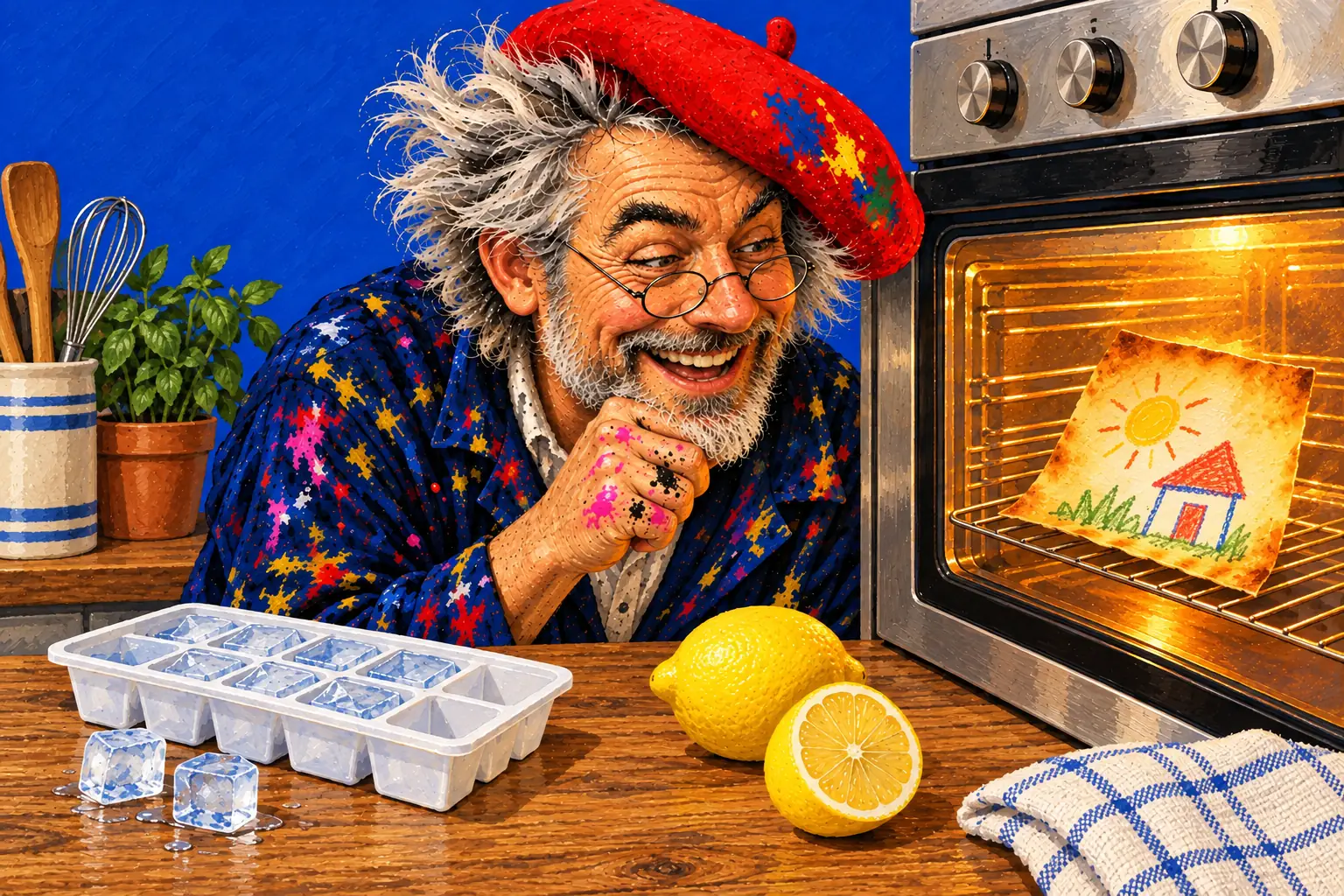
Put a hot cup on a square of chocolate and the chocolate goes soft. Run a hair dryer over a crayon drawing and the wax melts into the paper; it also sets a puddle of egg white. It won't bring out a secret message written in lemon juice, though. That takes more heat, such as the iron's.
None of this is a list of "dryer does X, iron does Y". Each tool only raises the temperature of the spots it touches. Chocolate softens at 32 °C, crayon melts at 60 °C, egg white sets at 63 °C, plastic slumps at 110 °C and paper scorches at 200 °C, whatever brought the heat. A test checks that a candle, a hair dryer, a magnifying glass and an iron each melt crayon and each set egg white, while a hot cup does neither but still softens chocolate.
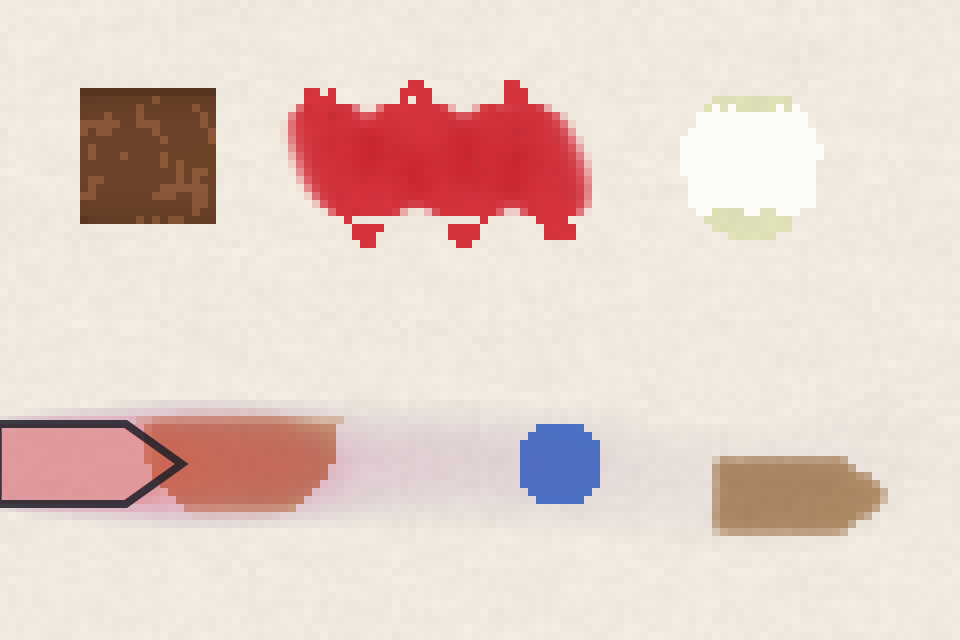
The iron is already gliding over chocolate, a red crayon zigzag, egg white, a heart drawn in lemon juice and a plastic bead. Pick a tool and drag it over the paper yourself, or press Glide over the sheet or Hold it on the heart. What to look for: the hot cup only softens the chocolate. The dryer also floods the crayon and sets the egg white, but the heart stays hidden. Only the iron browns the heart and slumps the bead, and held still it scorches its own outline without ever catching fire. Heat spreads, scorches, melts crayon, browns the ink, sets the egg and slumps the bead by the game's rules and thresholds. How fast the chocolate softens, and how chocolate, egg and bead look, are sketched.
This part of the page could not start.
The scale is anchored on one real number. Paper catches fire at about 230 °C in the game, inside the published range of 218 to 246 °C Autoignition, Wikipedia, which we found after the fact. Leave the iron standing and it climbs hot enough to scorch an iron-shaped mark, and stops just short of setting the paper alight. That ceiling is a design decision. Gentle heat in the game can't start a fire on bare paper.
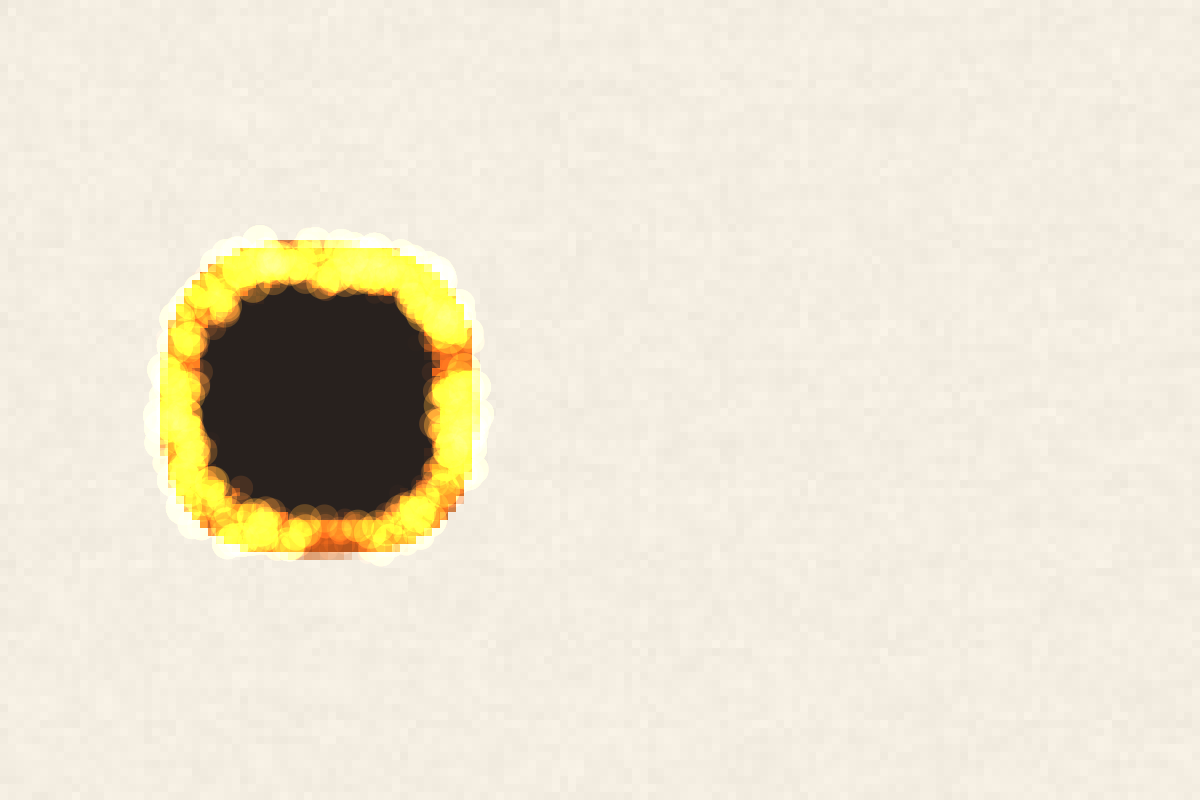
Strike a match on the paper. The spots under it pass 230 °C and catch. Each burning spot uses up its share of paper in about two seconds, gets very hot and warms its neighbours, until they catch too. Behind the flames the paper is gone and a hole opens, edged in black char with a thin brown scorch beyond it, because heat runs ahead of the fire and scorches the paper before it burns. While the fire burns, its flames cover both; they show once it's out.
Nowhere in the code is a speed for fire. It comes out of three rules: how heat spreads, when paper catches and how hot a burning spot gets. Measured in the released game, the front crawls at 1.85 cells a second, about 1.1 mm a second at the sheet's nominal scale. One published measurement, for plain paper burning downward, is 0.81 mm a second Ramli 2018. That's the same order of size. We found it after the fact and never tuned toward it, and a downward burn isn't a flat sheet. On a phone the sheet has fewer, bigger cells and the rules count cells, so the same drawing burns away sooner.
Paper isn't even. A noise field of fibres makes some spots carry heat and burn faster than others, so the edge of the fire wanders. Stand the sheet up on the easel and heat climbs, so the fire goes up faster than it creeps down. Turn on a breeze stronger than a flame's own updraft and the fire leans over and runs downwind. Automated tests pin both.
Graphics research has modelled burning paper down to its curling and its fibres Melek 2006 Larboulette 2013. We read that work and chose something far smaller: heat and fuel on a flat grid, cheap enough for a tablet, with no oxygen and no curling.
A match has already been struck near the left edge. Tap with the match to start another, or switch to water and paint across its path, or press Strike a match or Paint water across its path. What to look for: the brown band running ahead of the flames, the wandering edge where the fibres differ, the front readout hovering at 1.8 to 2.0 cells a second, close to the 1.85 measured in the game. Raise the wind past the flames' own updraft (40 on the slider) and the front leans and races; stand the sheet upright and it climbs. This is the game's paper rule on a 150 × 100 sheet, bare paper only. The flames are a sketch of the game's particles, and gusts strong enough to blow a fire out are left out.
This part of the page could not start.
The spot climbs from 33 °C at 46.5 s past 228 °C at 48 s, peaks at 462 °C at 49.5 s and is back at 24 °C by 53 s.
| seconds after the match | the spot | paper catches, 230 °C | water boils, 100 °C |
|---|---|---|---|
| 46.5 | 33 | 230 | 100 |
| 47 | 63 | ||
| 47.5 | 121 | ||
| 48 | 228 | ||
| 48.5 | 381 | ||
| 49 | 440 | ||
| 49.5 | 462 | ||
| 50 | 407 | ||
| 50.5 | 201 | ||
| 51 | 105 | ||
| 51.5 | 60 | ||
| 52 | 39 | ||
| 53 | 24 | 230 | 100 |
Source: Our re-implementation of the game's paper rule, for bare, dry paper, one spot 100 cells from the match. Not the game itself. The spot catches at about 48 s and burns through at 50 s.
From 180 °C both fall to 99 °C after 2 s and 25 °C after 10 s; at 12 s the formula gives 22 °C and the game 20 °C.
| seconds | Newton's law of cooling | released game, measured |
|---|---|---|
| 0 | 180 | 180 |
| 1 | 133 | 133 |
| 2 | 99 | 99 |
| 3 | 76 | 76 |
| 4 | 59 | 59 |
| 5 | 48 | 48 |
| 6 | 39 | 39 |
| 7 | 34 | 34 |
| 8 | 30 | 30 |
| 9 | 27 | 27 |
| 10 | 25 | 25 |
| 11 | 23 | 23 |
| 12 | 22 | 20 |
Source: Middle of a patch of paper at 180 °C, by second. The solid line is the formula, the dashed line the game. The two agree to the degree for 11 seconds. At the 12th the game is 2 °C lower, most likely heat lost to the cooler edge of the patch. Measured in the released game.
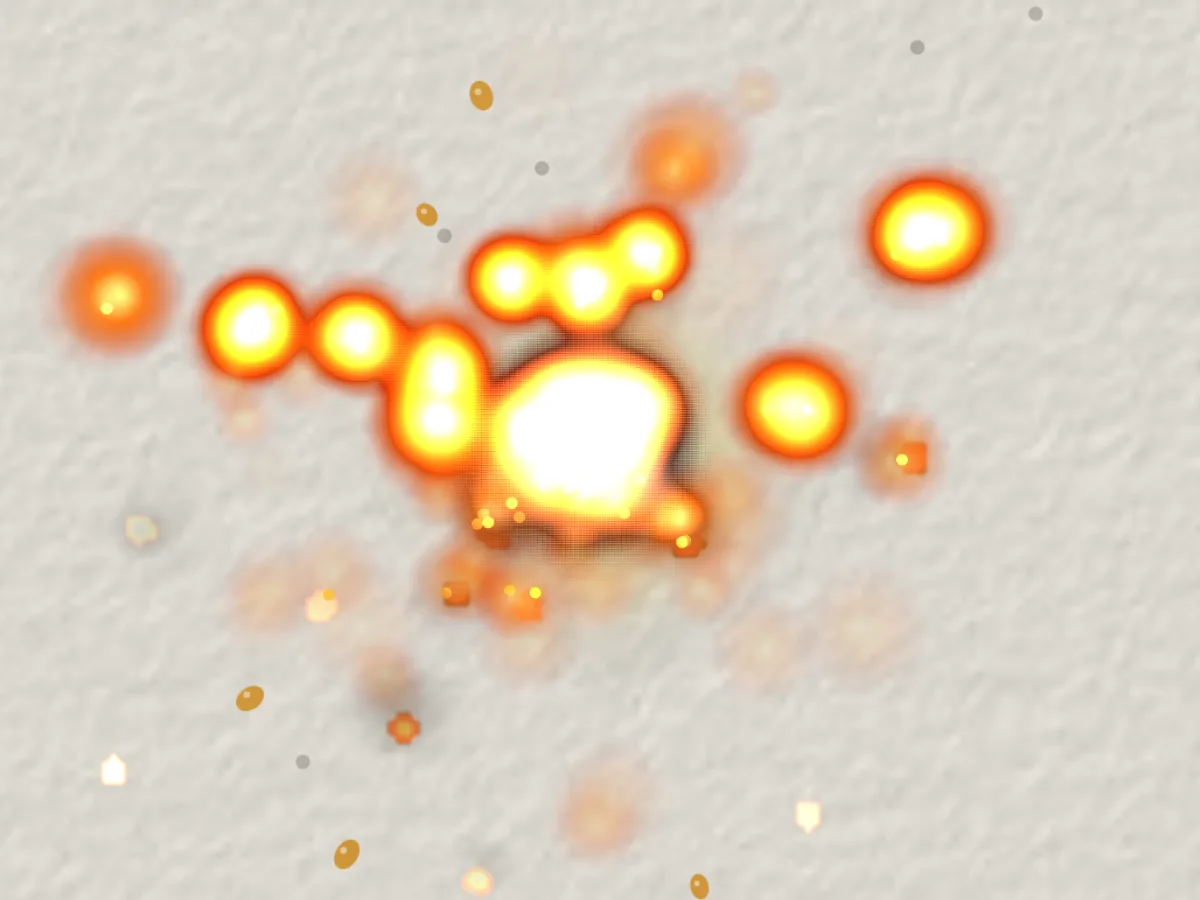
What you see dancing over a fire isn't what burns the paper. The heat lives in the grid; the flames are drawn on top of it. That split is what lets the fire look the same on a slow phone as on a fast tablet.
Drawn from the heat
Each burning cell sends up a flame particle now and then, and the paper glows by its temperature, from a dull red to full flame colour. On a slow device fewer, bigger flames keep the fire looking as thick.
Drawn, and smelled
Smoke is a picture and a gas at once. The puffs you see are particles. A smoke gas also drifts on the air grid, and animals read it and keep away.
Not in the game
Nothing lands from smoke. The dark mark round a burn is scorch: how charred the paper itself is, drawn through a colour table.
Drawn and heard
Boiling water sends up white puffs and a hiss. The steam itself carries no heat and wets nothing; the boiling that made it is computed.
Paint a stripe of water across the sheet and light a match on one side. A match held to soaked paper won't light it: the spot warms and hisses, and that's all, as an automated test checks. When the fire reaches the wet stripe, the wet spots hold their heat down while they dry, and they can't catch until they have. The front slows to a crawl, dries its way across, then speeds up again on the far side.
The chart below is the released game, measured: the same sheet with and without a wet stripe. The fire lost about 12 seconds getting through.
In the next update next update this follows the physics more closely. Heat above 100 °C goes into boiling the water off, at water's real latent heat of 2,260 joules per gram, so a wet spot sits at about boiling until it's dry, and only then burns. How long it waits isn't written anywhere. It follows from how much water is there. In the released game the delay is a simpler damping that starts well below boiling, and it happens to look much the same.
In a strip without the sideways wicking of real paper, soak the stripe enough and the fire dies there. A burning spot lasts only a couple of seconds. If the wet paper drinks more heat than the edge can give before it burns out, nothing is left to push the front on. Try it in the demo below. On the game's full sheet we haven't seen a poured band stop a fire for good. A band of many pours held one back for over a minute, and then the fire boiled it dry and burnt through.
A strip of paper with a wet band from cell 60 to 90. The fire starts on the left; the graph follows one spot in the middle of the wet band. What to look for: as the fire arrives, the spot's temperature climbs more slowly while its water (blue) boils away. Only when the water is gone does it shoot past 230 °C and burn. The next update's rule holds it a little above 100 °C; the released rule starts holding it back well below boiling. Raise the wetness and the front can stop: in this strip, the released rule gives up sooner. This strip leaves out how water wicks sideways in real paper, so it may stop a front that the game would let through.
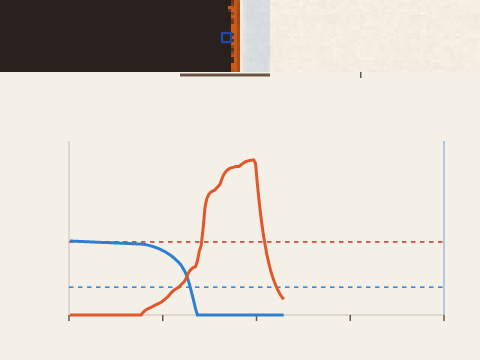
This part of the page could not start.
At 60 s the front on dry paper has reached cell 128 and the one with the wet stripe cell 119; through the stripe it crept from cell 58 at 25 s to cell 81 at 50 s.
| how far the front has got (cells) | dry paper | wet stripe from cell 60 to 90 |
|---|---|---|
| 25 | 5 | 5 |
| 34 | 10 | 10 |
| 43 | 15 | 15 |
| 52 | 20 | 20 |
| 58 | 25 | |
| 61 | 25 | |
| 63 | 30 | |
| 67 | 35 | |
| 71 | 30 | 40 |
| 75 | 45 | |
| 80 | 35 | |
| 81 | 50 | |
| 90 | 40 | |
| 99 | 45 | |
| 103 | 55 | |
| 109 | 50 | |
| 118 | 55 | |
| 119 | 60 | |
| 128 | 60 |
Source: Farthest burning point every 5 seconds, measured in the released game (how wet the stripe was isn't recorded). Through the stripe the front crawls at about 0.9 cells a second, against 1.85 on dry paper.
A pool of cooking oil on the paper is a fuel with its own rules. It has a fire point and a higher point where it catches by itself. In between, it needs a flame on it or beside it. Oil at 380 °C with no flame sits there quietly; strike a match beside it and it lights; at 460 °C it lights on its own. An automated test pins all three. In play, a match struck beside a cold pool only lights the paper; struck in the pool, it heats the oil there until it catches. One study of cooking oils measured them catching by themselves between 406 and 435 °C Buda-Ortins 2011, and the game's 420 °C sits inside that range. The same study found that butter didn't catch by itself at all, so butter's 400 °C has no support there.
Now pour water on burning oil. Water is heavier, so it slips under the oil. Water that ends up under oil far hotter than boiling flashes into steam, using water's real latent heat, and that burst throws the burning oil up. The drops come down still burning and start new fires where they land. An automated test checks that every bit of oil is accounted for, within 2 %. Pour water on oil that's hot but still under its fire point and the same code makes a harmless spit: no fireball and no lesson.
Then the game tells the child, at most once a minute, "Water on burning oil turns to steam at once and throws the burning oil up! If a pan catches fire, call a grown-up: they put a lid on it and turn off the heat. Never use water." That matches fire-safety advice for grown-ups, which we checked after the fact: slide a lid on, turn the heat off, never use water NFPA 2026.
The lid works the way a real one does. It shuts out the air and cools nothing. Lift it too soon with a flame nearby and the oil, still hot, lights again; leave it on until the oil has cooled and it doesn't. A test pins this.
Shake baking soda on the pool and the fire goes out; shake flour and it flashes up and keeps burning. No line of code names that pair. Heated soda gives off carbon dioxide, a heavy gas that pools on the paper, and the fire reads a deep enough layer of CO₂ as no air. It doesn't know where the gas came from, so vinegar fizzing on soda beside the pool puts it out too. Flour is a dust that catches as it falls through a flame, and its flash is a burst of drawn flames plus heat in the air. Tests pin both. This is how the game's air works, not kitchen advice.
Left alone, the pool holds about 1,020 cells alight for four seconds and is out at 7 s; with baking soda on it, or vinegar fizzing beside it, the 837 lit cells are down to none a second later.
| seconds | left alone | baking soda shaken on it | vinegar on soda beside it |
|---|---|---|---|
| 0 | 837 | 837 | 837 |
| 1 | 1020 | 0 | 0 |
| 2 | 1020 | 0 | 0 |
| 3 | 1020 | 0 | 0 |
| 4 | 1017 | 0 | 0 |
| 5 | 629 | 0 | 0 |
| 6 | 118 | 0 | 0 |
| 7 | 0 | 0 | 0 |
| 8 | 0 | 0 | 0 |
Source: Lit cells of one pool, by second, measured in the released game. Soda on it (solid) and vinegar fizzing beside it (dashed) end the same way: both lay CO₂ over the fire, and a second later nothing is alight.
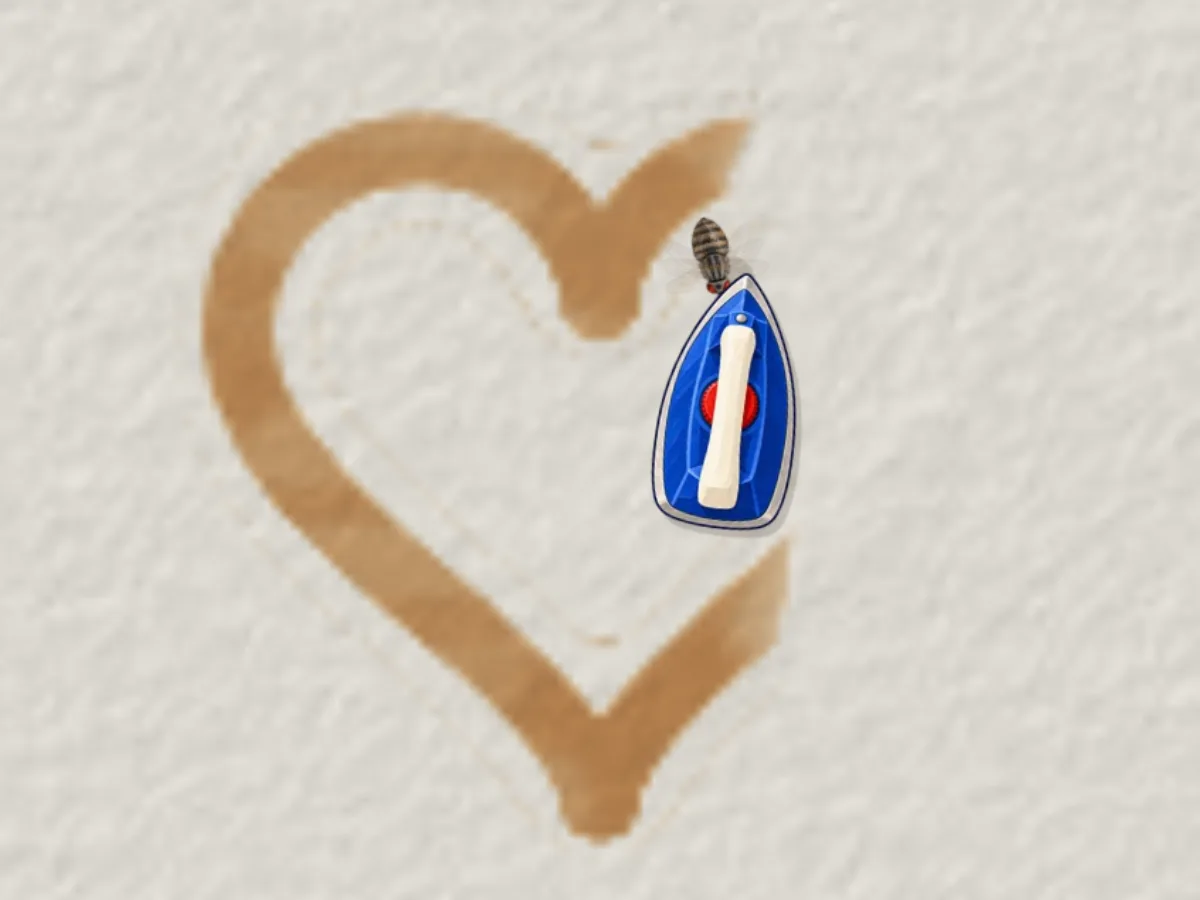
Write a heart in lemon juice and it disappears as it dries. Pass the iron over it and the heart comes up brown. The juice holds sugar and acid, and in the game anything food-like soaked into paper browns once it's hot enough, faster the hotter it gets. Fat soaked into the paper browns by the same rule but levels off amber instead of going black. A test pins both.
A hair dryer never brings out the ink. At 70 °C it stays under the threshold in both versions of the game. The released game starts browning a little above that. The next update next update moves that to 105 °C, where fructose, the earliest of the common sugars, starts to caramelise Caramelization, Wikipedia. Nobody has measured the point for lemon juice on paper. A test shows that the ink stays hidden at 95 °C and shows by 130 °C.
Crayon melts from 60 °C. Its colour floods into the gaps in the grain and bleeds a little way out, and the paper darkens a little where the wax soaked in, a nod to the melted-crayon craft. The wax in a crayon drawing doesn't burn, though: in the game only candle wax is fuel. Plastic slumps at 110 °C, and a pen left on a hot spot bursts and leaks its ink; a test pins both. Chocolate softens at 32 °C Wille 1966; egg white sets at 63 °C and yolk at 70 °C. Real yolk sets by time and temperature together Vega 2011, so one temperature with a rate is a simplification we chose.
The oven is a time skip: 20 minutes at 180 °C in one go. A page doesn't get stepped through those minutes. Instead a formula works out how far each spot has browned, toasts the edges of the sheet more than its middle, and caps the scorch so the drawing survives. A fire that was burning stops when the oven door shuts.
The released rule starts browning at 80 °C and reaches 2.88 a second at 250 °C; the next update's starts at 105 °C and reaches 2.48. A hair dryer's 70 °C is under both.
| °C | released game, from 80 °C | next update, from 105 °C |
|---|---|---|
| 50 | 0 | 0 |
| 79.9 | 0 | |
| 80 | 0.16 | |
| 104.9 | 0 | |
| 105 | 0.16 | |
| 250 | 2.88 | 2.48 |
Source: Browning rate per unit of food in the paper, from the game's rules: it starts at a threshold and grows with the temperature above it. The next update moves the threshold up to 105 °C, where fructose starts to caramelise.

Put a wet painting in the freezer and it comes out with frost in it. In the released game the freezer is a time skip: three hours at −18 °C, and each spot gets a frost value from how much water it held. Salt in the water holds the frost back. The frost shows as branching ferns, and while a patch is mostly frozen, the water and paint on it can't move. An ice cube does the same where you hold it, and leaves meltwater behind.
The next update next update lets temperature go below room temperature. An ice cube cools the spot under it below freezing, and the cold fades back over several seconds. Salt lowers the freezing point by a straight line, so sea water's 3.5 % of salt freezes at −1.89 °C, about where real sea water freezes. Each frost crystal grows six arms with side branches at about 60°, as real ice does, and each arm stops where it meets ice. A test pins the crystals. A warm hand melts frost by its skin temperature, 33 °C.
Heat and cold meet on the same page. A chilled spot keeps its cold while a fire burns elsewhere, and a fire that reaches it still warms it and catches (next update; a test pins it).
Fire never calls chemistry, electricity or the animals. It writes temperature, ash and holes, and the other systems read them.
Shared: ash
Ash is alkaline, so the juice turns blue in a thin ring round the burn. A test pins it.
Shared: current → heat
Joule heat in real units: it glows past 500 °C and catches fire where the clips bite. A test pins it.
Shared: air: updraft + wind
A burning scrap is lifted over the cut and starts a second fire beyond it. A test pins it.
Shared: heat under the paws
It feels the heat and walks away, whatever made it, and steps off an iron left standing. A test pins it.
Shared: water in the paper
A match won't light it, and a fire front slows there until the water has gone. A test pins it.
Shared: a spill's own heat
The spill carries its heat as it runs, softening the chocolate it reaches. Tests pin it.
Most of a page is cold most of the time, and the fire only works inside a box round the warm cells. Inside that box the page is cut into small tiles. A tile no warmer than 60 °C whose inputs come in exactly as they did last step keeps last step's answer. On a page with a ball of dough proving on a warm spot, 680 of the 768 tiles sleep and the fire does 4.6 times less work (measured when the change was made).
The 60 °C isn't a chosen number. It's the lowest temperature at which the fire loop does anything other than spread and cool heat, and a test holds it there. The same tests compare every saved field with sleeping on and off, on seven pages, and find them identical.
Where the device allows it, a second copy of the fire loop runs in WebAssembly SIMD, two cells at a time wherever they only spread heat, burn or scorch, and one at a time otherwise. A test compares it to the JavaScript to the last bit. On slower devices the fire steps less often with longer steps, and flames are drawn fewer and bigger. Embers are never thinned out, because they land and light things. Fast on a cheap tablet has the rest.
A 32 by 24 grid of tiles: 88 working round a warm spot in the middle, 680 asleep.
Source: The count is from the dough page; the layout is a sketch.