Floating layer
oil · wax · butter
Thick: covers. A sheen: seals. A towel, wind, a flame meet the top.
Game Tailors
Source: Runny, sticky and oily
The drawing app where the paper is real. No ads. No accounts. No personal data: only anonymous counts, which you can switch off.
Game Tailors · Schieweg 15Y-40, 2627 AN Delft (NL)
KvK 92437702 · VAT NL866044474B01
info@gametailors.com · +31 6 4227 5919
© 2026 Game Tailors
Runny, sticky and oily
Squeeze ketchup and it keeps its bead. Pour honey and it creeps out flat. Oil floats on water, beaten into egg yolk it turns into mayonnaise, and soap on milk sends the colours flying. Nobody wrote a special effect for any of these. Each spot of the page stores what lies there, and every liquid follows the same few rules with its own numbers.
Everything thick on the page, from paint to mud, is stored as a depth in each tiny square, about half a millimetre across. Many times a second, each square compares its height with its four neighbours and passes some of itself downhill. How much it passes comes from two numbers in the material's row of one shared table: how runny it is, and how steep a slope it can hold before it gives way. That second number is its yield.
Ketchup has a high yield. A step of nearly a whole square's height between neighbours stays put, so ketchup keeps a bead about 42° steep. Mustard holds 45°, mud 39°, tube paint 37°. Honey has no yield at all. It is only slow, and it keeps creeping until it is too thin to flow.
Testing a slope square by square has a catch. Each square looked at its four sides separately, so along a diagonal a slope could be √2 steeper before anything moved, and heaps came to rest as diamonds. next update Pastes now test how steep the whole slope is, whichever way it falls, and heaps come to rest round.
Thin liquids get one more change. next update Milk, ink, juice and drinks keep their way as they run, through four pipes per square that remember what went each way, slowed by the liquid's real viscosity. A hand dragged through milk leaves a track that is half full again in under half a second. In the released game that takes 1.7 s, and milk closes up more like syrup.
Ketchup on the left, honey on the right, run by the game's flow rule with their own table numbers. Pick a sauce and tap the paper to drop a heap, or press Drop a heap. What to look for: ketchup stops almost at once, honey never quite does. Then pick melted ice cream, drop it, and switch the yield test: per side it settles toward a diamond, by slope it comes out round. The roundness readout is the test's own measure (1 is round, 1.41 a diamond).
This part of the page could not start.
Drink spreads at 13.8 cells² a second, milk 12, oil 10.8, ketchup 6, mud 4.2, paint 3.6, honey 1.5 and dough 0.72.
| spreading rate | |
|---|---|
| drink | 13.8 |
| milk | 12 |
| oil | 10.8 |
| ketchup | 6 |
| mud | 4.2 |
| paint | 3.6 |
| honey | 1.5 |
| dough | 0.72 |
Source: Runniness from the game's own material table (paint is tube paint), as a spreading rate.
Each square can hold three things stacked: a film of water, a layer of goop, and a floating layer on top. Whenever something lands, one function decides where it goes by asking its row three questions. Does it shun water? Is it lighter than water and runny? Is it soft goop at all, and not grains or a lump?
Two soft things stay apart when one of them floats and only one of them shuns water. Then the lighter one lies on top. Oil on ketchup floats. Honey poured onto oil goes under it, and the oil comes up on top. Oil on melted chocolate stirs in: for its cocoa butter, chocolate's row puts it right on the line where a thing counts as oily. Melted cheese sits just under that line, so by the same rule oil floats on it.
Search the code that moves liquids for the name of any material and you find none. The rows of the table are typed in by hand, though, and a few sit exactly on a line because that gives the right result: chocolate and marbling ink both sit right on the line for shunning water. So the fair claim is that the code never names a material, and the table decides.
Because the layers are real state, everything else can read them. A paper towel dabbed on oily water takes the oil on the first dab and the water on the second. A thin film of oil stops a puddle drying: after 50 s the bare puddle is down to under 10 %, the oiled one still over half.
oil · wax · butter
Thick: covers. A sheen: seals. A towel, wind, a flame meet the top.
depth · colour · set
One material.
Can hold oil. Deep: lifts it.
Dent, cockle.
Up to three things stack in one square, each with its own fields: on top what shuns water and is light, under it one goop with its colours mixed, and under that the paper's own water. The notes are the rules that decide which layer a towel or the wind meets first, and when oil seals the water from the air. The water and the goop use different units on purpose.
Slide to pick what you pour and what it lands on. The answer comes from the same three properties and density comparison the game uses, from each material's row. Try: oil onto melted chocolate, then oil onto melted cheese.
This part of the page could not start.
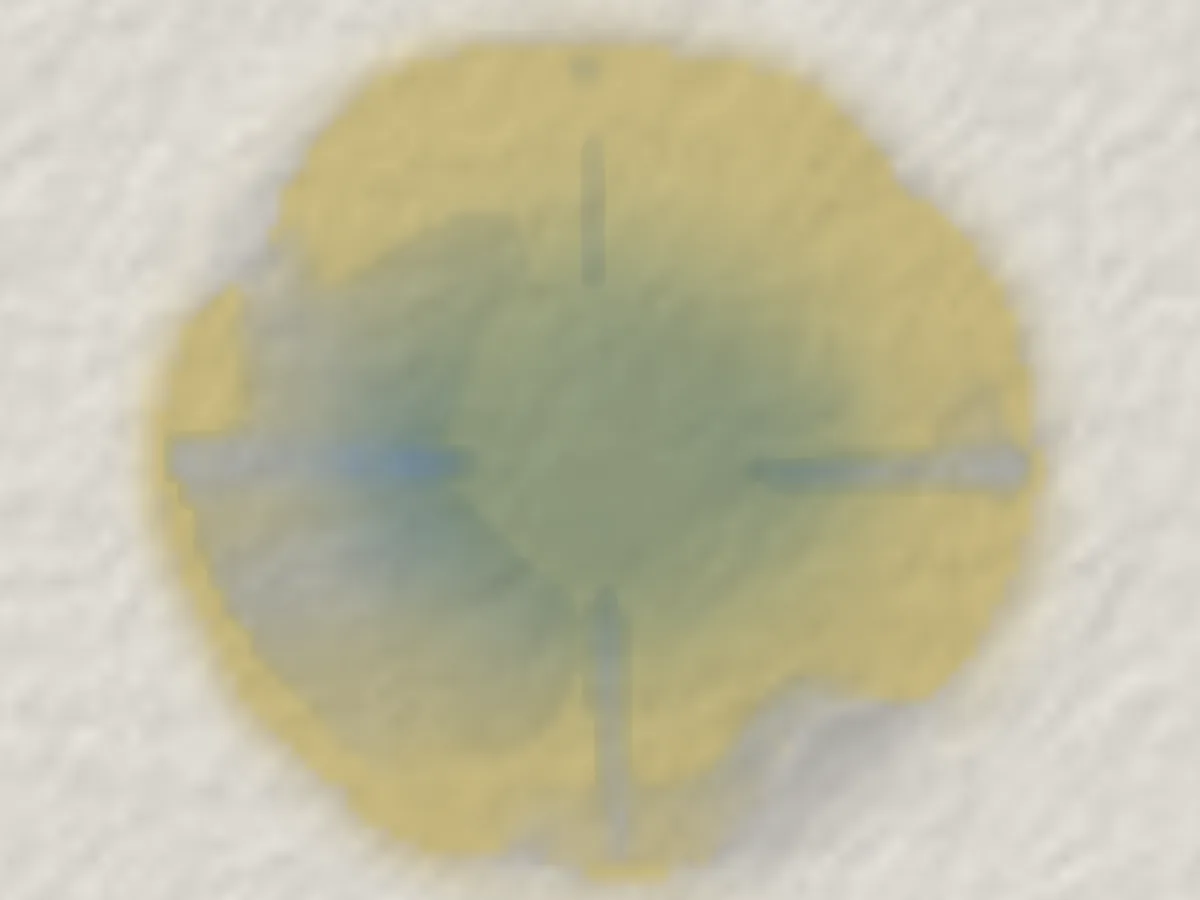
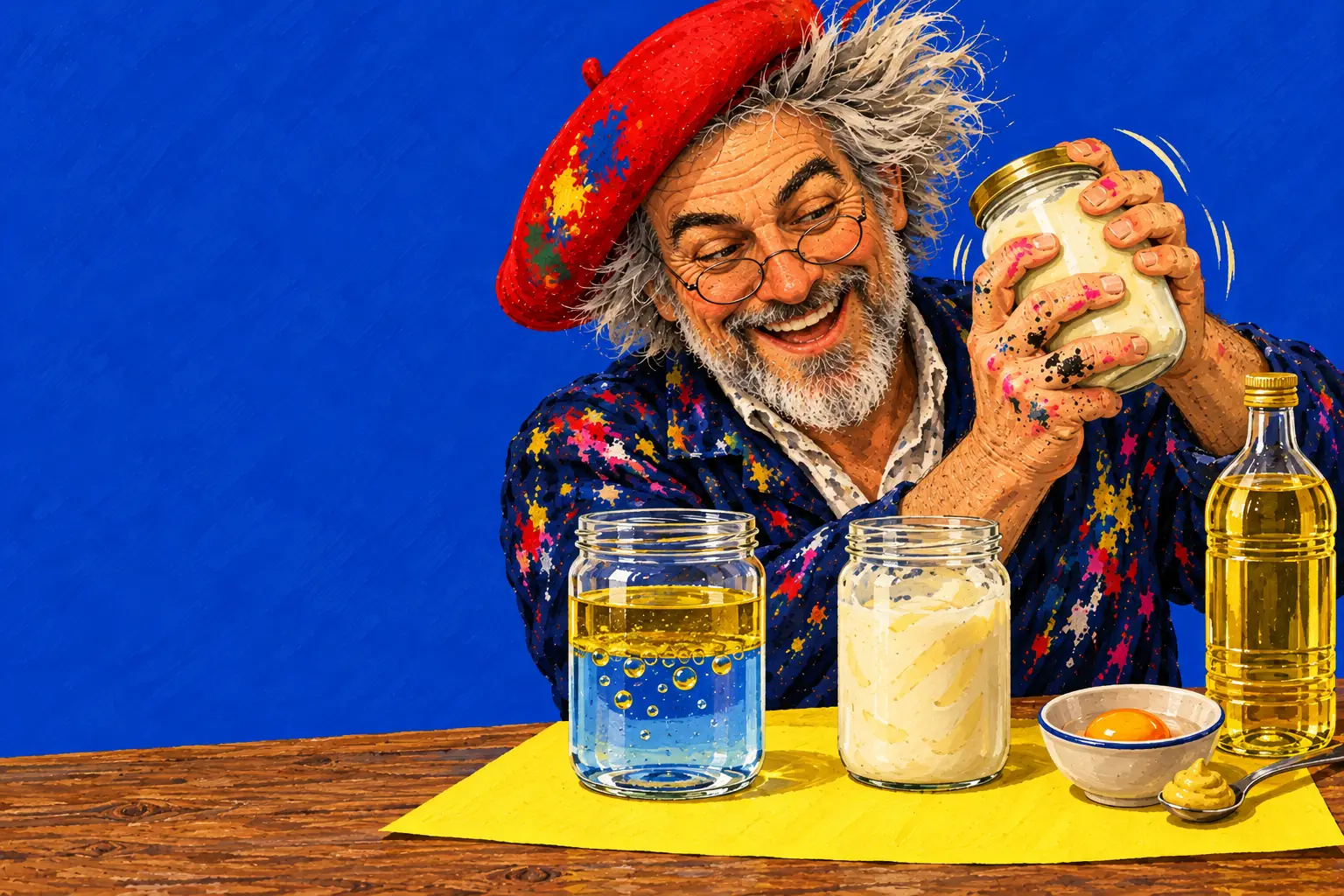
Pour oil onto egg yolk and leave it, and it stays a layer on top. Only working it mixes them: a finger whisking, a blow, drops splashing in. Then the two cloud together, and what happens next depends on what's in the bowl.
Yolk carries an emulsifier, and a little yolk can hold several times its own amount of oil. Beaten, it goes creamy and stays that way: a test checks it is still creamy two minutes later. Once there is clearly more oil than yolk, fully beaten, the oil is packed so tight that it stands up like mayonnaise. Vinegar has no emulsifier. Beaten, it clouds over, and in about two minutes it has cleared again. Soap counts as an emulsifier too, and soapy water worked over a grease spot lifts the fat out of the paper.
There are no droplets in the simulation. Each square keeps one number: the share of its oil beaten into what lies under it. The oil stays counted as oil and the water as water, so nothing can go missing when it separates again.
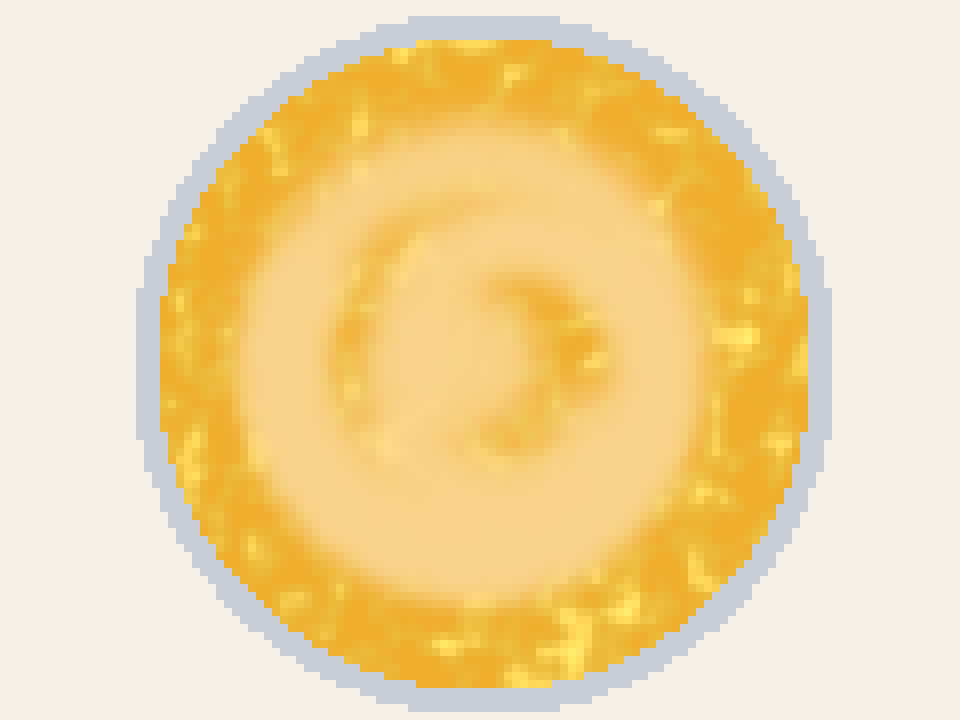
The bowl opens being whisked. Drag across it to whisk more, or press Whisk, then watch. What to look for: with egg yolk the cream stays; with vinegar or milk it goes back to streaks of oil within a couple of minutes (raise the time-lapse). Add oil until the readout says it stands. The emulsion rule is the game's; how it evens out across the bowl is a simple blur here.
This part of the page could not start.
Egg yolk stays fully mixed; with half the emulsifier it needs, 22 % is still mixed after two minutes, and beaten vinegar is down to 5 %.
| seconds after you stop | egg yolk (holds fully) | half the emulsifier it needs | vinegar (none) |
|---|---|---|---|
| 0 | 1 | 1 | 1 |
| 3 | 1 | 0.9632 | 0.9277 |
| 6 | 1 | 0.9277 | 0.8607 |
| 9 | 1 | 0.8936 | 0.7985 |
| 12 | 1 | 0.8607 | 0.7408 |
| 15 | 1 | 0.829 | 0.6873 |
| 18 | 1 | 0.7985 | 0.6376 |
| 21 | 1 | 0.7691 | 0.5916 |
| 24 | 1 | 0.7408 | 0.5488 |
| 27 | 1 | 0.7136 | 0.5092 |
| 30 | 1 | 0.6873 | 0.4724 |
| 33 | 1 | 0.662 | 0.4382 |
| 36 | 1 | 0.6376 | 0.4066 |
| 39 | 1 | 0.6142 | 0.3772 |
| 42 | 1 | 0.5916 | 0.3499 |
| 45 | 1 | 0.5698 | 0.3247 |
| 48 | 1 | 0.5488 | 0.3012 |
| 51 | 1 | 0.5286 | 0.2794 |
| 54 | 1 | 0.5092 | 0.2592 |
| 57 | 1 | 0.4904 | 0.2405 |
| 60 | 1 | 0.4724 | 0.2231 |
| 63 | 1 | 0.455 | 0.207 |
| 66 | 1 | 0.4382 | 0.192 |
| 69 | 1 | 0.4221 | 0.1782 |
| 72 | 1 | 0.4066 | 0.1653 |
| 75 | 1 | 0.3916 | 0.1534 |
| 78 | 1 | 0.3772 | 0.1423 |
| 81 | 1 | 0.3633 | 0.132 |
| 84 | 1 | 0.3499 | 0.1225 |
| 87 | 1 | 0.3371 | 0.1136 |
| 90 | 1 | 0.3247 | 0.1054 |
| 93 | 1 | 0.3127 | 0.0978 |
| 96 | 1 | 0.3012 | 0.0907 |
| 99 | 1 | 0.2901 | 0.0842 |
| 102 | 1 | 0.2794 | 0.0781 |
| 105 | 1 | 0.2691 | 0.0724 |
| 108 | 1 | 0.2592 | 0.0672 |
| 111 | 1 | 0.2497 | 0.0623 |
| 114 | 1 | 0.2405 | 0.0578 |
| 117 | 1 | 0.2317 | 0.0537 |
| 120 | 1 | 0.2231 | 0.0498 |
| 123 | 1 | 0.2149 | 0.0462 |
| 126 | 1 | 0.207 | 0.0429 |
| 129 | 1 | 0.1994 | 0.0398 |
| 132 | 1 | 0.192 | 0.0369 |
| 135 | 1 | 0.185 | 0.0342 |
| 138 | 1 | 0.1782 | 0.0317 |
| 141 | 1 | 0.1716 | 0.0295 |
| 144 | 1 | 0.1653 | 0.0273 |
| 147 | 1 | 0.1592 | 0.0253 |
| 150 | 1 | 0.1534 | 0.0235 |
| 153 | 1 | 0.1477 | 0.0218 |
| 156 | 1 | 0.1423 | 0.0202 |
| 159 | 1 | 0.137 | 0.0188 |
| 162 | 1 | 0.132 | 0.0174 |
| 165 | 1 | 0.1271 | 0.0162 |
| 168 | 1 | 0.1225 | 0.015 |
| 171 | 1 | 0.1179 | 0.0139 |
| 174 | 1 | 0.1136 | 0.0129 |
| 177 | 1 | 0.1094 | 0.012 |
| 180 | 1 | 0.1054 | 0.0111 |
Source: The game's separation rule: an emulsion short of emulsifier relaxes back at a steady rate, faster the further short it falls.
Up to a share of oil of 0.35 it runs freely; from 0.35 to 0.6 it stiffens, and past 0.6 it stands.
| share of oil, φ | how freely it runs |
|---|---|
| 0 | 1 |
| 0.01 | 1 |
| 0.02 | 1 |
| 0.03 | 1 |
| 0.04 | 1 |
| 0.05 | 1 |
| 0.06 | 1 |
| 0.07 | 1 |
| 0.08 | 1 |
| 0.09 | 1 |
| 0.1 | 1 |
| 0.11 | 1 |
| 0.12 | 1 |
| 0.13 | 1 |
| 0.14 | 1 |
| 0.15 | 1 |
| 0.16 | 1 |
| 0.17 | 1 |
| 0.18 | 1 |
| 0.19 | 1 |
| 0.2 | 1 |
| 0.21 | 1 |
| 0.22 | 1 |
| 0.23 | 1 |
| 0.24 | 1 |
| 0.25 | 1 |
| 0.26 | 1 |
| 0.27 | 1 |
| 0.28 | 1 |
| 0.29 | 1 |
| 0.3 | 1 |
| 0.31 | 1 |
| 0.32 | 1 |
| 0.33 | 1 |
| 0.34 | 1 |
| 0.35 | 1 |
| 0.36 | 0.96 |
| 0.37 | 0.92 |
| 0.38 | 0.88 |
| 0.39 | 0.84 |
| 0.4 | 0.8 |
| 0.41 | 0.76 |
| 0.42 | 0.72 |
| 0.43 | 0.68 |
| 0.44 | 0.64 |
| 0.45 | 0.6 |
| 0.46 | 0.56 |
| 0.47 | 0.52 |
| 0.48 | 0.48 |
| 0.49 | 0.44 |
| 0.5 | 0.4 |
| 0.51 | 0.36 |
| 0.52 | 0.32 |
| 0.53 | 0.28 |
| 0.54 | 0.24 |
| 0.55 | 0.2 |
| 0.56 | 0.16 |
| 0.57 | 0.12 |
| 0.58 | 0.08 |
| 0.59 | 0.04 |
| 0.6 | 0 |
| 0.61 | 0 |
| 0.62 | 0 |
| 0.63 | 0 |
| 0.64 | 0 |
| 0.65 | 0 |
| 0.66 | 0 |
| 0.67 | 0 |
| 0.68 | 0 |
| 0.69 | 0 |
| 0.7 | 0 |
| 0.71 | 0 |
| 0.72 | 0 |
| 0.73 | 0 |
| 0.74 | 0 |
| 0.75 | 0 |
| 0.76 | 0 |
| 0.77 | 0 |
| 0.78 | 0 |
| 0.79 | 0 |
| 0.8 | 0 |
| 0.81 | 0 |
| 0.82 | 0 |
| 0.83 | 0 |
| 0.84 | 0 |
| 0.85 | 0 |
| 0.86 | 0 |
| 0.87 | 0 |
| 0.88 | 0 |
| 0.89 | 0 |
| 0.9 | 0 |
| 0.91 | 0 |
| 0.92 | 0 |
| 0.93 | 0 |
| 0.94 | 0 |
| 0.95 | 0 |
| 0.96 | 0 |
| 0.97 | 0 |
| 0.98 | 0 |
| 0.99 | 0 |
| 1 | 0 |
Source: The game's stiffness ramp: past a certain packing of oil the emulsion jams.
Drop food colouring on milk, touch it with soap, and the colours burst away from the soap. That's the Marangoni effect Scriven 1960. Soap lowers the surface's tension, and the clean surface around it, pulling harder, draws the surface toward itself, carrying the colours along.
In the game soap lies on the surface as an amount per square. The surface moves as a sheet of blocks four squares across, each pulled toward where the tension is higher. Milk's fat matters twice. It makes the surface answer harder, so milk pulls far harder than water. And it binds the soap and is spent doing so. The motion eases by itself as the soap is used up and evened out, with no timer anywhere.
The same moving surface carries whatever rides on it. Soap on a puddle sprinkled with pepper sends the pepper fleeing at once. Soap on wet watercolour pushes the paint into a ring round a pale hole.
In the released game the colours burst outward and curl a little at the edges. next update They really swirl. Cream isn't spread evenly through milk, so along the soap's front the pull is stronger in one stretch than the next, and the two shear past each other. That difference spins the surface, and the spin goes on for seconds after the push has eased.
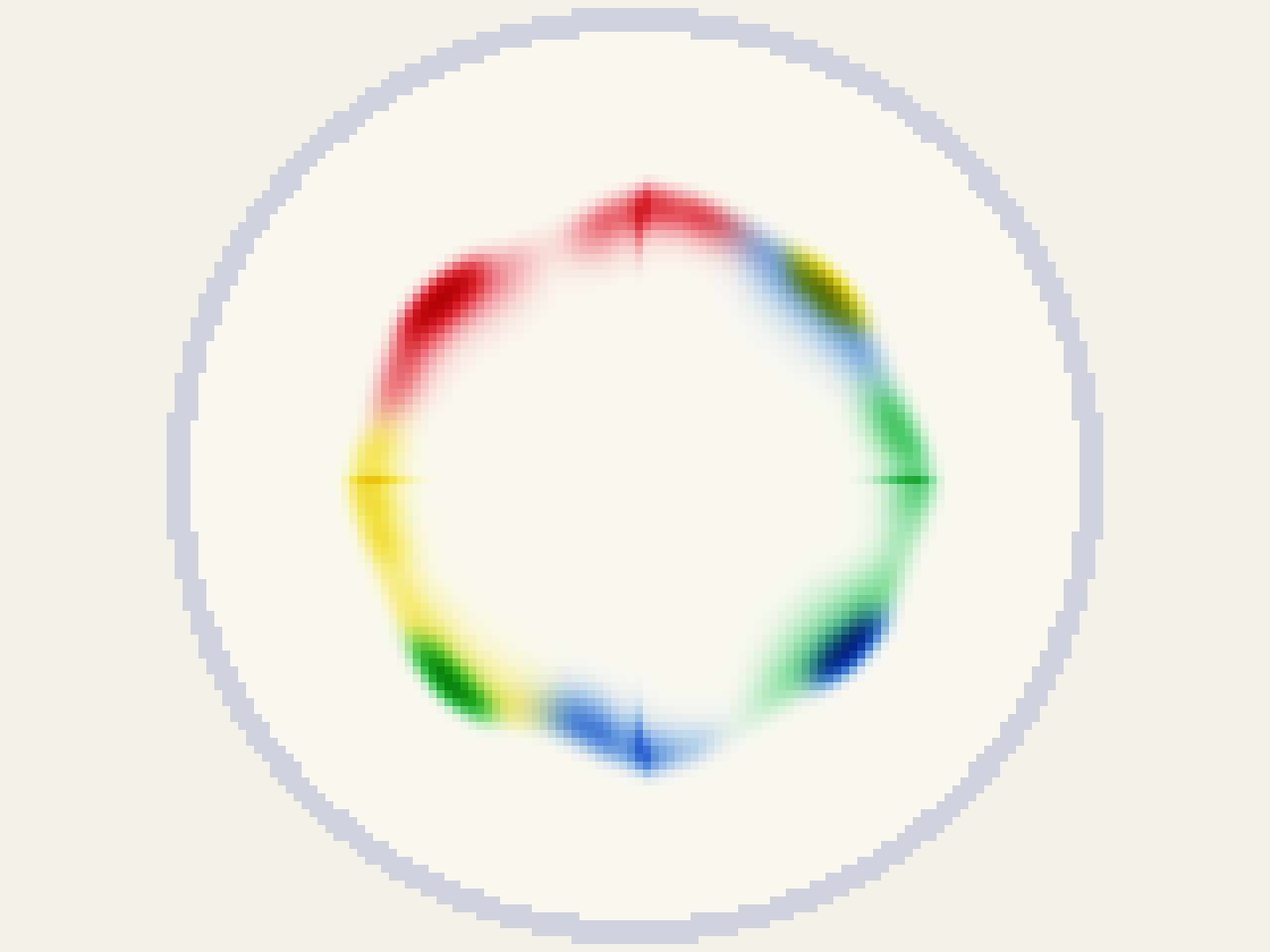
A soap drop lands in the middle soon after it opens. Tap to add more soap, or switch to colour and tap to add drops; the buttons add them too. What to look for: the burst, then the slow easing as fat binds the soap. A second soap drop on a soapy spot does little; on clean milk, a lot. Switch to the next update's milk for the swirl. The surface sheet follows the game's rule; here soap and colours ride it by a simpler method than the game's, and both keep every drop.
This part of the page could not start.
Tension is half gone at 0.005 of soap; by 0.05, where a spot counts as already soapy, it is down to 0.09.
| soap on the surface, as a power of ten | surface tension σ |
|---|---|
| −5 | 0.998 |
| −4.9375 | 0.9977 |
| −4.875 | 0.9973 |
| −4.8125 | 0.9969 |
| −4.75 | 0.9965 |
| −4.6875 | 0.9959 |
| −4.625 | 0.9953 |
| −4.5625 | 0.9946 |
| −4.5 | 0.9937 |
| −4.4375 | 0.9927 |
| −4.375 | 0.9916 |
| −4.3125 | 0.9904 |
| −4.25 | 0.9889 |
| −4.1875 | 0.9872 |
| −4.125 | 0.9852 |
| −4.0625 | 0.983 |
| −4 | 0.9804 |
| −3.9375 | 0.9774 |
| −3.875 | 0.974 |
| −3.8125 | 0.9701 |
| −3.75 | 0.9657 |
| −3.6875 | 0.9605 |
| −3.625 | 0.9547 |
| −3.5625 | 0.9481 |
| −3.5 | 0.9405 |
| −3.4375 | 0.9319 |
| −3.375 | 0.9222 |
| −3.3125 | 0.9113 |
| −3.25 | 0.8989 |
| −3.1875 | 0.8851 |
| −3.125 | 0.8696 |
| −3.0625 | 0.8524 |
| −3 | 0.8333 |
| −2.9375 | 0.8124 |
| −2.875 | 0.7895 |
| −2.8125 | 0.7645 |
| −2.75 | 0.7377 |
| −2.6875 | 0.7089 |
| −2.625 | 0.6783 |
| −2.5625 | 0.6461 |
| −2.5 | 0.6126 |
| −2.4375 | 0.5779 |
| −2.375 | 0.5425 |
| −2.3125 | 0.5066 |
| −2.25 | 0.4707 |
| −2.1875 | 0.435 |
| −2.125 | 0.4 |
| −2.0625 | 0.366 |
| −2 | 0.3333 |
| −1.9375 | 0.3022 |
| −1.875 | 0.2727 |
| −1.8125 | 0.2451 |
| −1.75 | 0.2195 |
| −1.6875 | 0.1958 |
| −1.625 | 0.1741 |
| −1.5625 | 0.1544 |
| −1.5 | 0.1365 |
| −1.4375 | 0.1204 |
| −1.375 | 0.106 |
| −1.3125 | 0.0931 |
| −1.25 | 0.0817 |
| −1.1875 | 0.0715 |
| −1.125 | 0.0625 |
| −1.0625 | 0.0546 |
| −1 | 0.0476 |
| −0.9375 | 0.0415 |
| −0.875 | 0.0361 |
| −0.8125 | 0.0314 |
| −0.75 | 0.0273 |
| −0.6875 | 0.0238 |
| −0.625 | 0.0206 |
| −0.5625 | 0.0179 |
| −0.5 | 0.0156 |
| −0.4375 | 0.0135 |
| −0.375 | 0.0117 |
| −0.3125 | 0.0102 |
| −0.25 | 0.0088 |
| −0.1875 | 0.0076 |
| −0.125 | 0.0066 |
| −0.0625 | 0.0057 |
| 0 | 0.005 |
Source: The game's tension curve: a chosen saturating shape, not a fitted isotherm.
Drag a palm through paint and the paste heaps up in front of it while runny stuff closes in behind. A soft palm doesn't wipe the paper clean. It rides on part of the paste and leaves a thinner layer behind, faintly streaked along the stroke. The same code serves a palm, a paw, a wheel, a ball and a squeegee. They differ in footprint, hardness, how flat their face is and how much they slip.
Strike oobleck with a hammer and it doesn't splash; press it slowly and you sink in. The faster a push is for its size, the more the cornflour jams.
A toothpick works differently. It drags what is near it along, and what is further out flows back the other way, the way a stick swirls colour on shaving foam. The flow is built so that whatever goes into a square comes out of it. The colour is drawn into veins and none is lost.
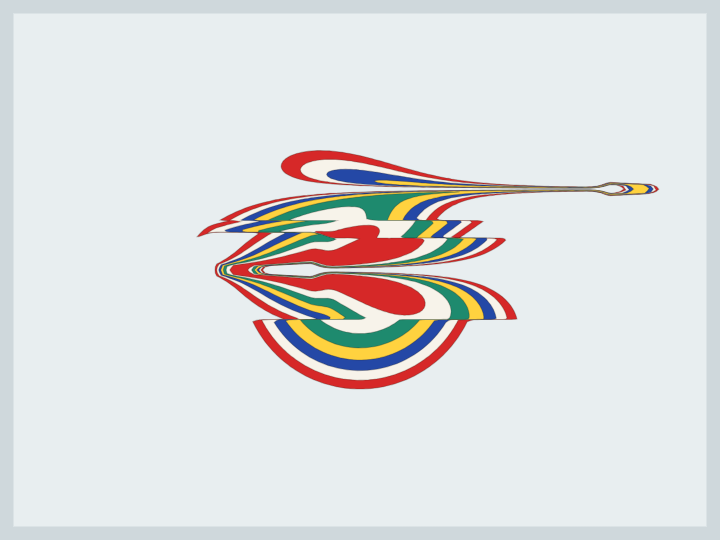
Marbling ink shows this most clearly. A new drop on water spreads at once into a thin film and pushes every earlier ring outward by exactly as much as makes room for itself. Drop after drop in one spot makes rings inside rings, each colour kept. Comb them and you get feathers. The result barely depends on how you move: combing in one long swipe or in tiny moves comes out within 15 % on shape.
Drops land in the middle, then a toothpick combs across. Tap to drop ink, or switch to the toothpick and drag; Drop ink and Comb across do the same from the keyboard. What to look for: each new drop pushes the old rings out without mixing them, and combing makes feathers. The readout compares the film's area with what the drops put in: combing never changes it. The rings here are outlines moved by the game's own formulas; the game moves the film cell by cell.
This part of the page could not start.
Grease. Melt butter on paper and it leaves a see-through spot that widens slowly to an edge and stops. Water and a sponge won't shift it. Add dish soap to the water and it washes out without scrubbing. Wet paper won't take fat in, and greasy paper keeps most water out, so whichever came first wins. Fat washed out always comes up as cooking oil, whatever went in: the paper keeps one number for fat, not a recipe.
Foam. Soapy water rubbed or splashed froths up into foam; still water on soap stays still. The foam itself is a stiff goop that never flows, and the bubbles on it are drawn objects with timers, up to a fixed number. They swell, pop and leave the paper a little damp. No gas is tracked.
Mud. Mud is just another row in the table, like ketchup: fairly stiff, holding a slope nearly as well as ketchup, and it forms a crust as it dries. A splat of it comes with pebbles and twigs. Leave it six hours or bake it, and it cracks into plates a few millimetres across. The cracks are a pattern laid down at the end of the wait. No stress is worked out, and nothing cracks while you play.
next update Stones lie on mud as a layer of their own and sink as the mud under them slumps, and froth bursts within seconds unless soap holds it up.
Pick one and tap the paper, or press Add one. What to look for: the butter spot widens fast, then slower, and stops at an edge (the readout says when it's at rest). The small bubbles go first and the heap thins out over a minute. The mud dries for six hours in a few seconds, then cracks into plates all at once. Each runs on the game's numbers: the grease spot on its own spreading rule, the bubbles on their own pop chance, the cracks on mud's plate size and gap. The drawing is simpler than the game's.
This part of the page could not start.
A full page is about 200,000 squares, and most of them aren't moving at any moment. The page is cut into small tiles that sleep when nothing in them changes, wake when something lands, and make up the time they slept when they get their turn. On a page with no oil the floating layer's work is skipped. The soap-on-milk surface only runs while something moves, and only round the soap.
The busiest loops also run as WebAssembly, written by hand and checked against the plain code square by square, most of them to the last bit. The engineering chapter tells that story.
The fire, the wind and the dog read and write the same fields as the liquids, and the effects below come out of that. Each is pinned by a test.
Shared: floating layer over water · air contact
The bare puddle dries; the oiled one is still there.
Shared: water under the floating layer · heat
It flashes to steam and throws the burning oil up. On hot oil it only spits; on cold oil it slides under.
Shared: wind · the top layer
The oil film blows along; the sauce under it barely moves, held by its yield.
Shared: the top layer · what paws carry
It leaves oily paw prints wherever it goes next.
Shared: acid element in goop
With enough of it, the milk curdles into curd and whey.
Shared: surfactant · wet paper's film
The surface pulls away and pushes the paint into a ring round a pale hole.
A child on a tablet needs ketchup that stands and honey that runs, sixty times a second, on 200,000 squares. Each shortcut below keeps a behaviour a child can see, and gives up something nobody at that scale would notice.