
Shakes the sheet
Speaker: a whole-sheet figure
Hammer and any blow: strong, local
Table bumped: everywhere at once, briefly
Monster truck: the strongest, fading over a long way
Toy car driving, water drops, hole punch: light, local
Game Tailors
Source: Sound and shaking
The drawing app where the paper is real. No ads. No accounts. No personal data: only anonymous counts, which you can switch off.
Game Tailors · Schieweg 15Y-40, 2627 AN Delft (NL)
KvK 92437702 · VAT NL866044474B01
info@gametailors.com · +31 6 4227 5919
© 2026 Game Tailors
Sound and shaking
Hold the speaker on the paper and the whole sheet starts to shake, in a pattern set by the note and by where you press. Salt hops off the parts that move and settles on the lines that stay still, so a figure appears that nobody drew. Flour does the opposite. And every sound effect you hear is made by code at that moment, from what just happened.
Sieve salt over the page, pick up the speaker and hold it in the middle. You hear a steady note. Within seconds the salt runs together into lines and curls, a symmetrical figure like the ones Ernst Chladni made famous with sand on a vibrating plate.
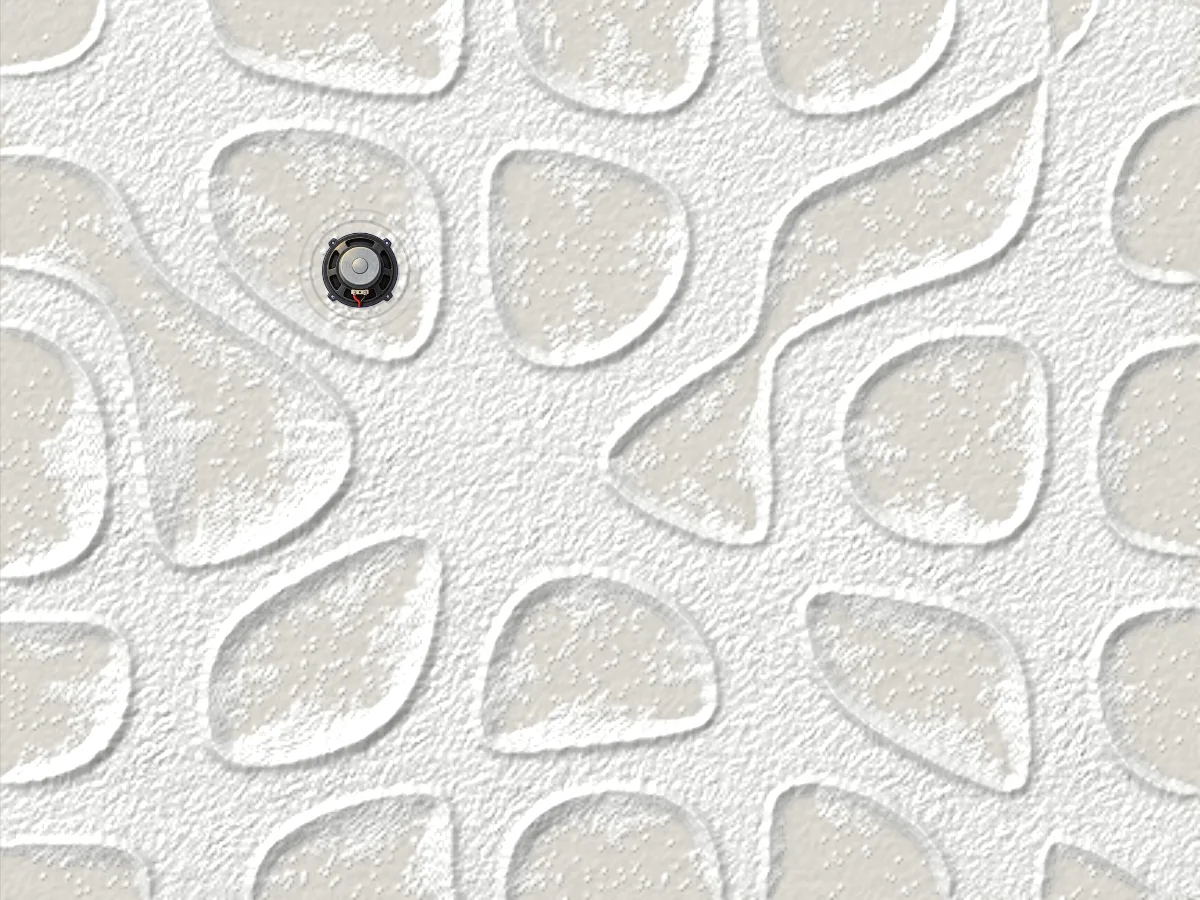
The surprising part is that the speaker's code knows nothing about salt. It does one thing: it sets the sheet shaking, hard in some places and not at all along certain lines. Everything lying on the paper reads that shaking in its own way. A salt grain gets bounced off the parts that move and comes to rest where the sheet is still. No line of code describes the figure. It's what's left once every grain has hopped away from the shaking.
A test holds the code to this. It reads the speaker's source file and fails if it ever mentions grains, foam, soap bubbles, water, ripples or particles. It also reads ten simulation files, among them the grains, the foam, the puddles and the shake map itself, and fails if any of them mentions the speaker. A second test sets the sheet ringing with no speaker on the page at all, and glitter still drifts to the still lines.
The rule each grain follows is written by hand, and it's short: when the sheet under you shakes hard enough, take a step toward where it shakes less. Salt doesn't fly through the air in the game, and it doesn't find the lines by chance. The figure is the only part that nobody wrote.
The sheet starts covered in salt, with the speaker already playing in the middle. Drag on the paper to move the speaker, or press Move the speaker; slide the note, or switch to sand or flour. What to look for: salt leaves the shaking parts and draws the still lines; flour does the reverse. Turn the volume right down and nothing moves. Turn it right up and grains get thrown about. This is the game's plate formula and grain rule, ported line for line, on a 160 × 120 sheet instead of 512 × 384. Only the checks for wet, frozen and holes are left out, since this sheet has none.
This part of the page could not start.
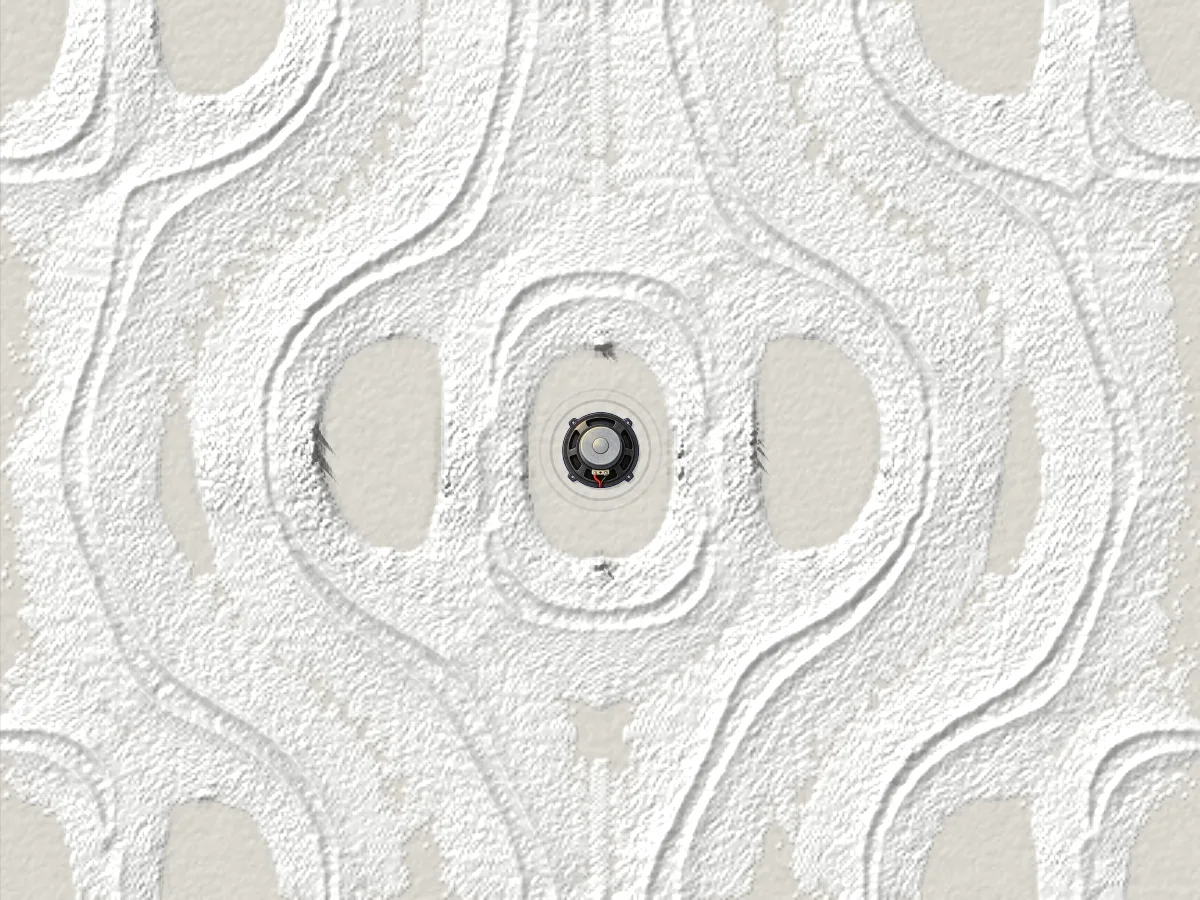
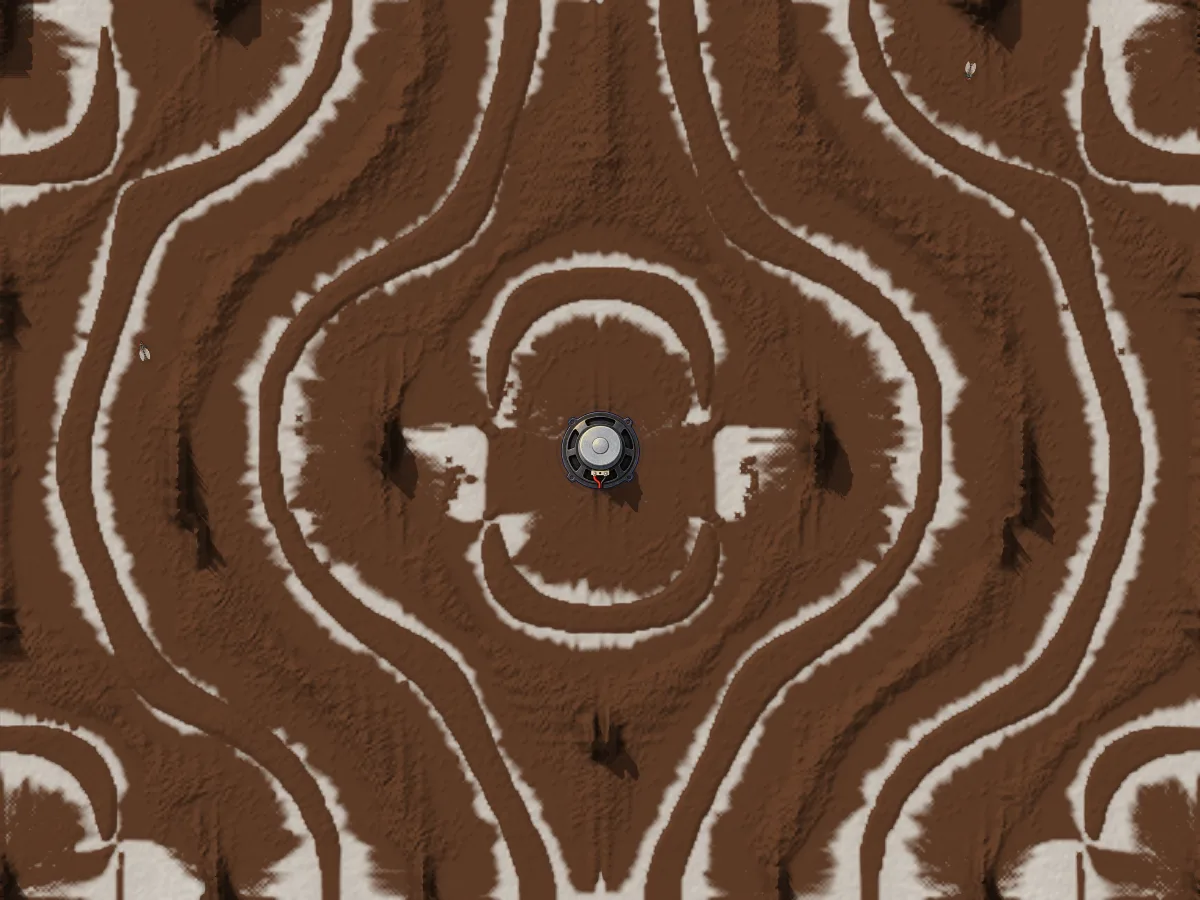
Slide the note up and the figure doesn't morph smoothly. It snaps in, goes weak and muddled, and then another one snaps in. Real plates do this too. A plate has a set of natural ways to vibrate, each with its own note, and it only answers strongly when you play close to one of them.
The game's sheet has 224 of these shapes. Each is a pattern of stripes across and down the sheet. For a speaker pressed in the middle of the page, 17 places along the slider give a clean figure. Between them the sheet barely answers, and the shaking is a small fraction of a clean figure's.
Where you press matters as much as the note. A shape that is still under the speaker can't be set going from there. Press in the exact middle and only shapes that are symmetric about the middle can answer, which is why centred figures look so tidy. Move the speaker off-centre and other shapes join in, so the figure changes and can lose its symmetry. An automated test checks both.
The figure the slider starts on is a mix. At 519 Hz two shapes, one with six still lines across and two down, the other with four each way, have notes only 3 % apart. Both answer at once, and their sum gives the lacy figure instead of a plain grid. Higher notes broadly give more lines, though not at every step.
This is the shake map itself, as the game works it out. White is where the sheet stands still, where salt would gather; red is where it shakes hardest. Drag to move the press point, or press Move the press point, and step from one clean note to the next with the buttons. What to look for: press on a white line and the figure weakens or changes. Switch the view to "up and down" to see that neighbouring patches swing in opposite directions, with the still lines running between them. The readout names the strongest shape in the mix by its stripes across and down.
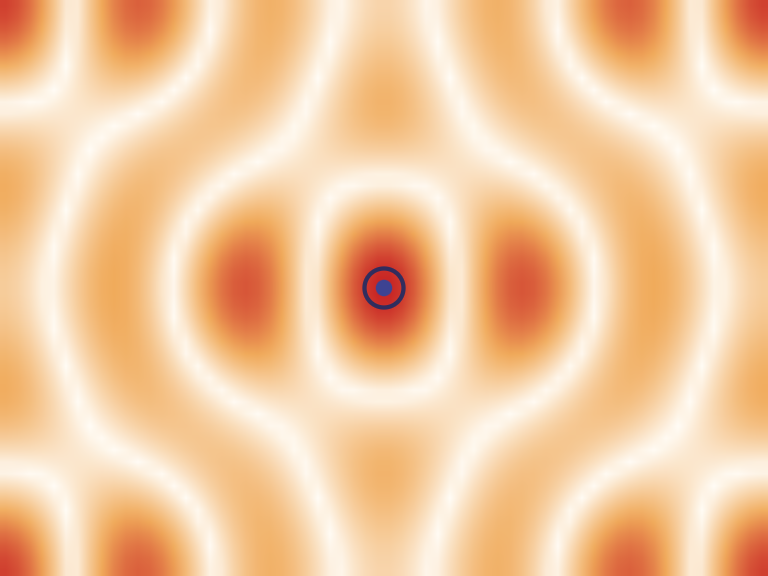
This part of the page could not start.
For a speaker in the middle, 17 narrow peaks between 90 and 880 Hz reach a clarity of 0.6 or more; between them the clarity falls far lower. The slider starts on the peak at 519 Hz.
| the note you hear (Hz) | speaker in the middle of a 4:3 sheet |
|---|---|
| 90 | 0.003 |
| 90.5 | 0.003 |
| 91 | 0.003 |
| 91.6 | 0.003 |
| 92.1 | 0.004 |
| 92.6 | 0.004 |
| 93.1 | 0.004 |
| 93.7 | 0.004 |
| 94.2 | 0.004 |
| 94.7 | 0.004 |
| 95.3 | 0.004 |
| 95.8 | 0.004 |
| 96.4 | 0.005 |
| 96.9 | 0.005 |
| 97.5 | 0.005 |
| 98 | 0.005 |
| 98.6 | 0.005 |
| 99.2 | 0.006 |
| 99.7 | 0.006 |
| 100.3 | 0.006 |
| 100.9 | 0.006 |
| 101.4 | 0.007 |
| 102 | 0.007 |
| 102.6 | 0.007 |
| 103.2 | 0.008 |
| 103.8 | 0.008 |
| 104.4 | 0.009 |
| 105 | 0.009 |
| 105.6 | 0.01 |
| 106.2 | 0.01 |
| 106.8 | 0.011 |
| 107.4 | 0.011 |
| 108 | 0.012 |
| 108.6 | 0.013 |
| 109.2 | 0.014 |
| 109.9 | 0.015 |
| 110.5 | 0.016 |
| 111.1 | 0.017 |
| 111.8 | 0.018 |
| 112.4 | 0.02 |
| 113 | 0.021 |
| 113.7 | 0.023 |
| 114.3 | 0.025 |
| 115 | 0.028 |
| 115.7 | 0.03 |
| 116.3 | 0.033 |
| 117 | 0.037 |
| 117.7 | 0.041 |
| 118.3 | 0.046 |
| 119 | 0.052 |
| 119.7 | 0.059 |
| 120.4 | 0.068 |
| 121.1 | 0.078 |
| 121.7 | 0.092 |
| 122.4 | 0.108 |
| 123.1 | 0.13 |
| 123.8 | 0.158 |
| 124.6 | 0.195 |
| 125.3 | 0.245 |
| 126 | 0.315 |
| 126.7 | 0.412 |
| 127.4 | 0.544 |
| 128.2 | 0.712 |
| 128.9 | 0.887 |
| 129.6 | 0.994 |
| 129.8 | 1 |
| 130.4 | 0.961 |
| 131.1 | 0.811 |
| 131.9 | 0.633 |
| 132.6 | 0.48 |
| 133.4 | 0.364 |
| 134.1 | 0.281 |
| 134.9 | 0.221 |
| 135.7 | 0.177 |
| 136.4 | 0.144 |
| 137.2 | 0.119 |
| 138 | 0.1 |
| 138.8 | 0.085 |
| 139.6 | 0.073 |
| 140.4 | 0.064 |
| 141.2 | 0.056 |
| 142 | 0.049 |
| 142.8 | 0.044 |
| 143.6 | 0.039 |
| 144.4 | 0.035 |
| 145.3 | 0.032 |
| 146.1 | 0.029 |
| 146.9 | 0.026 |
| 147.8 | 0.024 |
| 148.6 | 0.022 |
| 149.5 | 0.021 |
| 150.3 | 0.019 |
| 151.2 | 0.018 |
| 152.1 | 0.016 |
| 152.9 | 0.015 |
| 153.8 | 0.015 |
| 154.7 | 0.016 |
| 155.6 | 0.017 |
| 156.5 | 0.018 |
| 157.3 | 0.02 |
| 158.2 | 0.022 |
| 159.1 | 0.023 |
| 160.1 | 0.026 |
| 161 | 0.028 |
| 161.9 | 0.031 |
| 162.8 | 0.034 |
| 163.7 | 0.038 |
| 164.7 | 0.042 |
| 165.6 | 0.047 |
| 166.6 | 0.053 |
| 167.5 | 0.06 |
| 168.5 | 0.069 |
| 169.4 | 0.08 |
| 170.4 | 0.094 |
| 171.4 | 0.111 |
| 172.4 | 0.134 |
| 173.4 | 0.163 |
| 174.3 | 0.202 |
| 175.3 | 0.256 |
| 176.3 | 0.33 |
| 177.4 | 0.432 |
| 178.4 | 0.571 |
| 179.4 | 0.743 |
| 180.4 | 0.913 |
| 181.4 | 0.999 |
| 181.7 | 0.999 |
| 182.5 | 0.941 |
| 183.5 | 0.781 |
| 184.6 | 0.604 |
| 185.6 | 0.458 |
| 186.7 | 0.348 |
| 187.8 | 0.269 |
| 188.8 | 0.212 |
| 189.9 | 0.17 |
| 191 | 0.139 |
| 192.1 | 0.116 |
| 193.2 | 0.097 |
| 194.3 | 0.083 |
| 195.4 | 0.072 |
| 196.5 | 0.062 |
| 197.6 | 0.055 |
| 198.8 | 0.048 |
| 199.9 | 0.043 |
| 201 | 0.038 |
| 202.2 | 0.035 |
| 203.4 | 0.031 |
| 204.5 | 0.028 |
| 205.7 | 0.026 |
| 206.9 | 0.024 |
| 208 | 0.026 |
| 209.2 | 0.029 |
| 210.4 | 0.032 |
| 211.6 | 0.035 |
| 212.8 | 0.039 |
| 214.1 | 0.044 |
| 215.3 | 0.049 |
| 216.5 | 0.056 |
| 217.8 | 0.064 |
| 219 | 0.073 |
| 220.2 | 0.085 |
| 221.5 | 0.1 |
| 222.8 | 0.119 |
| 224 | 0.144 |
| 225.3 | 0.176 |
| 226.6 | 0.22 |
| 227.9 | 0.28 |
| 229.2 | 0.363 |
| 230.5 | 0.478 |
| 231.8 | 0.631 |
| 233.2 | 0.809 |
| 234.5 | 0.959 |
| 235.6 | 1 |
| 235.8 | 0.995 |
| 237.2 | 0.889 |
| 238.5 | 0.714 |
| 239.9 | 0.546 |
| 241.3 | 0.413 |
| 242.7 | 0.316 |
| 244 | 0.246 |
| 245.4 | 0.195 |
| 246.8 | 0.158 |
| 248.3 | 0.13 |
| 249.7 | 0.108 |
| 251.1 | 0.092 |
| 252.5 | 0.078 |
| 254 | 0.068 |
| 255.4 | 0.059 |
| 256.9 | 0.052 |
| 258.4 | 0.046 |
| 259.8 | 0.041 |
| 261.3 | 0.037 |
| 262.8 | 0.038 |
| 264.3 | 0.042 |
| 265.8 | 0.048 |
| 267.4 | 0.054 |
| 268.9 | 0.061 |
| 270.4 | 0.07 |
| 272 | 0.081 |
| 273.5 | 0.095 |
| 275.1 | 0.113 |
| 276.7 | 0.136 |
| 278.2 | 0.166 |
| 279.8 | 0.206 |
| 281.4 | 0.261 |
| 283 | 0.337 |
| 284.7 | 0.442 |
| 286.3 | 0.584 |
| 287.9 | 0.758 |
| 289.6 | 0.925 |
| 291.2 | 1 |
| 292.9 | 0.93 |
| 294.6 | 0.766 |
| 296.2 | 0.591 |
| 297.9 | 0.447 |
| 299.6 | 0.341 |
| 301.3 | 0.264 |
| 303.1 | 0.208 |
| 304.8 | 0.167 |
| 306.5 | 0.137 |
| 308.3 | 0.114 |
| 310.1 | 0.096 |
| 311.8 | 0.082 |
| 313.6 | 0.071 |
| 315.4 | 0.062 |
| 317.2 | 0.054 |
| 319 | 0.048 |
| 320.8 | 0.043 |
| 322.7 | 0.038 |
| 324.5 | 0.036 |
| 326.4 | 0.04 |
| 328.2 | 0.044 |
| 330.1 | 0.05 |
| 332 | 0.057 |
| 333.9 | 0.065 |
| 335.8 | 0.074 |
| 337.7 | 0.087 |
| 339.7 | 0.102 |
| 341.6 | 0.122 |
| 343.6 | 0.147 |
| 345.5 | 0.181 |
| 347.5 | 0.226 |
| 349.5 | 0.288 |
| 351.5 | 0.375 |
| 353.5 | 0.494 |
| 355.5 | 0.651 |
| 357.6 | 0.83 |
| 359.6 | 0.971 |
| 360.8 | 1 |
| 361.7 | 0.989 |
| 363.7 | 0.871 |
| 365.8 | 0.694 |
| 367.9 | 0.529 |
| 370 | 0.4 |
| 372.1 | 0.307 |
| 374.2 | 0.239 |
| 376.4 | 0.19 |
| 378.5 | 0.154 |
| 380.7 | 0.127 |
| 382.9 | 0.106 |
| 385.1 | 0.117 |
| 387.3 | 0.14 |
| 389.5 | 0.172 |
| 391.7 | 0.214 |
| 393.9 | 0.272 |
| 396.2 | 0.352 |
| 398.5 | 0.463 |
| 400.7 | 0.612 |
| 403 | 0.789 |
| 405.3 | 0.946 |
| 407.2 | 1 |
| 407.6 | 0.998 |
| 410 | 0.907 |
| 412.3 | 0.735 |
| 414.7 | 0.564 |
| 417 | 0.427 |
| 419.4 | 0.326 |
| 421.8 | 0.253 |
| 424.2 | 0.244 |
| 426.7 | 0.313 |
| 429.1 | 0.409 |
| 431.6 | 0.54 |
| 434 | 0.707 |
| 436.5 | 0.883 |
| 439 | 0.993 |
| 440 | 0.999 |
| 441.5 | 0.964 |
| 444 | 0.817 |
| 446.6 | 0.638 |
| 449.1 | 0.484 |
| 451.7 | 0.368 |
| 454.3 | 0.344 |
| 456.9 | 0.452 |
| 459.5 | 0.597 |
| 462.1 | 0.773 |
| 464.7 | 0.936 |
| 467.4 | 1 |
| 470.1 | 0.919 |
| 472.8 | 0.751 |
| 475.5 | 0.577 |
| 478.2 | 0.437 |
| 480.9 | 0.333 |
| 483.7 | 0.258 |
| 486.4 | 0.204 |
| 489.2 | 0.165 |
| 492 | 0.135 |
| 494.8 | 0.155 |
| 497.6 | 0.191 |
| 500.5 | 0.24 |
| 503.4 | 0.308 |
| 506.2 | 0.401 |
| 509.1 | 0.53 |
| 512 | 0.695 |
| 515 | 0.872 |
| 517.9 | 0.989 |
| 519.1 | 1 |
| 520.9 | 0.97 |
| 523.8 | 0.853 |
| 526.8 | 0.982 |
| 528 | 0.999 |
| 529.9 | 0.98 |
| 532.9 | 0.848 |
| 535.9 | 0.669 |
| 539 | 0.509 |
| 542.1 | 0.386 |
| 545.2 | 0.296 |
| 548.3 | 0.232 |
| 551.4 | 0.185 |
| 554.6 | 0.15 |
| 557.7 | 0.124 |
| 560.9 | 0.104 |
| 564.1 | 0.088 |
| 567.4 | 0.076 |
| 570.6 | 0.066 |
| 573.9 | 0.057 |
| 577.1 | 0.051 |
| 580.4 | 0.045 |
| 583.8 | 0.04 |
| 587.1 | 0.036 |
| 590.5 | 0.039 |
| 593.8 | 0.044 |
| 597.2 | 0.049 |
| 600.6 | 0.055 |
| 604.1 | 0.063 |
| 607.5 | 0.073 |
| 611 | 0.085 |
| 614.5 | 0.099 |
| 618 | 0.118 |
| 621.5 | 0.143 |
| 625.1 | 0.175 |
| 628.7 | 0.218 |
| 632.3 | 0.278 |
| 635.9 | 0.36 |
| 639.5 | 0.474 |
| 643.2 | 0.626 |
| 646.8 | 0.804 |
| 650.5 | 0.956 |
| 653.5 | 1 |
| 654.3 | 0.996 |
| 655.8 | 1 |
| 658 | 0.979 |
| 661.8 | 0.847 |
| 665.5 | 0.668 |
| 669.4 | 0.768 |
| 673.2 | 0.932 |
| 677 | 1 |
| 680.9 | 0.923 |
| 684.8 | 0.756 |
| 688.7 | 0.843 |
| 692.6 | 0.978 |
| 695 | 1 |
| 696.6 | 0.984 |
| 700.6 | 0.858 |
| 704.6 | 0.679 |
| 708.6 | 0.517 |
| 712.7 | 0.392 |
| 716.7 | 0.301 |
| 720.8 | 0.291 |
| 725 | 0.379 |
| 729.1 | 0.499 |
| 733.3 | 0.657 |
| 737.5 | 0.836 |
| 741.7 | 0.974 |
| 744.2 | 1 |
| 745.9 | 0.987 |
| 750.2 | 0.865 |
| 754.5 | 0.687 |
| 758.8 | 0.523 |
| 763.1 | 0.396 |
| 767.5 | 0.304 |
| 771.9 | 0.237 |
| 776.3 | 0.191 |
| 780.7 | 0.24 |
| 785.2 | 0.308 |
| 789.7 | 0.402 |
| 794.2 | 0.53 |
| 798.7 | 0.695 |
| 803.3 | 0.872 |
| 807.9 | 0.99 |
| 809.7 | 1 |
| 812.5 | 0.97 |
| 817.1 | 0.828 |
| 821.8 | 0.649 |
| 826.5 | 0.493 |
| 831.2 | 0.525 |
| 836 | 0.69 |
| 840.8 | 0.867 |
| 845.6 | 0.988 |
| 847.5 | 1 |
| 850.4 | 0.973 |
| 855.3 | 0.834 |
| 860.2 | 0.655 |
| 865.1 | 0.522 |
| 870 | 0.685 |
| 875 | 0.863 |
| 880 | 0.986 |
Source: Computed on this page with the game's own plate formula, 401 slider positions plus the 17 clean-figure peaks.
Sieve cocoa instead of salt and the picture turns inside out. The cocoa gathers where the sheet shakes hardest and leaves the still lines bare. Flour does the same, but white on white paper it hardly shows. Real powders do this. Félix Savart noticed it, and Michael Faraday explained it in 1831: very fine powder is swept along by the air the vibrating plate stirs up, while heavier grains bounce until they land where the plate is still.
The game doesn't compute that air. It sorts each material by grain size. Coarse grains (sand, salt, yeast, chia seeds) step down the shake map. Fine powders (flour, cocoa, icing sugar, baking soda, cornflour) step up it, more slowly. That's a written rule, and it's in the table at the bottom of this page. What isn't written anywhere is the figure each one draws.
The volume knob sets how thin the lines are. A grain only bounces where the sheet shakes harder than a set threshold, so the quiet strip along each still line is where grains come to rest. Turn it up and that strip narrows. But shake too hard and the grains on the most shaken parts are thrown a few cells in any direction, and the figure turns messy. Too quiet, and nothing lifts at all.
Sand piles its lines only as steep as sand can stand. Bouncing heaps grains up, the slope rule slides them down, and an automated test checks that after ten seconds almost no cell is steeper than sand can hold. Wet the sand first and it stays where it is.
Along the middle row at the starting note, the shaking dips to zero at each still line; at the default volume it peaks at 1.32 "g", at full volume at 2, past the 1.5 at which grains fly wild.
| across the middle of the sheet (0 left, 1 right) | volume 0.66 (default) | full volume |
|---|---|---|
| 0 | 0.363 | 0.55 |
| 0.0063 | 0.359 | 0.543 |
| 0.0125 | 0.346 | 0.524 |
| 0.0187 | 0.325 | 0.492 |
| 0.025 | 0.296 | 0.449 |
| 0.0313 | 0.26 | 0.394 |
| 0.0375 | 0.217 | 0.329 |
| 0.0437 | 0.168 | 0.255 |
| 0.05 | 0.114 | 0.172 |
| 0.0563 | 0.055 | 0.083 |
| 0.0625 | 0.007 | 0.011 |
| 0.0688 | 0.072 | 0.109 |
| 0.075 | 0.138 | 0.208 |
| 0.0813 | 0.204 | 0.308 |
| 0.0875 | 0.269 | 0.407 |
| 0.0938 | 0.331 | 0.502 |
| 0.1 | 0.391 | 0.592 |
| 0.1062 | 0.446 | 0.676 |
| 0.1125 | 0.496 | 0.752 |
| 0.1187 | 0.54 | 0.818 |
| 0.125 | 0.577 | 0.874 |
| 0.1313 | 0.606 | 0.918 |
| 0.1375 | 0.626 | 0.948 |
| 0.1437 | 0.637 | 0.965 |
| 0.15 | 0.638 | 0.967 |
| 0.1563 | 0.63 | 0.955 |
| 0.1625 | 0.612 | 0.928 |
| 0.1688 | 0.584 | 0.885 |
| 0.175 | 0.546 | 0.828 |
| 0.1812 | 0.499 | 0.756 |
| 0.1875 | 0.443 | 0.671 |
| 0.1938 | 0.378 | 0.572 |
| 0.2 | 0.305 | 0.462 |
| 0.2062 | 0.226 | 0.342 |
| 0.2125 | 0.14 | 0.212 |
| 0.2188 | 0.049 | 0.075 |
| 0.225 | 0.045 | 0.068 |
| 0.2313 | 0.142 | 0.215 |
| 0.2375 | 0.241 | 0.365 |
| 0.2437 | 0.339 | 0.514 |
| 0.25 | 0.437 | 0.662 |
| 0.2562 | 0.532 | 0.806 |
| 0.2625 | 0.623 | 0.943 |
| 0.2687 | 0.709 | 1.074 |
| 0.275 | 0.788 | 1.194 |
| 0.2813 | 0.86 | 1.303 |
| 0.2875 | 0.923 | 1.399 |
| 0.2938 | 0.977 | 1.48 |
| 0.3 | 1.02 | 1.545 |
| 0.3063 | 1.051 | 1.592 |
| 0.3125 | 1.071 | 1.622 |
| 0.3187 | 1.078 | 1.633 |
| 0.325 | 1.072 | 1.624 |
| 0.3312 | 1.053 | 1.595 |
| 0.3375 | 1.021 | 1.547 |
| 0.3438 | 0.976 | 1.479 |
| 0.35 | 0.919 | 1.392 |
| 0.3563 | 0.849 | 1.287 |
| 0.3625 | 0.769 | 1.165 |
| 0.3688 | 0.677 | 1.026 |
| 0.375 | 0.576 | 0.873 |
| 0.3812 | 0.467 | 0.707 |
| 0.3875 | 0.35 | 0.53 |
| 0.3937 | 0.227 | 0.345 |
| 0.4 | 0.1 | 0.152 |
| 0.4063 | 0.03 | 0.046 |
| 0.4125 | 0.162 | 0.245 |
| 0.4188 | 0.294 | 0.445 |
| 0.425 | 0.423 | 0.642 |
| 0.4313 | 0.55 | 0.833 |
| 0.4375 | 0.672 | 1.018 |
| 0.4437 | 0.787 | 1.193 |
| 0.45 | 0.895 | 1.356 |
| 0.4562 | 0.993 | 1.505 |
| 0.4625 | 1.081 | 1.638 |
| 0.4688 | 1.157 | 1.753 |
| 0.475 | 1.221 | 1.85 |
| 0.4813 | 1.272 | 1.927 |
| 0.4875 | 1.308 | 1.982 |
| 0.4938 | 1.33 | 2.016 |
| 0.5 | 1.338 | 2.027 |
| 0.5062 | 1.33 | 2.016 |
| 0.5125 | 1.308 | 1.982 |
| 0.5188 | 1.272 | 1.927 |
| 0.525 | 1.221 | 1.85 |
| 0.5313 | 1.157 | 1.753 |
| 0.5375 | 1.081 | 1.638 |
| 0.5437 | 0.993 | 1.505 |
| 0.55 | 0.895 | 1.356 |
| 0.5563 | 0.787 | 1.193 |
| 0.5625 | 0.672 | 1.018 |
| 0.5687 | 0.55 | 0.833 |
| 0.575 | 0.423 | 0.642 |
| 0.5813 | 0.294 | 0.445 |
| 0.5875 | 0.162 | 0.245 |
| 0.5938 | 0.03 | 0.046 |
| 0.6 | 0.1 | 0.152 |
| 0.6062 | 0.227 | 0.345 |
| 0.6125 | 0.35 | 0.53 |
| 0.6188 | 0.467 | 0.707 |
| 0.625 | 0.576 | 0.873 |
| 0.6312 | 0.677 | 1.026 |
| 0.6375 | 0.769 | 1.165 |
| 0.6438 | 0.849 | 1.287 |
| 0.65 | 0.919 | 1.392 |
| 0.6563 | 0.976 | 1.479 |
| 0.6625 | 1.021 | 1.547 |
| 0.6687 | 1.053 | 1.595 |
| 0.675 | 1.072 | 1.624 |
| 0.6813 | 1.078 | 1.633 |
| 0.6875 | 1.071 | 1.622 |
| 0.6937 | 1.051 | 1.592 |
| 0.7 | 1.02 | 1.545 |
| 0.7063 | 0.977 | 1.48 |
| 0.7125 | 0.923 | 1.399 |
| 0.7188 | 0.86 | 1.303 |
| 0.725 | 0.788 | 1.194 |
| 0.7312 | 0.709 | 1.074 |
| 0.7375 | 0.623 | 0.943 |
| 0.7438 | 0.532 | 0.806 |
| 0.75 | 0.437 | 0.662 |
| 0.7562 | 0.339 | 0.514 |
| 0.7625 | 0.241 | 0.365 |
| 0.7688 | 0.142 | 0.215 |
| 0.775 | 0.045 | 0.068 |
| 0.7813 | 0.049 | 0.075 |
| 0.7875 | 0.14 | 0.212 |
| 0.7937 | 0.226 | 0.342 |
| 0.8 | 0.305 | 0.462 |
| 0.8063 | 0.378 | 0.572 |
| 0.8125 | 0.443 | 0.671 |
| 0.8187 | 0.499 | 0.756 |
| 0.825 | 0.546 | 0.828 |
| 0.8313 | 0.584 | 0.885 |
| 0.8375 | 0.612 | 0.928 |
| 0.8438 | 0.63 | 0.955 |
| 0.85 | 0.638 | 0.967 |
| 0.8562 | 0.637 | 0.965 |
| 0.8625 | 0.626 | 0.948 |
| 0.8688 | 0.606 | 0.918 |
| 0.875 | 0.577 | 0.874 |
| 0.8812 | 0.54 | 0.818 |
| 0.8875 | 0.496 | 0.752 |
| 0.8938 | 0.446 | 0.676 |
| 0.9 | 0.391 | 0.592 |
| 0.9063 | 0.331 | 0.502 |
| 0.9125 | 0.269 | 0.407 |
| 0.9187 | 0.204 | 0.308 |
| 0.925 | 0.138 | 0.208 |
| 0.9313 | 0.072 | 0.109 |
| 0.9375 | 0.007 | 0.011 |
| 0.9437 | 0.055 | 0.083 |
| 0.95 | 0.114 | 0.172 |
| 0.9563 | 0.168 | 0.255 |
| 0.9625 | 0.217 | 0.329 |
| 0.9688 | 0.26 | 0.394 |
| 0.975 | 0.296 | 0.449 |
| 0.9812 | 0.325 | 0.492 |
| 0.9875 | 0.346 | 0.524 |
| 0.9938 | 0.359 | 0.543 |
| 1 | 0.363 | 0.55 |
Source: The game's own shake map at the starting note (519 Hz), speaker in the middle, sampled along the middle row with the game's plate formula; thresholds from the game's grain rule.
The speaker isn't the only thing that shakes the paper. A hammer blow, a water drop landing, a toy car driving past, the table being bumped and the monster truck rumbling by all write to the same shake map. They make a local shake that fades with distance and has no figure in it. Only the speaker can set the whole sheet ringing in a pattern.
Everything lying on the sheet reads that one map, each thing at its own threshold. Marbles are shaken loose by almost anything. Glitter and confetti need a little more, the same as it takes to bounce a grain of salt. Puddles ripple, the bubbles on soapy suds pop, sand turns runny. Shaving foam is a stiff bed with no bubbles, and the shaking leaves it as it is. The shake ladder below puts them all on one scale, with what each thing that shakes the sheet sets off.
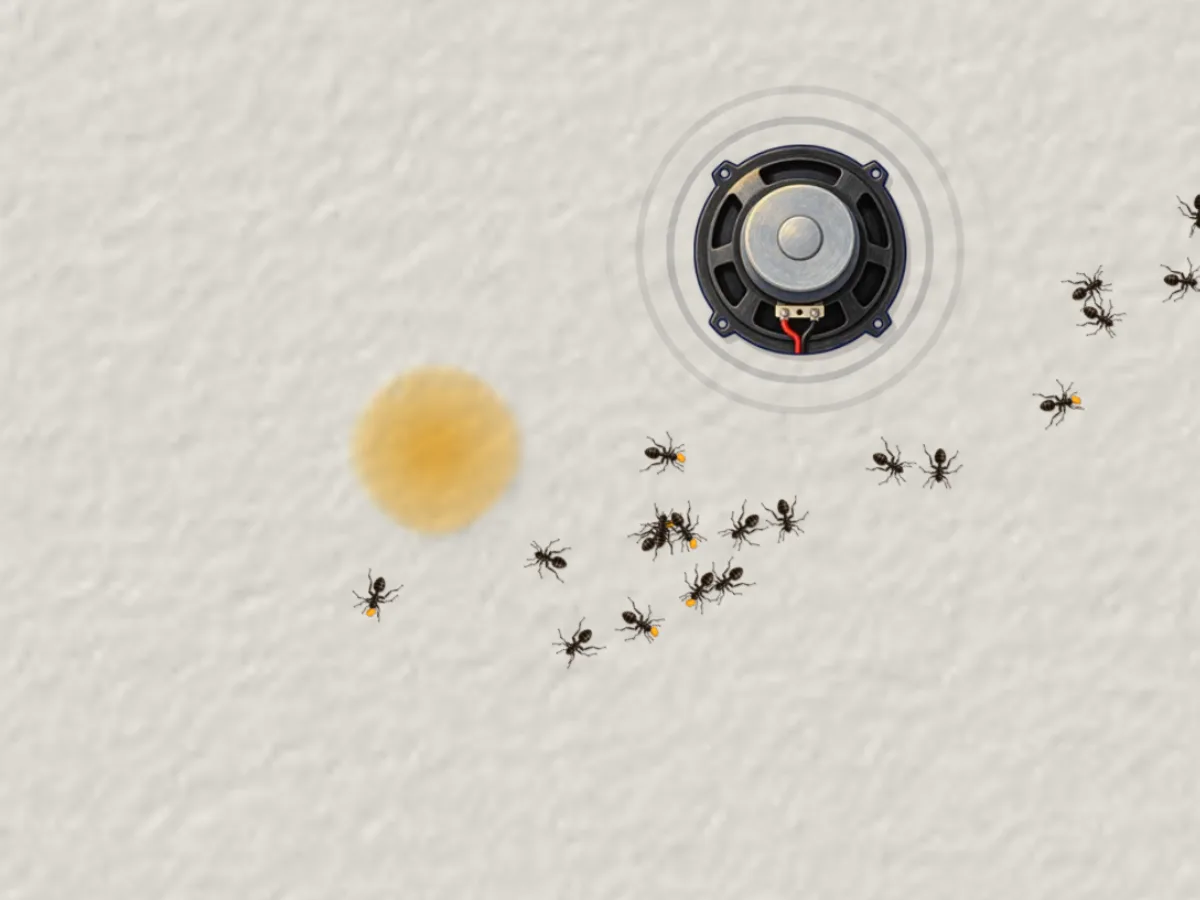
Creatures feel it too. Ants and snails can't hear anything in the game, but they feel the sheet. Hold the speaker near a line of ants and they scatter. Bump the table and a pigeon takes off, a snail tucks into its shell, ants scatter and sand jumps, all from one shake. Automated tests check each of these. Animals react to change, so a fan that keeps blowing startles a pigeon at most once.
The game's own rule The game's own constants. The scale is the game's own "g", tuned for play, not real acceleration. The speaker at its default volume reaches everything up to runny sand without throwing grains about; turn it up past 0.75 and it reaches the wild rung too.
| From | What happens | What |
|---|---|---|
| 0.03 "g" | A heap steeper than its grains can stand slides down | heaps |
| 0.04 "g" | Marbles and balls are shaken loose (toy cars from 0.05) | rolling things |
| 0.12 "g" | Dry grains bounce; glitter and confetti are shaken loose | grains, bits |
| 0.2 "g" | Puddles show ripples | puddles |
| 0.4 "g" | Bubbles on soapy foam and resting soap bubbles start to pop | bubbles |
| 0.6 "g" | Sand turns runny: no slope holds it | sand |
| 1.5 "g" | Grains are thrown about; puddles throw spray | grains, puddles |
| Shaker | Shakes the sheet | Highest rung it reaches |
|---|---|---|
| Speaker, volume 0.66 | 1.32 "g" on a clean figure, at its strongest spot | 0.6 "g": Sand turns runny: no slope holds it |
| Speaker, full volume | 2.00 "g" on a clean figure, at its strongest spot | 1.5 "g": Grains are thrown about; puddles throw spray |
| Water drop | 0.50 "g" where it lands, fading over 14 cells | 0.4 "g": Bubbles on soapy foam and resting soap bubbles start to pop |
| Toy car | 0.70 "g" at full speed, under it | 0.6 "g": Sand turns runny: no slope holds it |
| Hammer | 1.20 "g" at the blow, fading with distance | 0.6 "g": Sand turns runny: no slope holds it |
| Table bumped | 1.50 "g" everywhere at once, for 0.9 s | 1.5 "g": Grains are thrown about; puddles throw spray |
| Monster truck | 2.50 "g" beside it, fading over 400 cells | 1.5 "g": Grains are thrown about; puddles throw spray |
Speaker: a whole-sheet figure
Hammer and any blow: strong, local
Table bumped: everywhere at once, briefly
Monster truck: the strongest, fading over a long way
Toy car driving, water drops, hole punch: light, local
The shake map: how hard each spot of paper shakes
The feel layer: what creatures feel
Sand, salt, seeds: to the still lines
Flour, cocoa, baking soda: to the shaking parts
Puddles: ripples; spray when shaken hard
Bubbles on soapy foam, and resting soap bubbles: pop when shaken hard enough
Glitter, confetti, stickers, marbles, toy cars: shaken loose past their grip
Ants, snails, flies, pigeons, cats, dogs: startle at a sudden change
No arrow runs from a shaker straight to a reader. An automated test enforces it for the speaker in both directions, and another checks the table bump's own code, which may not name cups, balls, bits, sticks or cars. One exception remains in the shaking: a blow also kicks googly eyes directly, besides shaking the sheet.
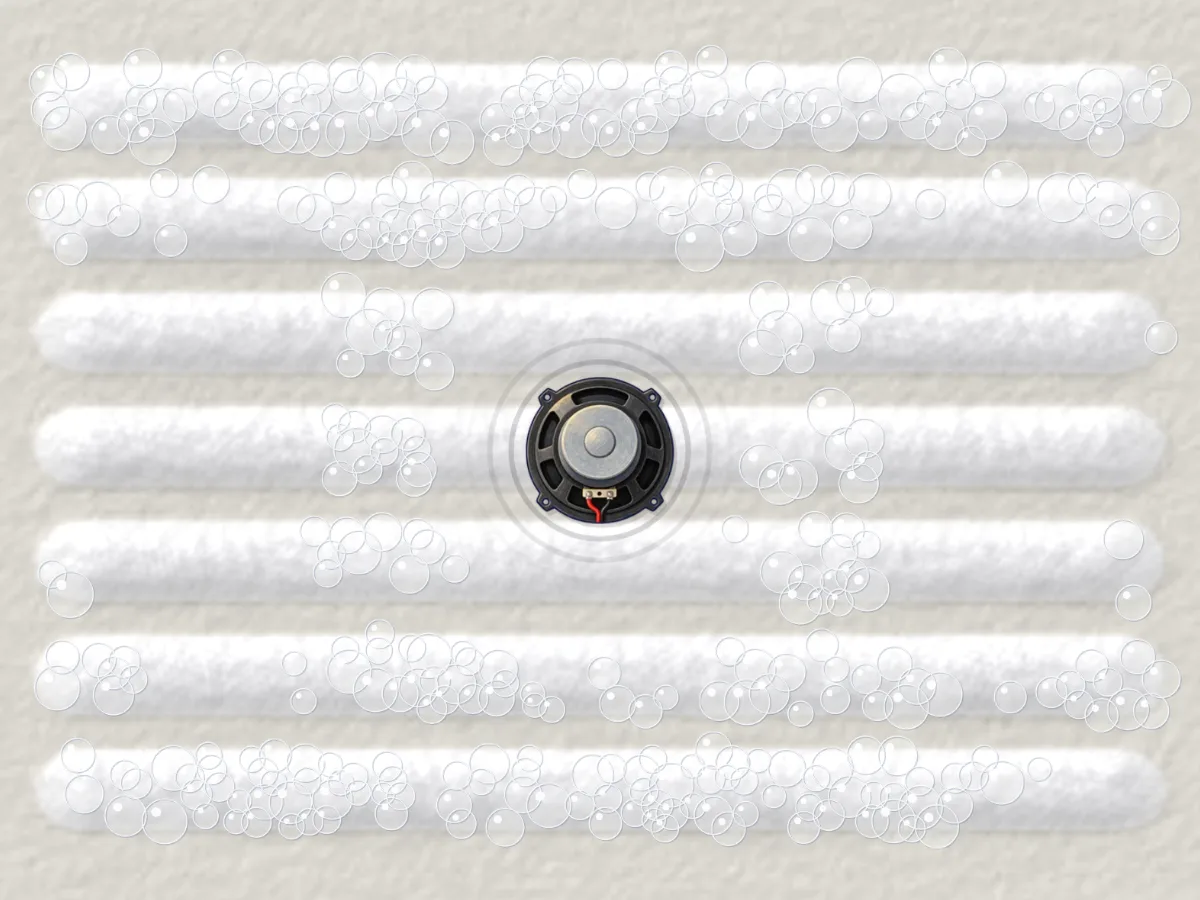
There isn't a single recorded sound effect in the game. A splat is a burst of filtered noise with a falling tone under it. A bonk is a tone gliding down with a short click on top. Fire is noise through a filter, and it gets louder as more of the page burns. The flies' buzz wobbles and grows a little with every fly, up to a quiet ceiling, so a swarm hums instead of roaring. The toy car's motor rises in pitch with its speed. The only audio files are the six songs and the professor's spoken lines.
A sound is also something that happens in the world. When the game plays a bang at a place, the bang writes a patch of noise that creatures hear, as loud as that kind of sound is: a splash is loud, a clink much quieter, a pencil scribble hardly there. The game does this before it checks whether you've muted it, so with the sound off a cat nearby still hears the bang. A dog doesn't startle at its own bark, because each creature takes the noise it made itself off what it hears. The pigeon nearby does startle, by its own hearing, and no code tells it the dog barked. An automated test checks it.
The professor's mouth opens and shuts with the loudness of his voice as it plays. That's two pictures, mouth shut and mouth open, swapped on loudness and each held a moment so they don't flicker. It isn't lip-sync. While he talks, the music dips.
The game's own recipe. Each sound is rebuilt here from the game's recipe, with the same oscillators, filters and numbers, and drawn as its waveform: a whole second and a half on top, a 30-millisecond close-up underneath. Pick a sound and move the slider to the quantity the game feeds it. Tap the waveform to hear three seconds. What to look for: fire is all noise and thickens with the burning; the car and the speaker are regular waves whose spacing shrinks as the pitch rises.
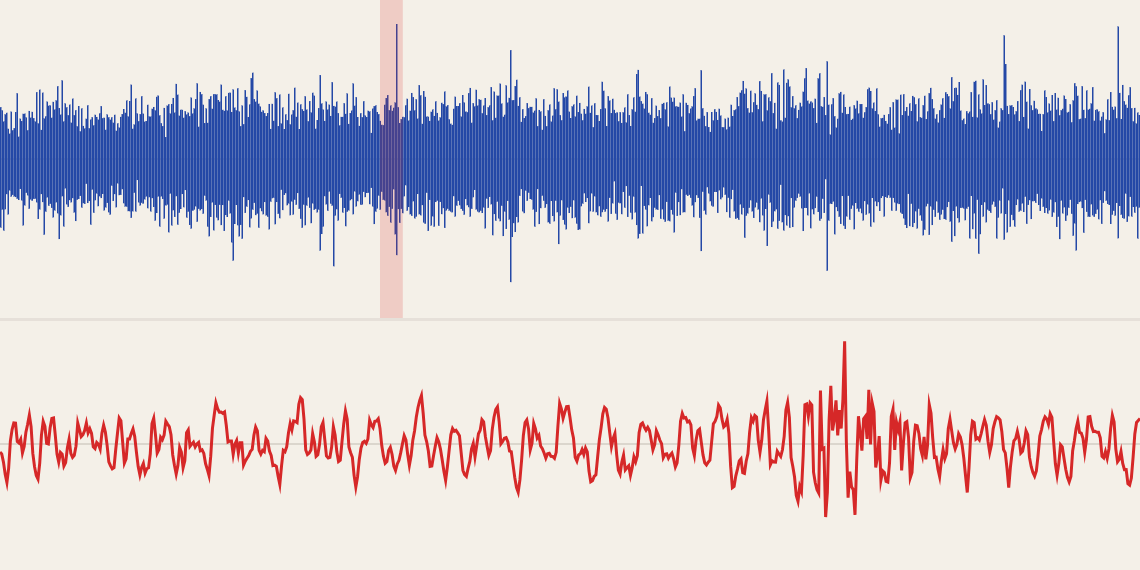
This part of the page could not start.
In the released game, a falling apple plays the same knock whatever height it falls from. In the next update, what you hear when something lands is worked out from the landing itself. How loud goes by the square root of its energy, so the same apple dropped from higher is louder. The pitch goes by the cube root of its weight, so a tin of paint thuds low and a strawberry ticks high. And a soft landing is duller: drop the apple into a deep blob of paint and it's quieter and lower. Automated tests check all three.
next update Pick a thing, set how high it falls from and how much runny paint it lands in. The game's formula picks how loud and at what pitch, and the game's voice recipe for that thing plays it: tap the waveform to hear it. What to look for: the apple from higher is taller in the waveform (every knock is drawn at one fixed scale) but its tone doesn't change; paint underneath makes it shorter and lower. (In the game a deep cushion can also swap the voice for a pat or a splat; this demo keeps each thing's own voice.)
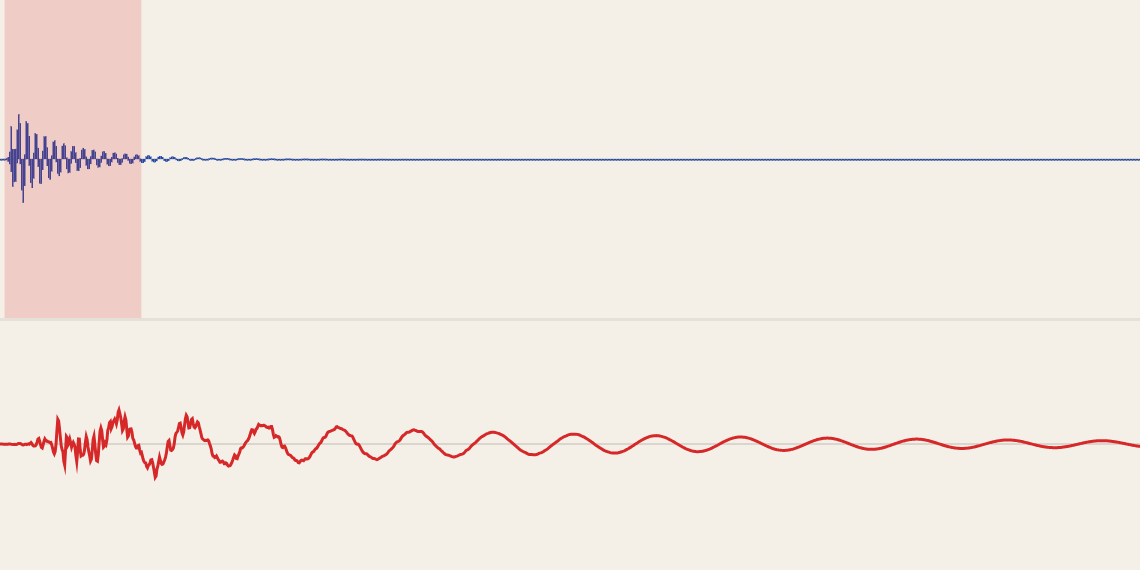
This part of the page could not start.
Shared: shake map → what creatures feel
They scatter. Ants are deaf in the game; they feel the sheet. Pinned by a test.
Shared: shake map + a jolt
A pigeon takes off, a snail tucks in, ants scatter and sand jumps, from one shake. Pinned by tests.
Shared: shake map, hard enough
Bubbles pop where it shakes and survive where it is still. Pinned by a test.
Shared: wetness
The sand stays where it is: wet grains stick together. Pinned by a test.
Shared: a local shake
The heap slumps to its own angle. Pinned by a test.
Shared: sound → noise creatures hear
The pet still hears it: the bang happened in the game's world.
A real Chladni plate is a hard problem in mechanics. A child with a tablet needs the figure to appear, change with the note and the press point, and sort sand from flour, within a few milliseconds a frame. Here is what we keep and what we let go.