
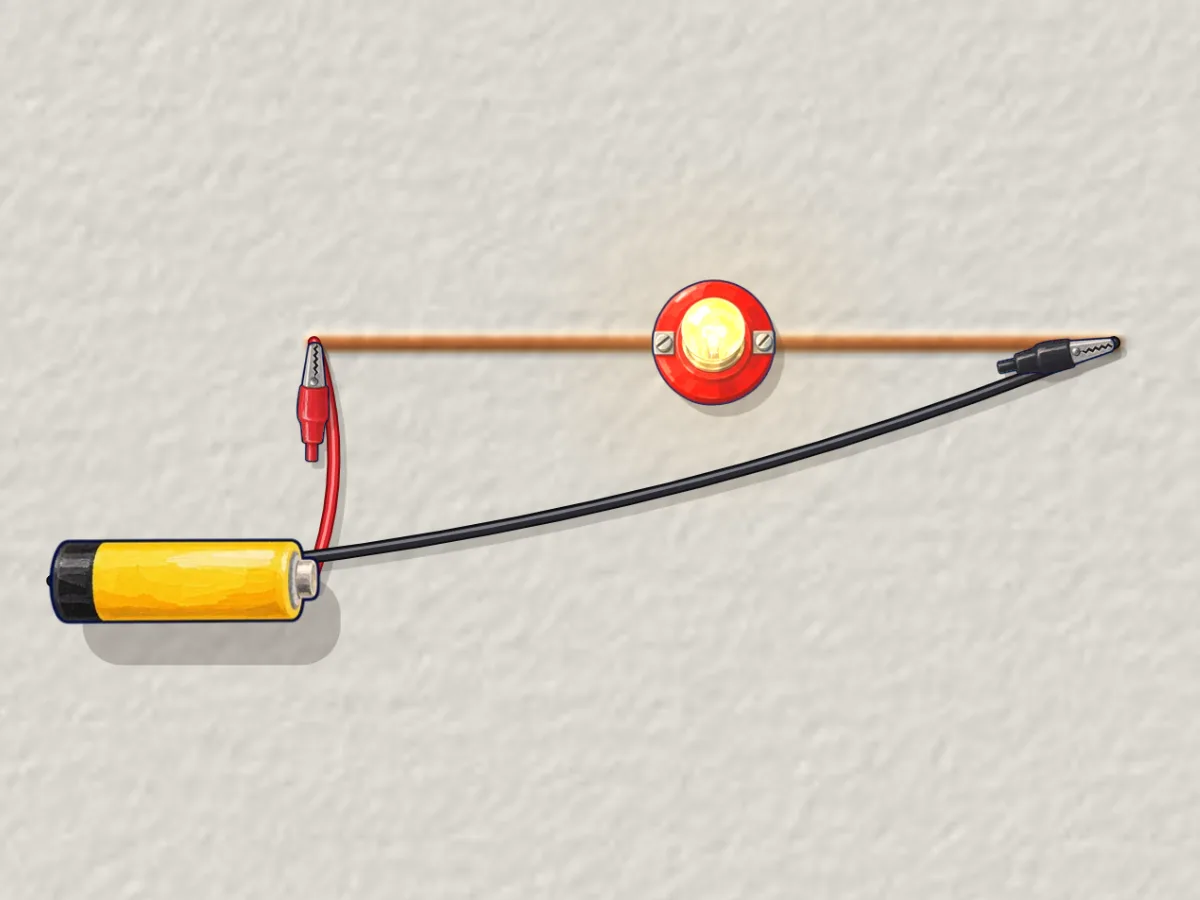
0.273 A
One bulb: glow 0.47
Game Tailors
Source: Electricity
The drawing app where the paper is real. No ads. No accounts. No personal data: only anonymous counts, which you can switch off.
Game Tailors · Schieweg 15Y-40, 2627 AN Delft (NL)
KvK 92437702 · VAT NL866044474B01
info@gametailors.com · +31 6 4227 5919
© 2026 Game Tailors
Electricity
Clip a toy battery to a drawing and the game works out the electricity on every tiny spot of the paper, in real volts, ohms and amps. Nothing tells it how the wires are joined. A copper line lights a bulb, a pencil line carries a trickle too small to see, salty water carries enough to turn sour at one clip, and too much current burns a bulb out with a pop.

A child picks up the battery, clips its two leads onto the page and draws. The battery and the bulbs are objects you can pick up. How they are joined is stored nowhere. Every spot of the paper knows only what lies on it: copper, pencil lead, salty water, a blob of ketchup, or nothing.
From that, the game works out a voltage for every spot, so the current finds its own way. Where a path splits, the current splits. Draw a shortcut round a bulb and nearly all of it takes the shortcut, and the bulb goes dark. Punch a hole through the wire and the current drops to exactly zero; an automated test checks it.
A drawing pin pushed through two wires that don't touch joins them, because the game counts a pin's steel point as metal that conducts. The pin has no circuit code of its own, and a test pins that down. Two wires that cross are joined too. Drawn wire has no insulation.
Draw in the demo below. It runs the game's own rule and constants on a smaller page.
The red + and the dark − are the battery's clips. Pick a starting drawing, then draw with copper, pencil or salty water, put bulbs down (up to four, as in the game) or rub things out. Draw on the page, or use the buttons: Draw a wire from clip to clip, Put down a bulb, Draw a wire round a bulb and Rub a hole in the wire. What to look for: two bulbs in a row go dim, side by side they stay bright, a wire round a bulb puts it out, and 9 V burns a single bulb out within a couple of seconds. In salty water, watch the ends of the wires: acid (pink) gathers where the current goes into the water and alkali (blue-violet) where it comes out. Turn on Voltage to see the volts on every spot, red at + and blue at −.
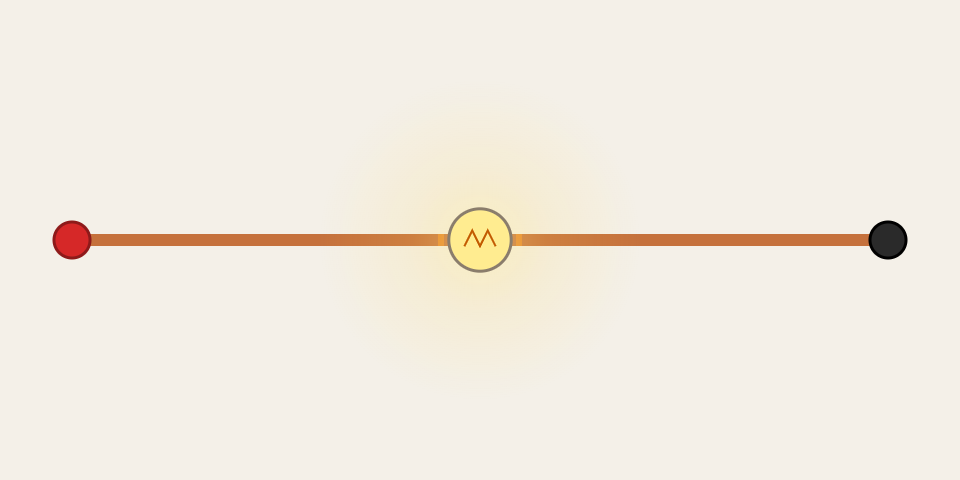
This part of the page could not start.
Copper, a pencil line, salty water and ketchup all go through the same short rule: how much of each thing is on this spot, times how well that thing conducts. Copper over pencil in a puddle adds up. In the game plain water carries nothing, because nothing is dissolved in it; real tap water carries a little. A crayon line carries nothing at all, and a test checks that too.
The range is enormous. Copper conducts fifty million times better than the heaviest pencil line, and both sit on the same page in the same calculation. A test lays wire, pencil, salty water, ketchup and steel on one page and checks that every cell in the circuit gets exactly what the rule says.
A drawn copper line has the resistance of a real 0.5 mm copper wire, length for length: 0.083 Ω a metre in the game, against 0.086 Ω a metre from copper's resistivity (HyperPhysics lists 84.2 Ω per km for 24-gauge wire).
The pencil is honest too. A pencil line really does conduct, and the game really does send current through it: with the real tools, 27 µA at 1.5 V over most of a page, 160 µA at 9 V. That is far too little for a torch bulb, as in real life, and nothing on the page shows it. So the game never pretends a pencil drawing can light a bulb.
Ketchup, mustard and tomato sauce conduct too. In the released game how well each one conducts is a number typed in by hand. In the next update next update it comes from their real salt share times their water, so ketchup (2.5 % salt) and tomato sauce (1 %) conduct in the ratio of their salt times their water. A test pins that ratio.
Copper wire conducts 10,000 siemens per square, a pin's point 300, steel wire 100, steel wool 1.5, a bulb 0.42, salty water 0.02, ketchup 0.016 and the heaviest pencil line 0.0002.
| conductance | |
|---|---|
| copper | 10 000 |
| pin | 300 |
| steel | 100 |
| wool | 1.5 |
| bulb | 0.42 |
| salt water | 0.02 |
| ketchup | 0.016 |
| pencil | 0.0002 |
Source: The game's values at full cover: copper wire, a pushpin's steel point, thin steel wire, steel wool, a bulb in its holder. Salty water is fully salted and wet through; ketchup is the released game's typed value (0.034 by its real salt in the next update); pencil at graphite 1, the heaviest line. Plain water and crayon are 0, so they have no bar. Copper to pencil: 5 × 10⁷.
A copper circuit with one bulb, and a gap in the wire bridged by a strip 6 cells wide (3.6 mm at full size). It uses the game's conductances, battery, bulb rating and burn-out rule, but adds up the circuit as resistors in a row (the rest of the page's 5.3 Ω, the strip, the battery) instead of solving every cell, and its steel wool is a solid strip where the game's is a loose tangle. Choose what the strip is made of and how long it is. What to look for: copper and steel wire hardly change anything. Pencil carries well under a milliamp, and the bulb stays dark. Steel wool lights the bulb dimly on 1.5 V; on 9 V it lets through enough to burn the bulb out.
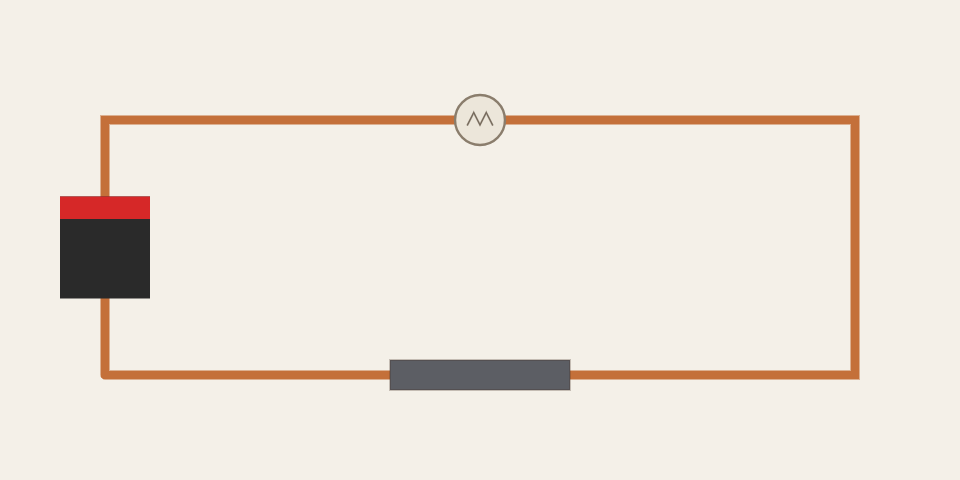
This part of the page could not start.
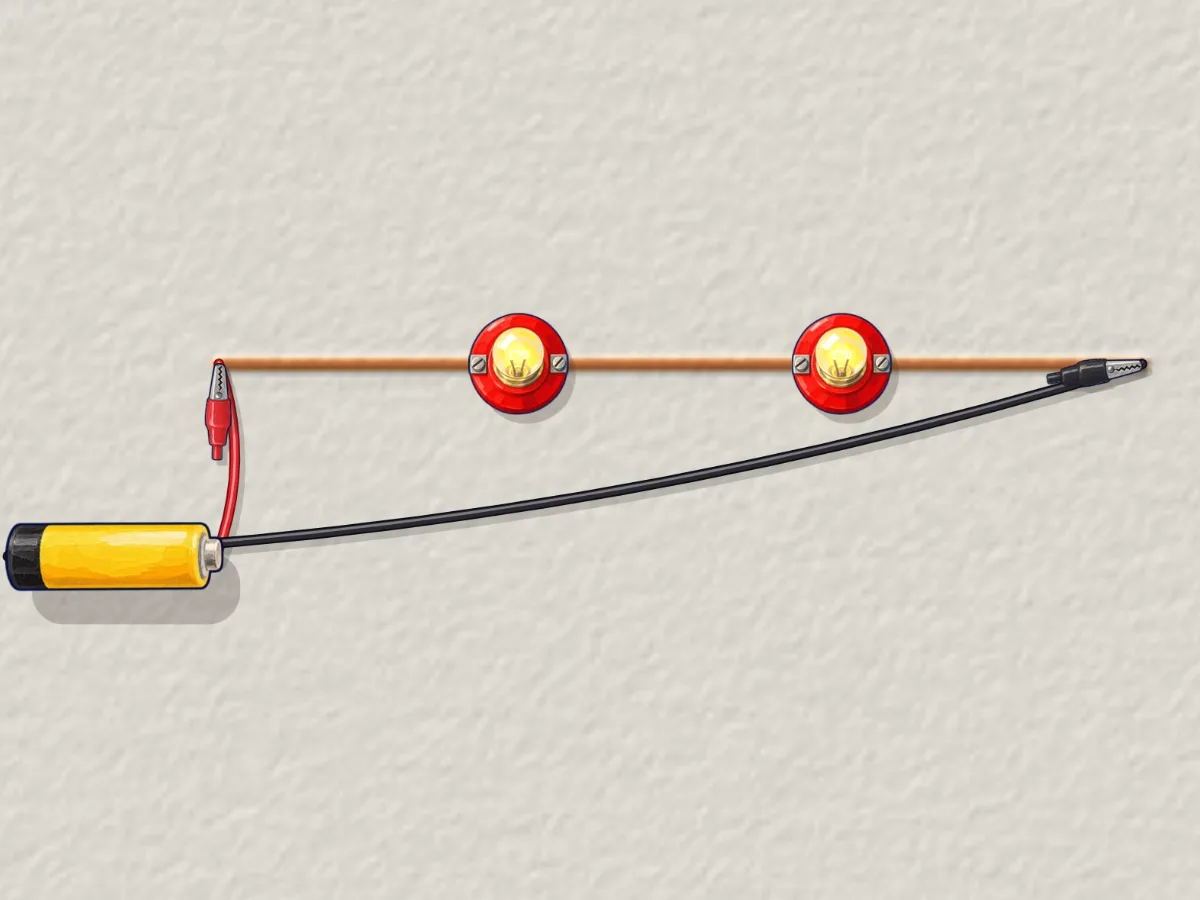
Put one bulb on the 1.5 V cell and it glows at about half its rated power. Put two in a row and each glows at about a quarter of that. Put two side by side and each stays nearly as bright as the single one, while the battery pushes out nearly twice the current. Real bulbs on a real battery do the same, in kind. Nowhere in the code is there a rule for "in a row" or "side by side". The grid of spots works it out.
Ohm's law says what to expect. If one bulb's path is 5.3 Ω, two in a row should be 10.6 Ω, and two side by side should be 2.65 Ω. The game's grid gives 10.6 Ω and 2.65 Ω, and the currents follow: 0.139 A and 0.526 A against 0.273 A for one.
We are careful about what this proves. The battery's own step is the school formula, written into the code: current equals voltage divided by the page's resistance plus the battery's own. So the same 5.3 Ω coming out of both batteries is built in, not a discovery. What the grid really computes is the page's resistance, and that is what we check: against an exact solve of the same grid, against Ohm's law for series and parallel, and against a real copper wire.
At 0.001 Ω the 1.5 V cell gives 7.46 A and the 9 V block 4.5 A; at 100 Ω they give 0.015 A and 0.088 A.
| resistance of the drawing, power of ten (Ω) | 1.5 V cell, 0.2 Ω inside | 9 V block, 2 Ω inside |
|---|---|---|
| −3 | 7.4627 | 4.4978 |
| −2.95 | 7.4582 | 4.4975 |
| −2.9 | 7.4531 | 4.4972 |
| −2.85 | 7.4474 | 4.4968 |
| −2.8 | 7.441 | 4.4964 |
| −2.75 | 7.4339 | 4.496 |
| −2.7 | 7.4259 | 4.4955 |
| −2.65 | 7.417 | 4.495 |
| −2.6 | 7.407 | 4.4944 |
| −2.55 | 7.3958 | 4.4937 |
| −2.5 | 7.3833 | 4.4929 |
| −2.45 | 7.3693 | 4.492 |
| −2.4 | 7.3536 | 4.4911 |
| −2.35 | 7.3362 | 4.49 |
| −2.3 | 7.3166 | 4.4888 |
| −2.25 | 7.2949 | 4.4874 |
| −2.2 | 7.2706 | 4.4858 |
| −2.15 | 7.2436 | 4.4841 |
| −2.1 | 7.2135 | 4.4822 |
| −2.05 | 7.18 | 4.48 |
| −2 | 7.1429 | 4.4776 |
| −1.95 | 7.1016 | 4.4749 |
| −1.9 | 7.0559 | 4.4719 |
| −1.85 | 7.0052 | 4.4684 |
| −1.8 | 6.9493 | 4.4646 |
| −1.75 | 6.8876 | 4.4603 |
| −1.7 | 6.8197 | 4.4556 |
| −1.65 | 6.745 | 4.4502 |
| −1.6 | 6.6631 | 4.4442 |
| −1.55 | 6.5736 | 4.4375 |
| −1.5 | 6.476 | 4.43 |
| −1.45 | 6.3699 | 4.4216 |
| −1.4 | 6.2549 | 4.4122 |
| −1.35 | 6.1307 | 4.4017 |
| −1.3 | 5.9972 | 4.39 |
| −1.25 | 5.854 | 4.3769 |
| −1.2 | 5.7013 | 4.3624 |
| −1.15 | 5.5393 | 4.3462 |
| −1.1 | 5.368 | 4.3281 |
| −1.05 | 5.1881 | 4.308 |
| −1 | 5 | 4.2857 |
| −0.95 | 4.8046 | 4.261 |
| −0.9 | 4.6027 | 4.2335 |
| −0.85 | 4.3956 | 4.2031 |
| −0.8 | 4.1842 | 4.1696 |
| −0.75 | 3.9701 | 4.1326 |
| −0.7 | 3.7544 | 4.0918 |
| −0.65 | 3.5388 | 4.047 |
| −0.6 | 3.3246 | 3.9979 |
| −0.55 | 3.1131 | 3.9442 |
| −0.5 | 2.9057 | 3.8856 |
| −0.45 | 2.7036 | 3.822 |
| −0.4 | 2.5079 | 3.753 |
| −0.35 | 2.3195 | 3.6784 |
| −0.3 | 2.1392 | 3.5983 |
| −0.25 | 1.9676 | 3.5124 |
| −0.2 | 1.8051 | 3.4208 |
| −0.15 | 1.6521 | 3.3236 |
| −0.1 | 1.5086 | 3.2208 |
| −0.05 | 1.3746 | 3.1128 |
| 0 | 1.25 | 3 |
| 0.05 | 1.1346 | 2.8828 |
| 0.1 | 1.0282 | 2.7616 |
| 0.15 | 0.9302 | 2.6373 |
| 0.2 | 0.8404 | 2.5105 |
| 0.25 | 0.7582 | 2.382 |
| 0.3 | 0.6833 | 2.2527 |
| 0.35 | 0.6151 | 2.1233 |
| 0.4 | 0.5531 | 1.9947 |
| 0.45 | 0.497 | 1.8678 |
| 0.5 | 0.4461 | 1.7434 |
| 0.55 | 0.4002 | 1.6222 |
| 0.6 | 0.3588 | 1.5047 |
| 0.65 | 0.3214 | 1.3917 |
| 0.7 | 0.2878 | 1.2835 |
| 0.75 | 0.2576 | 1.1806 |
| 0.8 | 0.2304 | 1.0831 |
| 0.85 | 0.2061 | 0.9912 |
| 0.9 | 0.1842 | 0.9051 |
| 0.95 | 0.1646 | 0.8247 |
| 1 | 0.1471 | 0.75 |
| 1.05 | 0.1313 | 0.6808 |
| 1.1 | 0.1173 | 0.6169 |
| 1.15 | 0.1047 | 0.5581 |
| 1.2 | 0.0935 | 0.5042 |
| 1.25 | 0.0834 | 0.4549 |
| 1.3 | 0.0744 | 0.41 |
| 1.35 | 0.0664 | 0.369 |
| 1.4 | 0.0592 | 0.3319 |
| 1.45 | 0.0528 | 0.2982 |
| 1.5 | 0.0471 | 0.2677 |
| 1.55 | 0.042 | 0.2401 |
| 1.6 | 0.0375 | 0.2153 |
| 1.65 | 0.0334 | 0.1929 |
| 1.7 | 0.0298 | 0.1727 |
| 1.75 | 0.0266 | 0.1545 |
| 1.8 | 0.0237 | 0.1383 |
| 1.85 | 0.0211 | 0.1236 |
| 1.9 | 0.0188 | 0.1105 |
| 1.95 | 0.0168 | 0.0988 |
| 2 | 0.015 | 0.0882 |
Source: Ohm's law, I = V/(R + r), with the game's two batteries. The curves cross at 0.16 Ω. Below that the 1.5 V cell pushes more current; on a dead short, 7.5 A against 4.5 A.
Wherever current flows, it warms the spots it passes through, in joules, into the same temperature the matches, the iron and the sun through a magnifying glass write to. So everything heat does follows. Steel wool on the 9 V battery passes 500 °C within two seconds and catches fire where the clips bite; in the test the paper under it catches too. The warmth of a hot wire rises into the air above it. A fly on a glowing wire is off it at once, unhurt, by the same "too hot to sit on" it uses for anything hot. Automated tests check each of these.
Why does steel wool burn on 9 V and not on 1.5 V? A pad 36 mm long is about 9.5 Ω. On 9 V that lets through about 0.78 A, nearly 6 W into a tangle of thin strands that hold very little heat, so they warm by hundreds of degrees a second before much heat can leave. On 1.5 V it's about 0.23 W, and the game's general cooling keeps up, so the wool only gets warm.
A copper line straight across the 1.5 V cell carries 7 A, yet stays under 60 °C, which a test checks. The cell's own 0.2 Ω limits the current, and a small cell can push more than the big battery: on a dead short the 1.5 V cell gives 7.5 A and the 9 V block only 4.5 A, because the block's insides resist ten times as much.
Bulbs have a limit of their own. The game's torch bulb is rated 0.75 W. Run it far past that for more than a moment and it burns out with a spark and a pop. One bulb on 9 V gets about 7 W, so it goes; a test checks it. Wear adds up: a bulb that was overdriven for a moment is closer to its end.
Metal that gets hotter than its melting point melts through there, with a spark, and opens the circuit like a fuse. The code does this; no test covers it yet.
| Temperature | What happens |
|---|---|
| 150 °C | A calm safety word about hot thin wire or steel wool |
| 170 °C | Hot spots start to glow on screen |
| 230 °C | Paper catches fire |
| 250 °C | You hear the wire sizzle |
| 450 °C | Steel wool burns, from any heat |
| 1,085 °C | Copper melts through: the circuit opens |
| 1,450 °C | Steel melts through |
| 1,600 °C | The current can heat nothing further |
The game's own thresholds, from the circuit, the fire and the drawing.
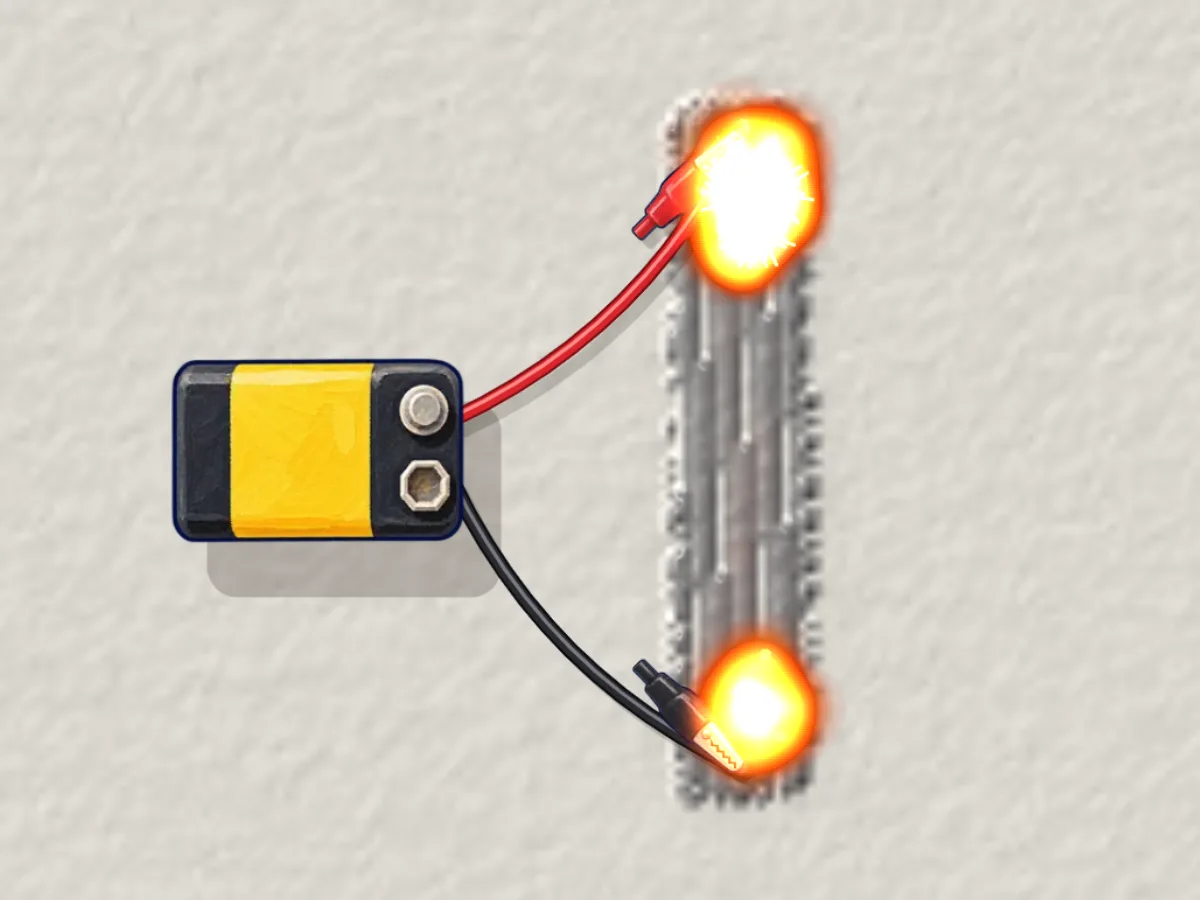
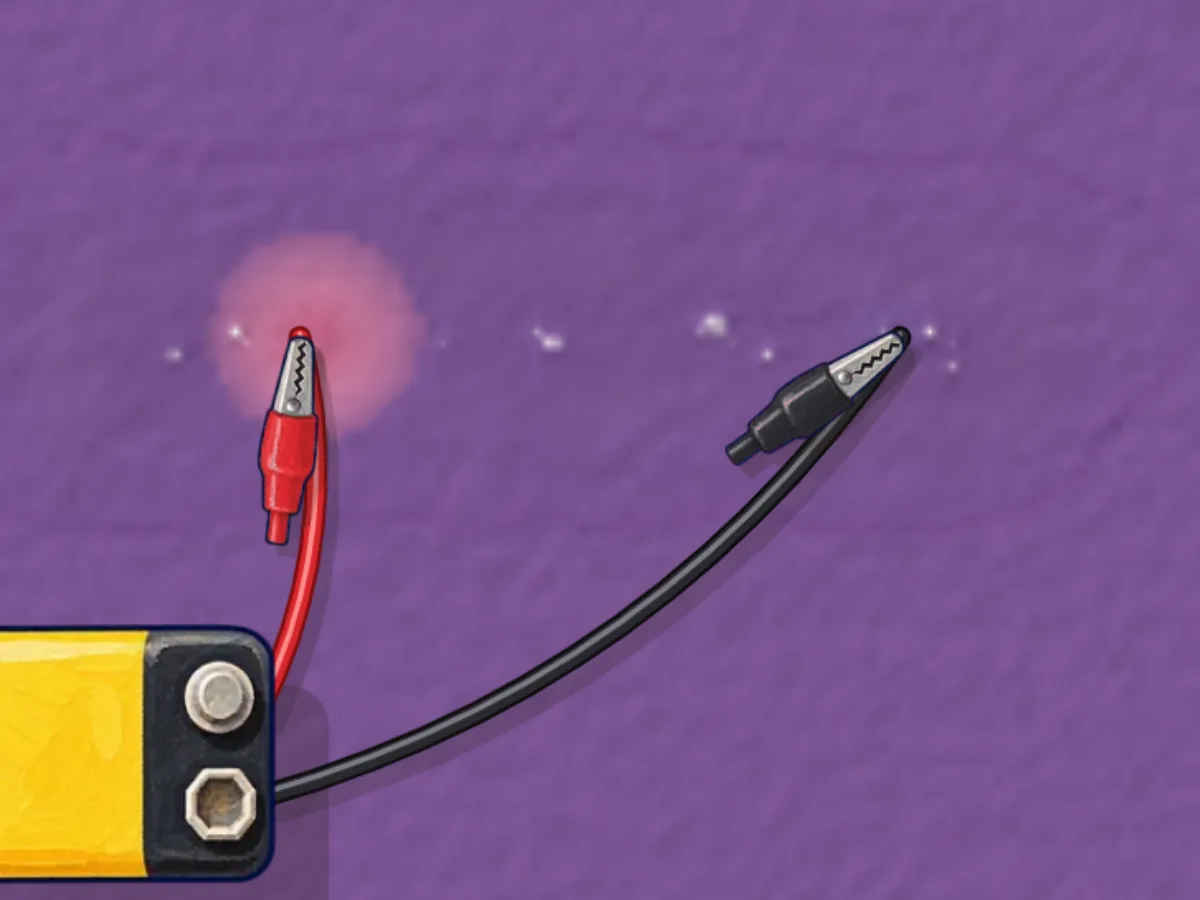
Pour salty water on the page and clip the battery into it. The game puts a few small bubbles at the clips, hard to tell apart from the salt. The water by the + clip turns sour, and the water by the − clip turns a little alkaline. On paper dipped in red cabbage juice you can see it: the water by the + clip goes pink. A test checks it.
Nothing marks a wire's end as special. Besides the clips themselves, the game looks for spots where water that carries current by its dissolved salt meets something that carries it as metal does: a copper wire, a pencil line, a bulb. Where the current goes from the metal into the water, the water goes sour. Where it comes out of the water into the metal, it goes alkaline, with twice the bubbles. So the end of any wire dipped in the puddle should work the same way. That follows from the code, and the demo above shows it; the game's test covers only the clips.
The acid made at the + clip is the same acid as vinegar's, so the cabbage dye shows it without knowing it came from a battery. In the next update next update the − clip makes a soapy alkali, like bar soap, that doesn't fizz with the acid. In the released game it makes dissolved baking soda.
We keep the colours honest. With the real tools, the + side goes clearly pink. The − side only gets a faint bluer purple, not green, because with the real tools the game makes too little alkali for that. And we don't name the gas: real salty water makes chlorine at the + side, and a test makes sure the game's electricity code and its list of features never name oxygen or chlorine next update.
Working out the voltage on every spot is real computing, and it has to share a cheap tablet with the water, the fire and the air. So the circuit sleeps entirely until both clips are on the paper, and it only works on the spots that conduct, not the whole page. A copper wire with one bulb is a few hundred spots.
Its work is counted and capped each tick. A test floods a whole page with salty water and checks that the circuit stays close to its share of the work on the slowest setting, and that the current still arrives within 15 seconds of game time. The test counts work units, not milliseconds, so it shows the circuit keeps to its share, not how long a tick takes.
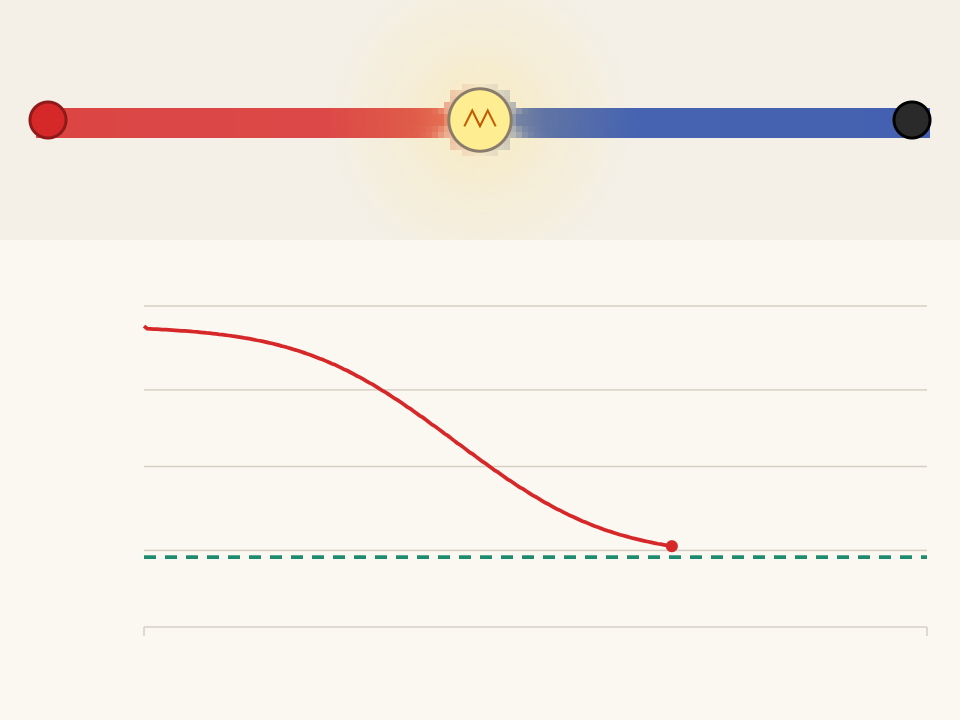
It also has one real weakness, and we show it. Draw a pencil line that closes a circuit through a bulb, then draw copper over the pencil line. The game keeps its old answer as a starting point, because no new spots joined. That answer now reads like a dead short: 7.4 A and a dark bulb. The sweeps then crawl toward the truth, and on the released game they settle at 0.555 A after about 16 seconds, where the true answer is 0.272 A. The simple circuits a child starts with come out within about half a percent.
Five attempts at an exact solver were each worse somewhere, so the work is parked. A theorem gives some comfort: the way the game reads the current, any error can only make it too high, never too low.
what conducts, from +
new circuits only
most of the work
from the heat made
heat, bulbs, water
What the circuit does each tick, inside one counted budget.
Top: a strip of the page, coloured by voltage. Bottom: what the solver reads, sweep by sweep, against an exact solve of the same grid (dashed). It runs the game's budget at its top detail level, at 60 ticks a second. In the fault case the bulb starts dark and brightens only as the sweeps creep in: the false current runs through the copper, not the bulb. Try: the fault case with the warm start, as the game does it, then the same with a fresh guess. Then turn the over-relaxation down to 1 (plain Gauss-Seidel) and see how much slower it gets.
This part of the page could not start.
The sweeps start at 7.49 A, still read 6.55 A after 2,048 sweeps and 1.74 A after 8,192, and stop at 0.353 A after 14,080, against a true 0.272 A.
| sweeps | what the sweeps read | the true answer, 0.272 A |
|---|---|---|
| 0 | 7.492 | 0.272 |
| 16 | 7.209 | |
| 128 | 7.148 | |
| 1024 | 6.915 | |
| 2048 | 6.548 | |
| 4096 | 5.262 | |
| 6144 | 3.381 | |
| 8192 | 1.743 | |
| 10 240 | 0.847 | |
| 12 288 | 0.478 | |
| 14 080 | 0.353 | |
| 14 500 | 0.272 |
Source: A re-creation of the game's method on a 240 × 120 page, same constants: it starts from the old voltages, which read as a dead short, and the settle test passes at about 0.35 A after some 14,100 sweeps. In the released game the same case settles at 0.555 A after about 16 s. The good case beside it: copper and a bulb, 64 sweeps from the guess, 0.273 A against 0.272 A.
The circuit writes heat into the same temperature as the fire, and acid into the same dissolved acid as vinegar's. It reads metal, pencil lead, water and salt that other tools lay down. None of these links is written as a special case.
Shared: current → temp
It passes 500 °C within two seconds and bursts into flame where the clips bite.
Heat and fire · a test checks it
Shared: acid
Pink at the + clip. The circuit writes acid, the cabbage chart reads it.
Chemistry and pH · a test checks it
Shared: salt in goop → ions
Salt dough lights the bulb dimly and warms; bread dough carries over 10 mA, unsalted dough less than a tenth of that.
Dough, mould and time · a test checks it
Shared: temp
It's off at once, unhurt, as off anything too hot to sit on.
Animals with their own minds · a test checks it
Shared: temp → air
Its warmth rises into the air above it, like any warm spot's.
Air that really moves · a test checks it
Shared: bodies
They slide along like any other object on the table.
Things that push things · a test checks it