
2.45×
The most a kneaded dough rises, at any warmth from 3 to 50 °C, before it tears and sinks. Unkneaded dough stops at 1.69×. Worked out on this page for one spot from the game's own yeast rule.
Game Tailors
Source: Dough, mould and time
The drawing app where the paper is real. No ads. No accounts. No personal data: only anonymous counts, which you can switch off.
Game Tailors · Schieweg 15Y-40, 2627 AN Delft (NL)
KvK 92437702 · VAT NL866044474B01
info@gametailors.com · +31 6 4227 5919
© 2026 Game Tailors
Dough, mould and time
Mix flour and water on the page and you have dough. Sprinkle yeast on it and keep it warm, and it rises, as slowly as real dough does. Leave ketchup out and it grows fuzzy mould; leave honey out and it doesn't. Water some cress seeds and they come up. Some of this takes days, so the game has a "Wait 3 days" button, and it works out what those days would do instead of playing them.

Dough on the page isn't a picture of dough. Sieve flour onto a wet patch and it turns into a soft lump. From then on, each tiny spot of that lump keeps track of what's in it: how much of it is gas, how much live yeast it holds, how much salt and sugar went in, how many sheets of butter are folded through it, and how stretchy it has become.
Knead it with your finger and it gets stretchier. Stretchy dough holds its shape, so a stamp or a toy car leaves a dent that stays. It also holds on to gas. That one number decides most of what happens next: kneaded dough keeps most of the gas the yeast makes and rises, while a shaggy, unkneaded lump lets most of it escape and spreads sideways. Seen from above, an hour's rise hardly shows; what you do see is the kneaded lump gone smooth and the other still shaggy.
Any sliding contact kneads: a hand rubbed across the dough works it, while a ball rolling over it only presses, and a test pins the difference. The rolling pin and a fold work it too.
Outside the table of materials and the sieve's list of what it sifts, the simulation never names dough, flour or yeast. Dough's behaviour comes from columns in that table (how well it kneads, how much gas it holds), so by our reading a second kind of dough would need only one more row. There isn't one yet to prove it.
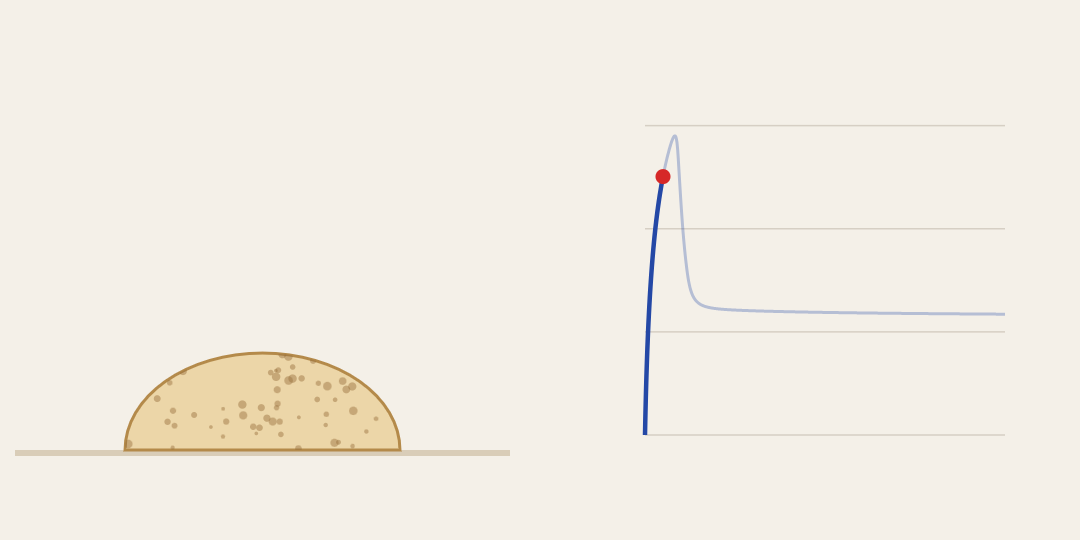
A kneaded dough with one dose of yeast proving at 30 °C, two hours a second; the faint curve is its whole future. Move the warmth, knead it less (0.15 is shaggy), or change what's in it. What to look for: it doubles in about an hour at 30 °C and tops out near 2.45 times its size at any warmth from 3 to 50 °C, then tears and sinks. Hotter than 50 °C the yeast dies before the dough gets far. Unkneaded dough stops below 1.7 times and spreads wider. This is the game's own yeast rule for one spot; the dome follows the game's own spreading rule, and the pores are drawn.
This part of the page could not start.
At 30 °C it reaches 1.86× in an hour and peaks at 2.46× after 4.0 h; at 5 °C it peaks at 2.42× only after 29.7 h.
| hours | 5 °C | 20 °C | 30 °C | 35 °C |
|---|---|---|---|---|
| 0 | 1 | 1 | 1 | 1 |
| 0.167 | 1.039 | 1.125 | 1.257 | 1.358 |
| 0.333 | 1.075 | 1.229 | 1.437 | 1.58 |
| 0.5 | 1.11 | 1.318 | 1.575 | 1.74 |
| 0.667 | 1.142 | 1.395 | 1.686 | 1.863 |
| 0.833 | 1.173 | 1.463 | 1.779 | 1.963 |
| 1 | 1.202 | 1.525 | 1.858 | 2.046 |
| 1.167 | 1.23 | 1.58 | 1.927 | 2.117 |
| 1.333 | 1.257 | 1.63 | 1.987 | 2.178 |
| 1.5 | 1.282 | 1.677 | 2.041 | 2.231 |
| 1.667 | 1.307 | 1.72 | 2.089 | 2.279 |
| 1.833 | 1.33 | 1.759 | 2.133 | 2.321 |
| 2 | 1.353 | 1.796 | 2.173 | 2.359 |
| 2.167 | 1.374 | 1.831 | 2.209 | 2.394 |
| 2.333 | 1.395 | 1.863 | 2.242 | 2.425 |
| 2.5 | 1.416 | 1.894 | 2.273 | 2.45 |
| 2.667 | 1.435 | 1.923 | 2.302 | 2.465 |
| 2.833 | 1.454 | 1.951 | 2.329 | 2.459 |
| 3 | 1.473 | 1.976 | 2.354 | 2.406 |
| 3.167 | 1.491 | 2.001 | 2.377 | 2.307 |
| 3.333 | 1.508 | 2.024 | 2.399 | 2.193 |
| 3.5 | 1.525 | 2.047 | 2.419 | 2.093 |
| 3.667 | 1.541 | 2.068 | 2.436 | 2.008 |
| 3.833 | 1.557 | 2.088 | 2.448 | 1.936 |
| 4 | 1.573 | 2.108 | 2.455 | 1.874 |
| 4.167 | 1.588 | 2.127 | 2.45 | 1.82 |
| 4.333 | 1.602 | 2.145 | 2.427 | 1.774 |
| 4.5 | 1.617 | 2.162 | 2.372 | 1.736 |
| 4.667 | 1.631 | 2.178 | 2.284 | 1.708 |
| 4.833 | 1.644 | 2.194 | 2.189 | 1.688 |
| 5 | 1.658 | 2.21 | 2.096 | 1.673 |
| 5.167 | 1.671 | 2.224 | 2.011 | 1.662 |
| 5.333 | 1.683 | 2.239 | 1.938 | 1.653 |
| 5.5 | 1.696 | 2.253 | 1.876 | 1.646 |
| 5.667 | 1.708 | 2.266 | 1.822 | 1.641 |
| 5.833 | 1.72 | 2.279 | 1.775 | 1.637 |
| 6 | 1.731 | 2.292 | 1.737 | 1.633 |
| 6.167 | 1.743 | 2.304 | 1.709 | 1.63 |
| 6.333 | 1.754 | 2.315 | 1.688 | 1.628 |
| 6.5 | 1.765 | 2.327 | 1.672 | 1.625 |
| 6.667 | 1.776 | 2.338 | 1.661 | 1.624 |
| 6.833 | 1.786 | 2.349 | 1.652 | 1.622 |
| 7 | 1.797 | 2.359 | 1.645 | 1.62 |
| 7.167 | 1.807 | 2.37 | 1.639 | 1.619 |
| 7.333 | 1.817 | 2.379 | 1.635 | 1.618 |
| 7.5 | 1.826 | 2.389 | 1.631 | 1.617 |
| 7.667 | 1.836 | 2.398 | 1.628 | 1.616 |
| 7.833 | 1.845 | 2.406 | 1.625 | 1.615 |
| 8 | 1.855 | 2.414 | 1.623 | 1.615 |
| 8.167 | 1.864 | 2.421 | 1.621 | 1.614 |
| 8.333 | 1.873 | 2.427 | 1.619 | 1.613 |
| 8.5 | 1.881 | 2.432 | 1.617 | 1.613 |
| 8.667 | 1.89 | 2.436 | 1.616 | 1.612 |
| 8.833 | 1.898 | 2.438 | 1.615 | 1.612 |
| 9 | 1.907 | 2.438 | 1.614 | 1.611 |
| 9.167 | 1.915 | 2.436 | 1.613 | 1.611 |
| 9.333 | 1.923 | 2.432 | 1.612 | 1.61 |
| 9.5 | 1.931 | 2.424 | 1.611 | 1.61 |
| 9.667 | 1.939 | 2.412 | 1.611 | 1.609 |
| 9.833 | 1.947 | 2.395 | 1.61 | 1.609 |
| 10 | 1.954 | 2.374 | 1.609 | 1.609 |
| 10.167 | 1.962 | 2.346 | 1.609 | 1.608 |
| 10.333 | 1.969 | 2.312 | 1.608 | 1.608 |
| 10.5 | 1.976 | 2.272 | 1.608 | 1.608 |
| 10.667 | 1.983 | 2.227 | 1.607 | 1.607 |
| 10.833 | 1.99 | 2.177 | 1.607 | 1.607 |
| 11 | 1.997 | 2.125 | 1.607 | 1.607 |
| 11.167 | 2.004 | 2.071 | 1.606 | 1.606 |
| 11.333 | 2.011 | 2.017 | 1.606 | 1.606 |
| 11.5 | 2.018 | 1.965 | 1.606 | 1.606 |
| 11.667 | 2.024 | 1.915 | 1.605 | 1.606 |
| 11.833 | 2.031 | 1.868 | 1.605 | 1.605 |
| 12 | 2.037 | 1.825 | 1.605 | 1.605 |
| 12.167 | 2.043 | 1.785 | 1.604 | 1.605 |
| 12.333 | 2.049 | 1.749 | 1.604 | 1.605 |
| 12.5 | 2.056 | 1.717 | 1.604 | 1.604 |
| 12.667 | 2.062 | 1.693 | 1.604 | 1.604 |
| 12.833 | 2.068 | 1.676 | 1.603 | 1.604 |
| 13 | 2.074 | 1.663 | 1.603 | 1.604 |
| 13.167 | 2.079 | 1.652 | 1.603 | 1.604 |
| 13.333 | 2.085 | 1.644 | 1.603 | 1.603 |
| 13.5 | 2.091 | 1.638 | 1.602 | 1.603 |
| 13.667 | 2.096 | 1.632 | 1.602 | 1.603 |
| 13.833 | 2.102 | 1.628 | 1.602 | 1.603 |
| 14 | 2.107 | 1.624 | 1.602 | 1.602 |
| 14.167 | 2.113 | 1.621 | 1.602 | 1.602 |
| 14.333 | 2.118 | 1.618 | 1.601 | 1.602 |
| 14.5 | 2.123 | 1.616 | 1.601 | 1.602 |
| 14.667 | 2.129 | 1.614 | 1.601 | 1.602 |
| 14.833 | 2.134 | 1.612 | 1.601 | 1.602 |
| 15 | 2.139 | 1.61 | 1.601 | 1.601 |
| 15.167 | 2.144 | 1.609 | 1.601 | 1.601 |
| 15.333 | 2.149 | 1.608 | 1.6 | 1.601 |
| 15.5 | 2.154 | 1.607 | 1.6 | 1.601 |
| 15.667 | 2.159 | 1.606 | 1.6 | 1.601 |
| 15.833 | 2.164 | 1.605 | 1.6 | 1.6 |
| 16 | 2.168 | 1.604 | 1.6 | 1.6 |
| 16.167 | 2.173 | 1.603 | 1.6 | 1.6 |
| 16.333 | 2.178 | 1.603 | 1.599 | 1.6 |
| 16.5 | 2.182 | 1.602 | 1.599 | 1.6 |
| 16.667 | 2.187 | 1.601 | 1.599 | 1.6 |
| 16.833 | 2.191 | 1.601 | 1.599 | 1.599 |
| 17 | 2.196 | 1.6 | 1.599 | 1.599 |
| 17.167 | 2.2 | 1.6 | 1.599 | 1.599 |
| 17.333 | 2.205 | 1.599 | 1.598 | 1.599 |
| 17.5 | 2.209 | 1.599 | 1.598 | 1.599 |
| 17.667 | 2.213 | 1.599 | 1.598 | 1.599 |
| 17.833 | 2.218 | 1.598 | 1.598 | 1.599 |
| 18 | 2.222 | 1.598 | 1.598 | 1.598 |
| 18.167 | 2.226 | 1.598 | 1.598 | 1.598 |
| 18.333 | 2.23 | 1.598 | 1.598 | 1.598 |
| 18.5 | 2.234 | 1.597 | 1.598 | 1.598 |
| 18.667 | 2.238 | 1.597 | 1.597 | 1.598 |
| 18.833 | 2.242 | 1.597 | 1.597 | 1.598 |
| 19 | 2.246 | 1.597 | 1.597 | 1.598 |
| 19.167 | 2.25 | 1.596 | 1.597 | 1.597 |
| 19.333 | 2.254 | 1.596 | 1.597 | 1.597 |
| 19.5 | 2.258 | 1.596 | 1.597 | 1.597 |
| 19.667 | 2.262 | 1.596 | 1.597 | 1.597 |
| 19.833 | 2.265 | 1.596 | 1.597 | 1.597 |
| 20 | 2.269 | 1.595 | 1.596 | 1.597 |
| 20.167 | 2.273 | 1.595 | 1.596 | 1.597 |
| 20.333 | 2.277 | 1.595 | 1.596 | 1.597 |
| 20.5 | 2.28 | 1.595 | 1.596 | 1.596 |
| 20.667 | 2.284 | 1.595 | 1.596 | 1.596 |
| 20.833 | 2.287 | 1.595 | 1.596 | 1.596 |
| 21 | 2.291 | 1.595 | 1.596 | 1.596 |
| 21.167 | 2.294 | 1.595 | 1.596 | 1.596 |
| 21.333 | 2.298 | 1.594 | 1.595 | 1.596 |
| 21.5 | 2.301 | 1.594 | 1.595 | 1.596 |
| 21.667 | 2.305 | 1.594 | 1.595 | 1.596 |
| 21.833 | 2.308 | 1.594 | 1.595 | 1.596 |
| 22 | 2.311 | 1.594 | 1.595 | 1.595 |
| 22.167 | 2.315 | 1.594 | 1.595 | 1.595 |
| 22.333 | 2.318 | 1.594 | 1.595 | 1.595 |
| 22.5 | 2.321 | 1.594 | 1.595 | 1.595 |
| 22.667 | 2.325 | 1.593 | 1.595 | 1.595 |
| 22.833 | 2.328 | 1.593 | 1.595 | 1.595 |
| 23 | 2.331 | 1.593 | 1.594 | 1.595 |
| 23.167 | 2.334 | 1.593 | 1.594 | 1.595 |
| 23.333 | 2.337 | 1.593 | 1.594 | 1.595 |
| 23.5 | 2.34 | 1.593 | 1.594 | 1.595 |
| 23.667 | 2.344 | 1.593 | 1.594 | 1.594 |
| 23.833 | 2.347 | 1.593 | 1.594 | 1.594 |
| 24 | 2.35 | 1.593 | 1.594 | 1.594 |
| 24.167 | 2.353 | 1.593 | 1.594 | 1.594 |
| 24.333 | 2.356 | 1.593 | 1.594 | 1.594 |
| 24.5 | 2.359 | 1.592 | 1.594 | 1.594 |
| 24.667 | 2.362 | 1.592 | 1.594 | 1.594 |
| 24.833 | 2.365 | 1.592 | 1.593 | 1.594 |
| 25 | 2.367 | 1.592 | 1.593 | 1.594 |
| 25.167 | 2.37 | 1.592 | 1.593 | 1.594 |
| 25.333 | 2.373 | 1.592 | 1.593 | 1.593 |
| 25.5 | 2.376 | 1.592 | 1.593 | 1.593 |
| 25.667 | 2.378 | 1.592 | 1.593 | 1.593 |
| 25.833 | 2.381 | 1.592 | 1.593 | 1.593 |
| 26 | 2.384 | 1.592 | 1.593 | 1.593 |
| 26.167 | 2.386 | 1.592 | 1.593 | 1.593 |
| 26.333 | 2.389 | 1.592 | 1.593 | 1.593 |
| 26.5 | 2.391 | 1.591 | 1.593 | 1.593 |
| 26.667 | 2.393 | 1.591 | 1.593 | 1.593 |
| 26.833 | 2.395 | 1.591 | 1.592 | 1.593 |
| 27 | 2.397 | 1.591 | 1.592 | 1.593 |
| 27.167 | 2.399 | 1.591 | 1.592 | 1.593 |
| 27.333 | 2.401 | 1.591 | 1.592 | 1.592 |
| 27.5 | 2.403 | 1.591 | 1.592 | 1.592 |
| 27.667 | 2.405 | 1.591 | 1.592 | 1.592 |
| 27.833 | 2.407 | 1.591 | 1.592 | 1.592 |
| 28 | 2.408 | 1.591 | 1.592 | 1.592 |
| 28.167 | 2.409 | 1.591 | 1.592 | 1.592 |
| 28.333 | 2.411 | 1.591 | 1.592 | 1.592 |
| 28.5 | 2.412 | 1.591 | 1.592 | 1.592 |
| 28.667 | 2.413 | 1.591 | 1.592 | 1.592 |
| 28.833 | 2.414 | 1.591 | 1.592 | 1.592 |
| 29 | 2.415 | 1.59 | 1.591 | 1.592 |
| 29.167 | 2.415 | 1.59 | 1.591 | 1.592 |
| 29.333 | 2.416 | 1.59 | 1.591 | 1.592 |
| 29.5 | 2.416 | 1.59 | 1.591 | 1.591 |
| 29.667 | 2.417 | 1.59 | 1.591 | 1.591 |
| 29.833 | 2.417 | 1.59 | 1.591 | 1.591 |
| 30 | 2.417 | 1.59 | 1.591 | 1.591 |
| 30.167 | 2.417 | 1.59 | 1.591 | 1.591 |
| 30.333 | 2.416 | 1.59 | 1.591 | 1.591 |
| 30.5 | 2.416 | 1.59 | 1.591 | 1.591 |
| 30.667 | 2.416 | 1.59 | 1.591 | 1.591 |
| 30.833 | 2.415 | 1.59 | 1.591 | 1.591 |
| 31 | 2.414 | 1.59 | 1.591 | 1.591 |
| 31.167 | 2.413 | 1.59 | 1.591 | 1.591 |
| 31.333 | 2.412 | 1.59 | 1.59 | 1.591 |
| 31.5 | 2.411 | 1.59 | 1.59 | 1.591 |
| 31.667 | 2.41 | 1.589 | 1.59 | 1.591 |
| 31.833 | 2.408 | 1.589 | 1.59 | 1.591 |
| 32 | 2.407 | 1.589 | 1.59 | 1.59 |
| 32.167 | 2.405 | 1.589 | 1.59 | 1.59 |
| 32.333 | 2.404 | 1.589 | 1.59 | 1.59 |
| 32.5 | 2.402 | 1.589 | 1.59 | 1.59 |
| 32.667 | 2.4 | 1.589 | 1.59 | 1.59 |
| 32.833 | 2.398 | 1.589 | 1.59 | 1.59 |
| 33 | 2.396 | 1.589 | 1.59 | 1.59 |
| 33.167 | 2.393 | 1.589 | 1.59 | 1.59 |
| 33.333 | 2.391 | 1.589 | 1.59 | 1.59 |
| 33.5 | 2.389 | 1.589 | 1.59 | 1.59 |
| 33.667 | 2.386 | 1.589 | 1.59 | 1.59 |
| 33.833 | 2.383 | 1.589 | 1.59 | 1.59 |
| 34 | 2.381 | 1.589 | 1.589 | 1.59 |
| 34.167 | 2.378 | 1.589 | 1.589 | 1.59 |
| 34.333 | 2.375 | 1.589 | 1.589 | 1.59 |
| 34.5 | 2.372 | 1.589 | 1.589 | 1.59 |
| 34.667 | 2.369 | 1.588 | 1.589 | 1.589 |
| 34.833 | 2.366 | 1.588 | 1.589 | 1.589 |
| 35 | 2.363 | 1.588 | 1.589 | 1.589 |
| 35.167 | 2.36 | 1.588 | 1.589 | 1.589 |
| 35.333 | 2.357 | 1.588 | 1.589 | 1.589 |
| 35.5 | 2.354 | 1.588 | 1.589 | 1.589 |
| 35.667 | 2.35 | 1.588 | 1.589 | 1.589 |
| 35.833 | 2.347 | 1.588 | 1.589 | 1.589 |
| 36 | 2.344 | 1.588 | 1.589 | 1.589 |
Source: One spot, well kneaded, one dose of yeast, no salt. Worked out on this page with the game's own yeast rule, in 10-minute steps.
Yeast in the game makes gas at a rate set by how warm it is. It's at its best around 35 °C, slows steadily as it cools and stops near freezing. Above its best it slows again and stops making gas well before boiling. From about 50 °C the heat also starts killing it, and the hotter it gets the faster that goes: a couple of minutes in the low sixties leaves almost none alive, which a test checks. A freezer only pauses it. Thaw the dough and warm it, and it rises; a test checks that too.
Salt draws water out of yeast, so salty dough rises more slowly, and very salty dough hardly at all. Sugar feeds it: a little makes it busier, but a lot draws water out just as salt does, so a very sweet dough starts slower than a plain one. The yeast eats as it goes, so a rise never runs on forever.
Real baker's yeast grows best at a little over 32 °C, a published measurement found after the game was built Salvadó 2011. Our 35 °C is a touch warmer. The paper measures growth, and the game models how fast the yeast makes gas, so it's a consistent neighbour, not a calibration.
Leave a dough far too long and it over-proves: once the gas has stretched the gluten close to its limit, more gas tears it, and the dough sinks back part of the way.
Plain yeast is fully busy at 35 °C, half as busy near 27 °C and at 45 °C, and idle at 2 °C and 55 °C; one dose of salt makes it about a quarter less busy. Above 50 °C the share killed in a minute climbs to nearly all of it in the low sixties.
| °C | how busy (plain) | how busy, 1 dose of salt | share killed in a minute |
|---|---|---|---|
| 0 | 0 | 0 | 0 |
| 0.5 | 0 | 0 | 0 |
| 1 | 0 | 0 | 0 |
| 1.5 | 0 | 0 | 0 |
| 2 | 0 | 0 | 0 |
| 2.5 | 0.0666 | 0.0513 | 0 |
| 3 | 0.0695 | 0.0534 | 0 |
| 3.5 | 0.0724 | 0.0557 | 0 |
| 4 | 0.0755 | 0.0581 | 0 |
| 4.5 | 0.0787 | 0.0606 | 0 |
| 5 | 0.0821 | 0.0631 | 0 |
| 5.5 | 0.0856 | 0.0658 | 0 |
| 6 | 0.0892 | 0.0686 | 0 |
| 6.5 | 0.093 | 0.0715 | 0 |
| 7 | 0.097 | 0.0746 | 0 |
| 7.5 | 0.1011 | 0.0778 | 0 |
| 8 | 0.1054 | 0.0811 | 0 |
| 8.5 | 0.1099 | 0.0845 | 0 |
| 9 | 0.1146 | 0.0881 | 0 |
| 9.5 | 0.1194 | 0.0919 | 0 |
| 10 | 0.1245 | 0.0958 | 0 |
| 10.5 | 0.1298 | 0.0999 | 0 |
| 11 | 0.1353 | 0.1041 | 0 |
| 11.5 | 0.1411 | 0.1085 | 0 |
| 12 | 0.1471 | 0.1132 | 0 |
| 12.5 | 0.1534 | 0.118 | 0 |
| 13 | 0.1599 | 0.123 | 0 |
| 13.5 | 0.1667 | 0.1282 | 0 |
| 14 | 0.1738 | 0.1337 | 0 |
| 14.5 | 0.1812 | 0.1394 | 0 |
| 15 | 0.1889 | 0.1453 | 0 |
| 15.5 | 0.1969 | 0.1515 | 0 |
| 16 | 0.2053 | 0.1579 | 0 |
| 16.5 | 0.214 | 0.1646 | 0 |
| 17 | 0.2231 | 0.1716 | 0 |
| 17.5 | 0.2326 | 0.1789 | 0 |
| 18 | 0.2425 | 0.1866 | 0 |
| 18.5 | 0.2528 | 0.1945 | 0 |
| 19 | 0.2636 | 0.2028 | 0 |
| 19.5 | 0.2748 | 0.2114 | 0 |
| 20 | 0.2865 | 0.2204 | 0 |
| 20.5 | 0.2987 | 0.2298 | 0 |
| 21 | 0.3114 | 0.2395 | 0 |
| 21.5 | 0.3247 | 0.2497 | 0 |
| 22 | 0.3385 | 0.2604 | 0 |
| 22.5 | 0.3529 | 0.2714 | 0 |
| 23 | 0.3679 | 0.283 | 0 |
| 23.5 | 0.3835 | 0.295 | 0 |
| 24 | 0.3998 | 0.3076 | 0 |
| 24.5 | 0.4169 | 0.3207 | 0 |
| 25 | 0.4346 | 0.3343 | 0 |
| 25.5 | 0.4531 | 0.3485 | 0 |
| 26 | 0.4724 | 0.3634 | 0 |
| 26.5 | 0.4925 | 0.3788 | 0 |
| 27 | 0.5134 | 0.3949 | 0 |
| 27.5 | 0.5353 | 0.4117 | 0 |
| 28 | 0.558 | 0.4293 | 0 |
| 28.5 | 0.5818 | 0.4475 | 0 |
| 29 | 0.6065 | 0.4666 | 0 |
| 29.5 | 0.6323 | 0.4864 | 0 |
| 30 | 0.6592 | 0.5071 | 0 |
| 30.5 | 0.6873 | 0.5287 | 0 |
| 31 | 0.7165 | 0.5512 | 0 |
| 31.5 | 0.747 | 0.5746 | 0 |
| 32 | 0.7788 | 0.5991 | 0 |
| 32.5 | 0.8119 | 0.6246 | 0 |
| 33 | 0.8465 | 0.6511 | 0 |
| 33.5 | 0.8825 | 0.6788 | 0 |
| 34 | 0.92 | 0.7077 | 0 |
| 34.5 | 0.9592 | 0.7378 | 0 |
| 35 | 1 | 0.7692 | 0 |
| 35.5 | 0.975 | 0.75 | 0 |
| 36 | 0.95 | 0.7308 | 0 |
| 36.5 | 0.925 | 0.7115 | 0 |
| 37 | 0.9 | 0.6923 | 0 |
| 37.5 | 0.875 | 0.6731 | 0 |
| 38 | 0.85 | 0.6538 | 0 |
| 38.5 | 0.825 | 0.6346 | 0 |
| 39 | 0.8 | 0.6154 | 0 |
| 39.5 | 0.775 | 0.5962 | 0 |
| 40 | 0.75 | 0.5769 | 0 |
| 40.5 | 0.725 | 0.5577 | 0 |
| 41 | 0.7 | 0.5385 | 0 |
| 41.5 | 0.675 | 0.5192 | 0 |
| 42 | 0.65 | 0.5 | 0 |
| 42.5 | 0.625 | 0.4808 | 0 |
| 43 | 0.6 | 0.4615 | 0 |
| 43.5 | 0.575 | 0.4423 | 0 |
| 44 | 0.55 | 0.4231 | 0 |
| 44.5 | 0.525 | 0.4038 | 0 |
| 45 | 0.5 | 0.3846 | 0 |
| 45.5 | 0.475 | 0.3654 | 0 |
| 46 | 0.45 | 0.3462 | 0 |
| 46.5 | 0.425 | 0.3269 | 0 |
| 47 | 0.4 | 0.3077 | 0 |
| 47.5 | 0.375 | 0.2885 | 0 |
| 48 | 0.35 | 0.2692 | 0 |
| 48.5 | 0.325 | 0.25 | 0 |
| 49 | 0.3 | 0.2308 | 0 |
| 49.5 | 0.275 | 0.2115 | 0 |
| 50 | 0.25 | 0.1923 | 0 |
| 50.5 | 0.225 | 0.1731 | 0.4148 |
| 51 | 0.2 | 0.1538 | 0.4369 |
| 51.5 | 0.175 | 0.1346 | 0.4597 |
| 52 | 0.15 | 0.1154 | 0.483 |
| 52.5 | 0.125 | 0.0962 | 0.5069 |
| 53 | 0.1 | 0.0769 | 0.5313 |
| 53.5 | 0.075 | 0.0577 | 0.5561 |
| 54 | 0.05 | 0.0385 | 0.5813 |
| 54.5 | 0.025 | 0.0192 | 0.6066 |
| 55 | 0 | 0 | 0.6321 |
| 55.5 | 0 | 0 | 0.6576 |
| 56 | 0 | 0 | 0.683 |
| 56.5 | 0 | 0 | 0.708 |
| 57 | 0 | 0 | 0.7327 |
| 57.5 | 0 | 0 | 0.7569 |
| 58 | 0 | 0 | 0.7803 |
| 58.5 | 0 | 0 | 0.803 |
| 59 | 0 | 0 | 0.8247 |
| 59.5 | 0 | 0 | 0.8453 |
| 60 | 0 | 0 | 0.8647 |
| 60.5 | 0 | 0 | 0.8828 |
| 61 | 0 | 0 | 0.8995 |
| 61.5 | 0 | 0 | 0.9148 |
| 62 | 0 | 0 | 0.9286 |
| 62.5 | 0 | 0 | 0.9409 |
| 63 | 0 | 0 | 0.9518 |
| 63.5 | 0 | 0 | 0.9612 |
| 64 | 0 | 0 | 0.9693 |
| 64.5 | 0 | 0 | 0.9761 |
| 65 | 0 | 0 | 0.9817 |
| 65.5 | 0 | 0 | 0.9863 |
| 66 | 0 | 0 | 0.9899 |
| 66.5 | 0 | 0 | 0.9927 |
| 67 | 0 | 0 | 0.9949 |
| 67.5 | 0 | 0 | 0.9965 |
| 68 | 0 | 0 | 0.9977 |
| 68.5 | 0 | 0 | 0.9985 |
| 69 | 0 | 0 | 0.9991 |
| 69.5 | 0 | 0 | 0.9994 |
| 70 | 0 | 0 | 0.9997 |
Source: The game's own warmth, salt and heat-kill curves; the jumps at 2 °C and 50 °C are the game's too.
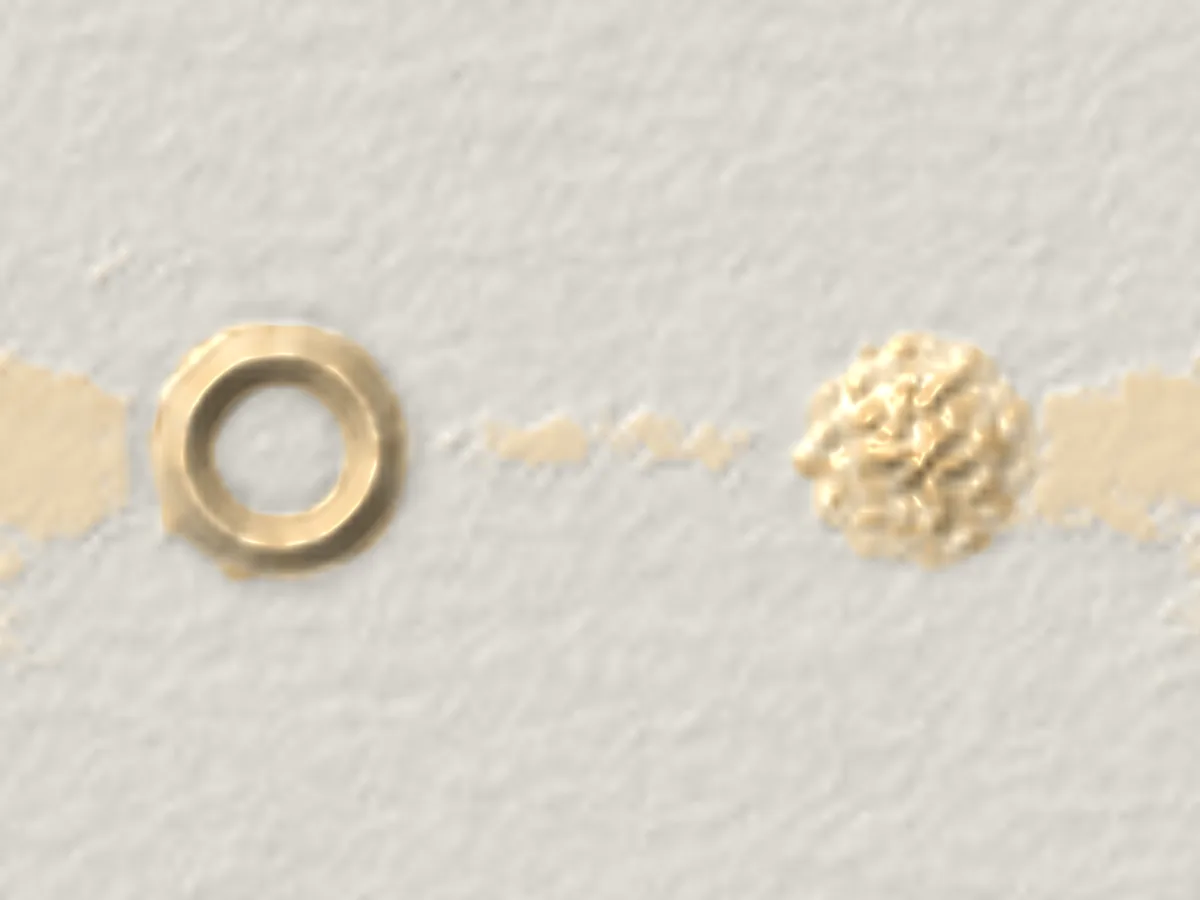
Yeast works in real seconds while you play, so a yeasted dough barely moves in a minute: a minute of warm play raises it by a few percent at most, as a test checks. The rise you can watch comes from a fizz. Baking soda and vinegar in unyeasted dough give off gas that enters the dough by the yeast's own rule. It grows by about a third in twenty seconds of play and bakes full of holes; a test checks both.
In the oven the yeast has a last burst before it dies, the gas swells with heat and steam, and at 75 °C dough turns into bread. Fold cold butter in, fold again, roll it out, and it bakes flaky; work the butter in warm and it smears, and the layers are gone. A test pins both.
Leave ketchup on the page for three days and fuzzy spots appear: green-blue, white, black, now and then orange. Leave honey beside it and it stays clean. Spray vinegar over half the food and that half stays clear for days, and mould already on it dies into a stain. A test checks all three.
Nobody told the mould about honey, ketchup or vinegar. At every spot it reads what's there, whoever put it there: how acid it is, how much sugar there is against the water, how much salt and bleach, whether it's burnt, frozen or very hot. Honey is so sugary that there's no water left for mould. Ketchup is sour, but not sour enough, and moulds happily. Vinegar is sour enough. Water honey down enough and its sugar drops below the limit, and mould can start.
Mould needs food, and it never eats it up. A colony can only start on something with food in it, and the food sets how thick the fuzz grows; on bare paper a big colony only shows as a faint halo. A crayon stroke through mould clears a path that doesn't grow straight back, because the crayon took the food with it. A test checks that too.
A spore that lands takes 20 game-hours to show, so two days show mould and half a day doesn't. The oven kills it and keeps the page clear for a week. Tests pin both.
Four dabs left out on a sheet of paper: bread (top left), ketchup (top right), honey (bottom left) and ketchup with vinegar sprayed on it (bottom right). Time runs at six game-hours a second and stops after two weeks; the buttons wait an hour or three days at once. What to look for: each spot shows 20 hours after its spore lands, then grows fast and then slower. Honey stays clean until you water it down enough, then opens to mould step by step. A little vinegar only slows mould; enough keeps its dab clear. Colony sizes, edges, colours, seeding and habitability are the game's own; the food in each dab is set for the demo (ketchup's pinch of salt is left out), and the game's shader fuzz is left out.

This part of the page could not start.
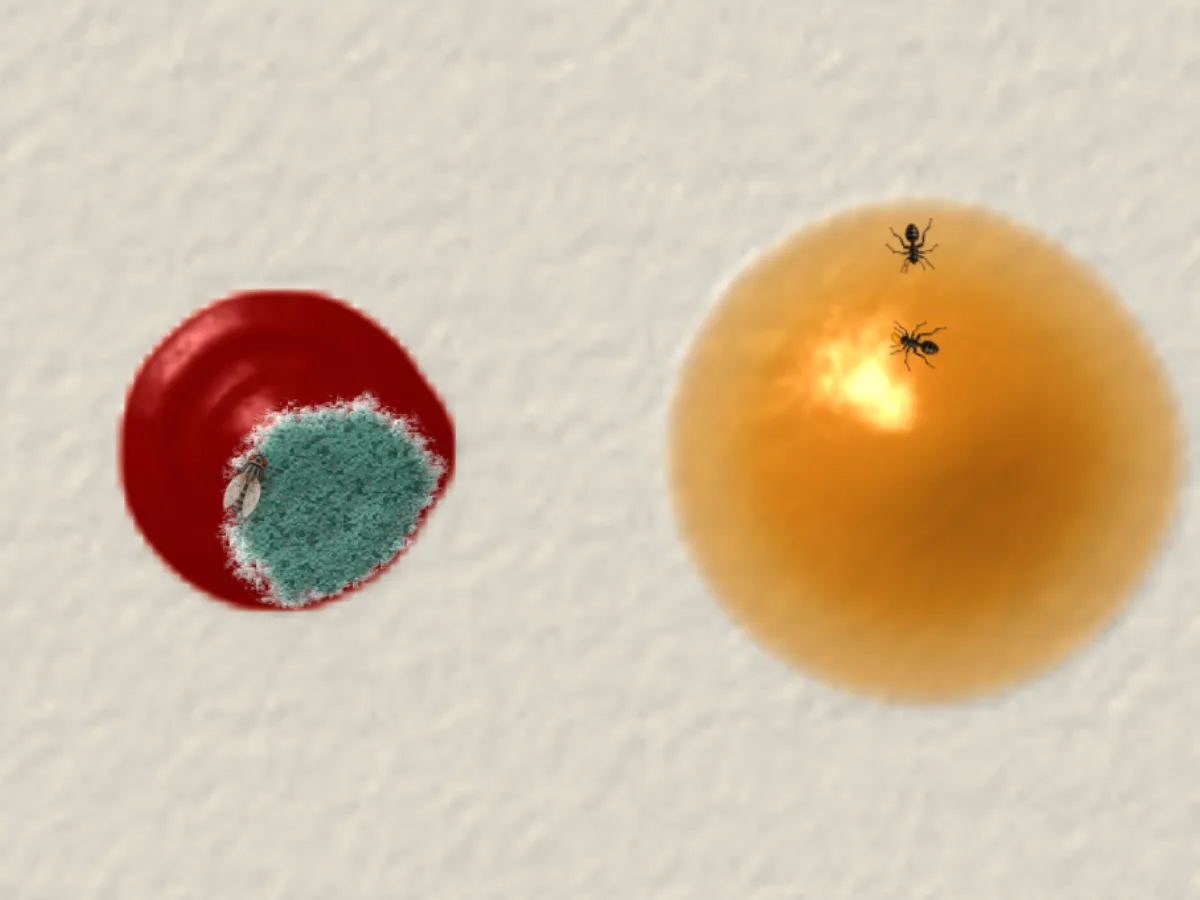
Real mould spreads by growing threads. Simulating those, or the random walkers used for branching growth Witten 1981, would mean working through every hour of a three-day wait. Instead each colony stores when it started and how fast it grows, and its size is a formula of its age: a three-day wait is one sum per colony. Only new colonies need the hours in between, as a dice roll at each step of the wait.
Mould also travels. A big enough colony lets its spores go when wind blows over it or something jolts the paper. The spores ride the same air as smoke and smells, settle out, and start new colonies where they land on food. Bounce a ball on a mouldy patch in a breeze, wait, and new mould appears downwind; a test checks it. The mould code has no rule about balls: the bounce is a jolt and a touch, and the wind is the air simulation.
Every colony is unseen for 20 hours; three days after its spore landed its radius is 11.6 to 32.4 mm, and the faster ones reach the largest size, 42 mm, within the fortnight.
| hours since the spore landed | slowest colony | middle | fastest |
|---|---|---|---|
| 0 | 0 | 0 | 0 |
| 2 | 0 | 0 | 0 |
| 4 | 0 | 0 | 0 |
| 6 | 0 | 0 | 0 |
| 8 | 0 | 0 | 0 |
| 10 | 0 | 0 | 0 |
| 12 | 0 | 0 | 0 |
| 14 | 0 | 0 | 0 |
| 16 | 0 | 0 | 0 |
| 18 | 0 | 0 | 0 |
| 20 | 0 | 0 | 0 |
| 22 | 3.24 | 5.27 | 7.31 |
| 24 | 4.08 | 6.96 | 9.84 |
| 26 | 4.73 | 8.25 | 11.78 |
| 28 | 5.27 | 9.35 | 13.42 |
| 30 | 5.75 | 10.31 | 14.86 |
| 32 | 6.19 | 11.18 | 16.16 |
| 34 | 6.59 | 11.98 | 17.36 |
| 36 | 6.96 | 12.72 | 18.48 |
| 38 | 7.31 | 13.42 | 19.53 |
| 40 | 7.64 | 14.08 | 20.52 |
| 42 | 7.95 | 14.71 | 21.46 |
| 44 | 8.25 | 15.31 | 22.36 |
| 46 | 8.54 | 15.89 | 23.23 |
| 48 | 8.82 | 16.44 | 24.06 |
| 50 | 9.09 | 16.97 | 24.86 |
| 52 | 9.35 | 17.49 | 25.64 |
| 54 | 9.6 | 17.99 | 26.39 |
| 56 | 9.84 | 18.48 | 27.12 |
| 58 | 10.08 | 18.95 | 27.83 |
| 60 | 10.31 | 19.41 | 28.52 |
| 62 | 10.53 | 19.86 | 29.2 |
| 64 | 10.75 | 20.3 | 29.86 |
| 66 | 10.97 | 20.73 | 30.5 |
| 68 | 11.18 | 21.15 | 31.13 |
| 70 | 11.38 | 21.56 | 31.75 |
| 72 | 11.58 | 21.97 | 32.35 |
| 74 | 11.78 | 22.36 | 32.95 |
| 76 | 11.98 | 22.75 | 33.53 |
| 78 | 12.17 | 23.13 | 34.1 |
| 80 | 12.35 | 23.51 | 34.66 |
| 82 | 12.54 | 23.88 | 35.22 |
| 84 | 12.72 | 24.24 | 35.76 |
| 86 | 12.9 | 24.6 | 36.3 |
| 88 | 13.07 | 24.95 | 36.82 |
| 90 | 13.25 | 25.3 | 37.34 |
| 92 | 13.42 | 25.64 | 37.86 |
| 94 | 13.59 | 25.97 | 38.36 |
| 96 | 13.75 | 26.31 | 38.86 |
| 98 | 13.92 | 26.64 | 39.35 |
| 100 | 14.08 | 26.96 | 39.84 |
| 102 | 14.24 | 27.28 | 40.32 |
| 104 | 14.4 | 27.6 | 40.79 |
| 106 | 14.55 | 27.91 | 41.26 |
| 108 | 14.71 | 28.22 | 41.73 |
| 110 | 14.86 | 28.52 | 42 |
| 112 | 15.01 | 28.82 | 42 |
| 114 | 15.16 | 29.12 | 42 |
| 116 | 15.31 | 29.42 | 42 |
| 118 | 15.46 | 29.71 | 42 |
| 120 | 15.6 | 30 | 42 |
| 122 | 15.74 | 30.29 | 42 |
| 124 | 15.89 | 30.57 | 42 |
| 126 | 16.03 | 30.85 | 42 |
| 128 | 16.16 | 31.13 | 42 |
| 130 | 16.3 | 31.41 | 42 |
| 132 | 16.44 | 31.68 | 42 |
| 134 | 16.57 | 31.95 | 42 |
| 136 | 16.71 | 32.22 | 42 |
| 138 | 16.84 | 32.48 | 42 |
| 140 | 16.97 | 32.75 | 42 |
| 142 | 17.11 | 33.01 | 42 |
| 144 | 17.24 | 33.27 | 42 |
| 146 | 17.36 | 33.53 | 42 |
| 148 | 17.49 | 33.78 | 42 |
| 150 | 17.62 | 34.04 | 42 |
| 152 | 17.74 | 34.29 | 42 |
| 154 | 17.87 | 34.54 | 42 |
| 156 | 17.99 | 34.79 | 42 |
| 158 | 18.12 | 35.03 | 42 |
| 160 | 18.24 | 35.28 | 42 |
| 162 | 18.36 | 35.52 | 42 |
| 164 | 18.48 | 35.76 | 42 |
| 166 | 18.6 | 36 | 42 |
| 168 | 18.72 | 36.24 | 42 |
| 170 | 18.84 | 36.47 | 42 |
| 172 | 18.95 | 36.71 | 42 |
| 174 | 19.07 | 36.94 | 42 |
| 176 | 19.19 | 37.17 | 42 |
| 178 | 19.3 | 37.4 | 42 |
| 180 | 19.41 | 37.63 | 42 |
| 182 | 19.53 | 37.86 | 42 |
| 184 | 19.64 | 38.08 | 42 |
| 186 | 19.75 | 38.31 | 42 |
| 188 | 19.86 | 38.53 | 42 |
| 190 | 19.98 | 38.75 | 42 |
| 192 | 20.09 | 38.97 | 42 |
| 194 | 20.19 | 39.19 | 42 |
| 196 | 20.3 | 39.41 | 42 |
| 198 | 20.41 | 39.62 | 42 |
| 200 | 20.52 | 39.84 | 42 |
| 202 | 20.63 | 40.05 | 42 |
| 204 | 20.73 | 40.27 | 42 |
| 206 | 20.84 | 40.48 | 42 |
| 208 | 20.94 | 40.69 | 42 |
| 210 | 21.05 | 40.9 | 42 |
| 212 | 21.15 | 41.11 | 42 |
| 214 | 21.26 | 41.31 | 42 |
| 216 | 21.36 | 41.52 | 42 |
| 218 | 21.46 | 41.73 | 42 |
| 220 | 21.56 | 41.93 | 42 |
| 222 | 21.67 | 42 | 42 |
| 224 | 21.77 | 42 | 42 |
| 226 | 21.87 | 42 | 42 |
| 228 | 21.97 | 42 | 42 |
| 230 | 22.07 | 42 | 42 |
| 232 | 22.17 | 42 | 42 |
| 234 | 22.27 | 42 | 42 |
| 236 | 22.36 | 42 | 42 |
| 238 | 22.46 | 42 | 42 |
| 240 | 22.56 | 42 | 42 |
| 242 | 22.66 | 42 | 42 |
| 244 | 22.75 | 42 | 42 |
| 246 | 22.85 | 42 | 42 |
| 248 | 22.94 | 42 | 42 |
| 250 | 23.04 | 42 | 42 |
| 252 | 23.13 | 42 | 42 |
| 254 | 23.23 | 42 | 42 |
| 256 | 23.32 | 42 | 42 |
| 258 | 23.42 | 42 | 42 |
| 260 | 23.51 | 42 | 42 |
| 262 | 23.6 | 42 | 42 |
| 264 | 23.69 | 42 | 42 |
| 266 | 23.79 | 42 | 42 |
| 268 | 23.88 | 42 | 42 |
| 270 | 23.97 | 42 | 42 |
| 272 | 24.06 | 42 | 42 |
| 274 | 24.15 | 42 | 42 |
| 276 | 24.24 | 42 | 42 |
| 278 | 24.33 | 42 | 42 |
| 280 | 24.42 | 42 | 42 |
| 282 | 24.51 | 42 | 42 |
| 284 | 24.6 | 42 | 42 |
| 286 | 24.69 | 42 | 42 |
| 288 | 24.77 | 42 | 42 |
| 290 | 24.86 | 42 | 42 |
| 292 | 24.95 | 42 | 42 |
| 294 | 25.04 | 42 | 42 |
| 296 | 25.12 | 42 | 42 |
| 298 | 25.21 | 42 | 42 |
| 300 | 25.3 | 42 | 42 |
| 302 | 25.38 | 42 | 42 |
| 304 | 25.47 | 42 | 42 |
| 306 | 25.55 | 42 | 42 |
| 308 | 25.64 | 42 | 42 |
| 310 | 25.72 | 42 | 42 |
| 312 | 25.81 | 42 | 42 |
| 314 | 25.89 | 42 | 42 |
| 316 | 25.97 | 42 | 42 |
| 318 | 26.06 | 42 | 42 |
| 320 | 26.14 | 42 | 42 |
| 322 | 26.22 | 42 | 42 |
| 324 | 26.31 | 42 | 42 |
| 326 | 26.39 | 42 | 42 |
| 328 | 26.47 | 42 | 42 |
| 330 | 26.55 | 42 | 42 |
| 332 | 26.64 | 42 | 42 |
| 334 | 26.72 | 42 | 42 |
| 336 | 26.8 | 42 | 42 |
Source: The game's own growth curve for a colony, at its slowest, middle and fastest pace, at the nominal 0.6 mm a spot, up to its largest size.
Sow cress on wet paper and after one to two and a half damp game-hours the seeds split and send up shoots. They keep growing while they're damp, up to between 4 and 7 mm. Let the paper dry and they go yellow and flop over; water them again and they recover. Grass is slower and taller, and a lush tuft may flower into a daisy, a buttercup or clover.
Chia and flax from the sieve are seeds too. Sprinkle chia on a wet patch and wait three days, and you have a patch of cress; dry chia stays seed, and a test checks it. Crush flax with the rolling pin first and it won't come up. Seeds under ketchup or paint sprout; under chocolate or peanut butter they stay dry, because fat isn't water. Strong heat roasts them, and the pigeon eats any it finds before they sprout.
One difference between play and a wait is deliberate. A seed that has started to drink and then dries out for a day dies, but only over a time skip. While you play, it waits for the next watering. A child who forgets to water for a few minutes doesn't lose the seeds.
next update New shoots come up pale and turn green over about a day in the light, as real seedlings do.
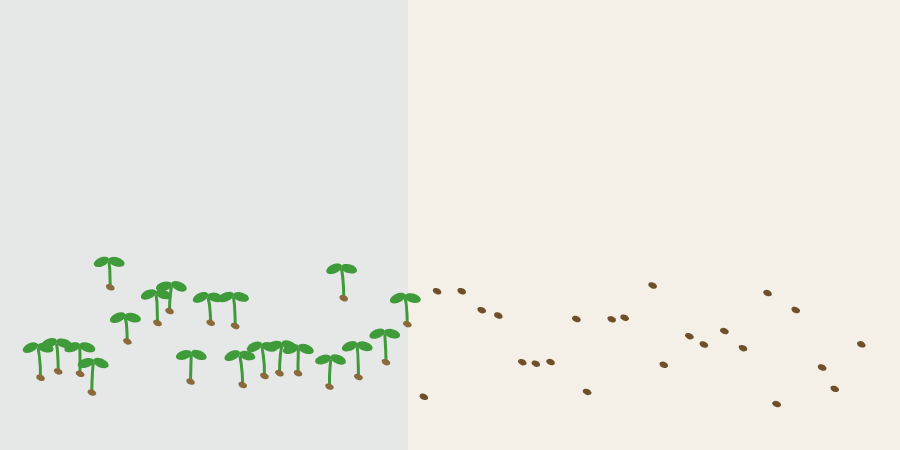
Cress seeds on a strip of paper, the left part wet. Time runs at a game-hour a second, sixty times the game's own play clock. Drag across the paper to water it, or press Water the strip. What to look for: wet seeds sprout after one to two and a half damp hours; as the paper dries they yellow and droop, and watering brings them back. Switch on "over a time skip" and seeds that drank and then stayed dry for 24 hours die. The seed rules are the game's; how fast this paper dries is set for the demo, and the shoots are drawn simply.
This part of the page could not start.
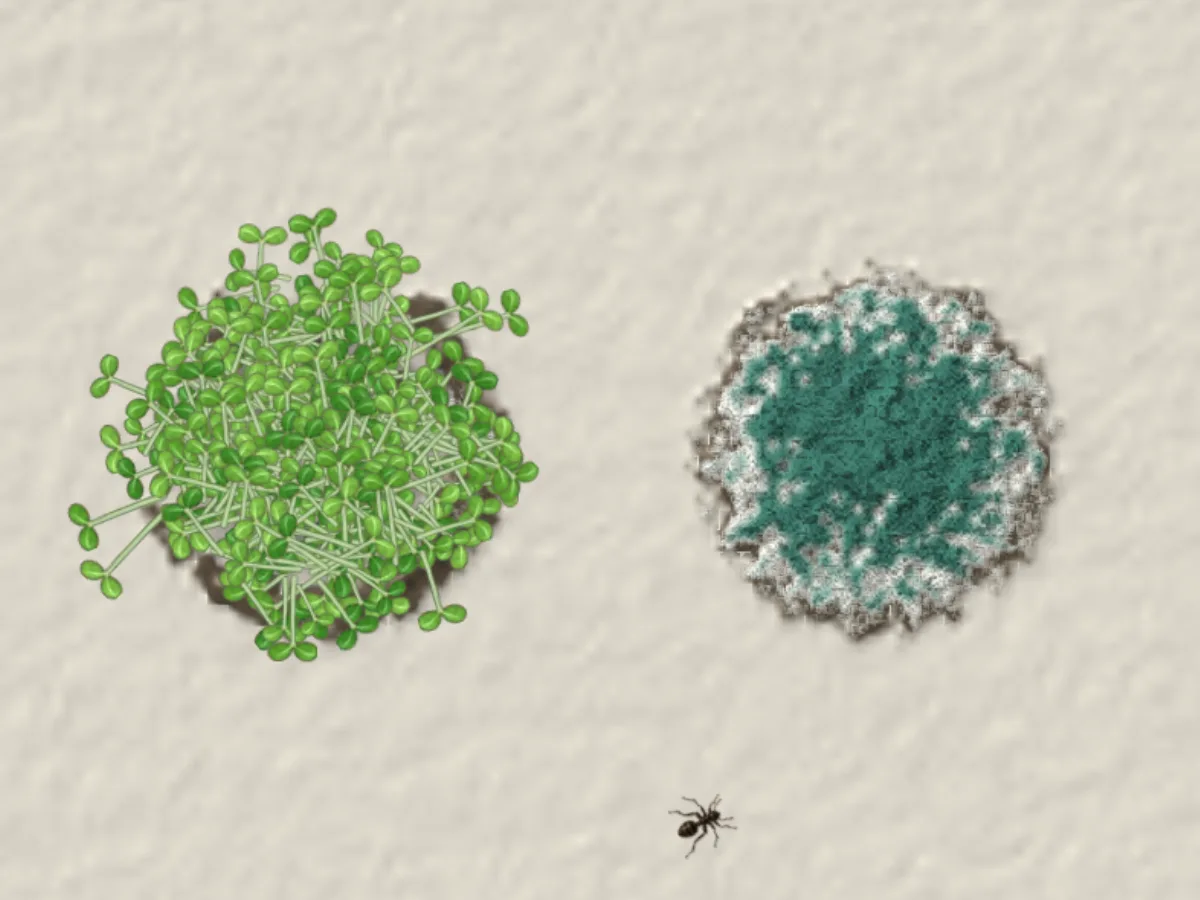
Squash an apple into pulp, or lay out slices of banana or cucumber, and leave them for three days. They come back browner. The slices also lose a little height, which from above doesn't show. A whole apple or tomato darkens and shrinks too, and other foods dim a little. This is a plain colour-and-size curve that runs only during a time skip. It doesn't model the enzyme and the oxygen that brown real fruit, so lemon juice doesn't stop it (a lemon slice browns too), and nothing browns while you watch.
Rotting comes from shared rules, not from a fruit rule. By our reading of the code (no test names fruit here), fruit left out soaks its food into the paper during a wait, so mould can start on it, and its sweet smell drifts on the air and draws flies.
Fruit and slices let through 12 % less light per day down to 55 %; other food 3 % less down to 80 %; whole fruit and slices lose 6 % of their height per day down to 70 %.
| days of waiting | fruit and slices: light let through | other food: light let through | whole fruit and slices: height |
|---|---|---|---|
| 0 | 1 | 1 | 1 |
| 0.25 | 0.97 | 0.993 | 0.985 |
| 0.5 | 0.94 | 0.985 | 0.97 |
| 0.75 | 0.91 | 0.978 | 0.955 |
| 1 | 0.88 | 0.97 | 0.94 |
| 1.25 | 0.85 | 0.963 | 0.925 |
| 1.5 | 0.82 | 0.955 | 0.91 |
| 1.75 | 0.79 | 0.948 | 0.895 |
| 2 | 0.76 | 0.94 | 0.88 |
| 2.25 | 0.73 | 0.932 | 0.865 |
| 2.5 | 0.7 | 0.925 | 0.85 |
| 2.75 | 0.67 | 0.917 | 0.835 |
| 3 | 0.64 | 0.91 | 0.82 |
| 3.25 | 0.61 | 0.902 | 0.805 |
| 3.5 | 0.58 | 0.895 | 0.79 |
| 3.75 | 0.55 | 0.887 | 0.775 |
| 4 | 0.55 | 0.88 | 0.76 |
| 4.25 | 0.55 | 0.873 | 0.745 |
| 4.5 | 0.55 | 0.865 | 0.73 |
| 4.75 | 0.55 | 0.858 | 0.715 |
| 5 | 0.55 | 0.85 | 0.7 |
| 5.25 | 0.55 | 0.843 | 0.7 |
| 5.5 | 0.55 | 0.835 | 0.7 |
| 5.75 | 0.55 | 0.828 | 0.7 |
| 6 | 0.55 | 0.82 | 0.7 |
| 6.25 | 0.55 | 0.813 | 0.7 |
| 6.5 | 0.55 | 0.805 | 0.7 |
| 6.75 | 0.55 | 0.8 | 0.7 |
| 7 | 0.55 | 0.8 | 0.7 |
Source: The game's own browning rule, applied in a time skip only, once per skip.
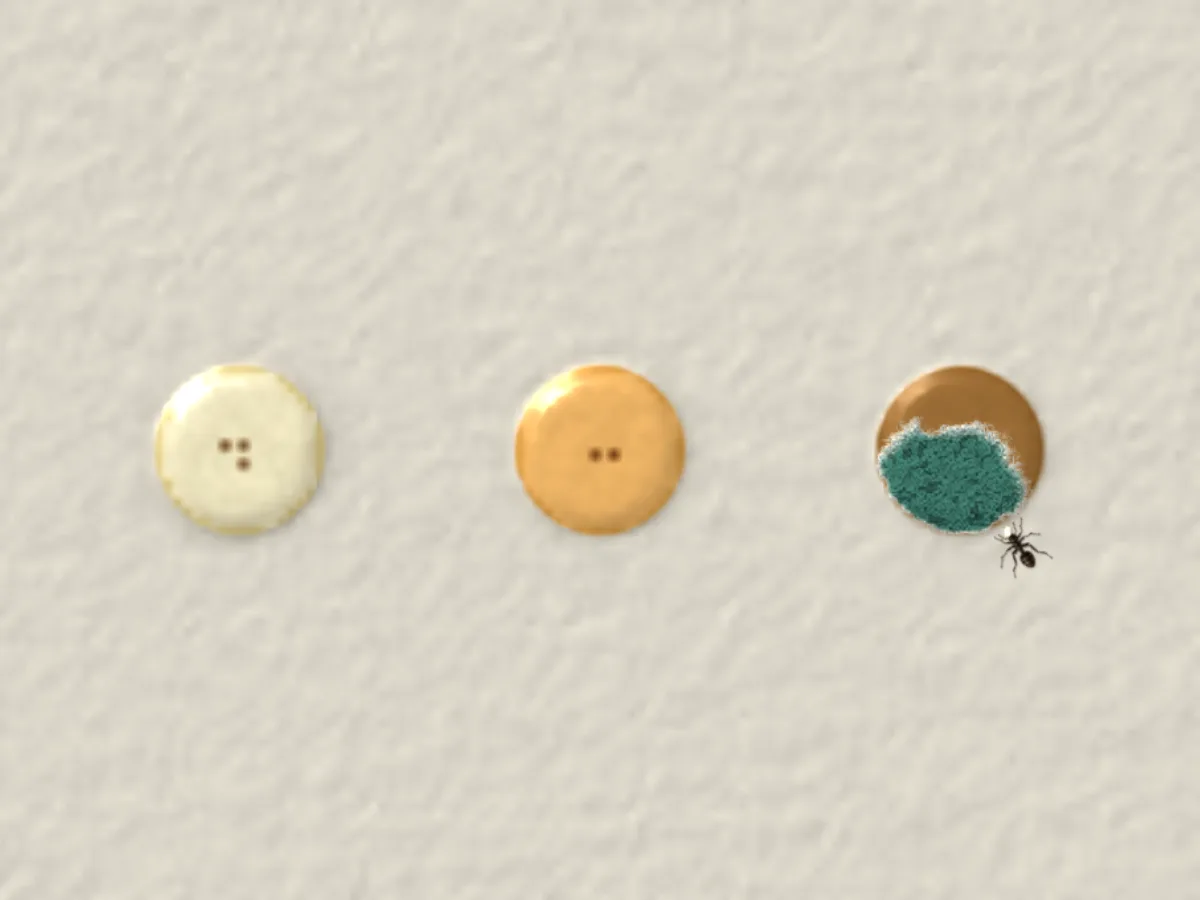
Each living thing runs on its own clock while you play. Dough ferments in real seconds, kneading is sped up about 20 times, mould gets a game-hour every one and a half minutes and plants one every minute. A child can watch cress come up within a few minutes, and mould shows after about half an hour of play. A yeasted dough rises at its real pace, which is too slow to watch.
That's what the time buttons are for: "Wait 1 hour", "Wait 3 days", "Bake in the oven", "Put in the freezer" and "A week in the sun". They aren't five different features. They are one recipe, given a temperature and a number of hours. The oven is 180 °C for twenty minutes, the freezer −18 °C for three hours, the sunny window 35 °C for a week. Anything new only has to say how it reacts to warmth and time.
The same recipe runs when you come back. Open the app after more than half an hour and the page has aged by the time you were away, up to two weeks; bring it back to the front after two hours or more and the same happens. A sentence then tells you what changed: the dough rose, or the ketchup grew mould.
| Step | Wait 1 hour | Wait 3 days | Bake in the oven | Put in the freezer | A week in the sun |
|---|---|---|---|---|---|
| Whatever was in the air lands, fires go out, the heat goes back to the room | Runs. Every skip starts here. | Runs. Every skip starts here. | Runs. Every skip starts here. | Stops here. Below 0 °C nothing runs, reacts, dries or grows: the water is ice. | Runs. Every skip starts here. |
| Heat changes solid things for good; crayon wax melts | Skipped. Not hot enough. | Skipped. Not hot enough. | Runs. Plastic slumps, a pen bursts, crayon melts into the paper. | Skipped. | Skipped. Not hot enough. |
| Soft things melt, runny things run | Runs. Played out for a while, longer for a longer wait, up to a cap. | Runs. Played out for a while, longer for a longer wait, up to a cap. | Runs. Played out only if something melted. | Skipped. | Runs. Played out for a while, longer for a longer wait, up to a cap. |
| Reactions run; yeasted dough proves | Runs. Reaction clock: 1 room-hours. Dough: half-hour steps that double once it settles. | Runs. Reaction clock: 72 room-hours. Dough: half-hour steps that double once it settles. | Runs. Reaction clock: 21,845 room-hours. Dough: oven spring. | Skipped. | Runs. Reaction clock: 475 room-hours. Dough: half-hour steps that double once it settles. |
| Hot: cooking, browning, mould dies. Cool: food soaks in, mould and plants grow | Runs. Mould and plants get 1 hours. | Runs. Mould and plants get 72 hours. | Runs. Mould dies into a stain; the page stays mould-free for a week. | Skipped. | Runs. Mould and plants get only part of the week: a sunny window is dry. |
| Things dry | Runs. Paper dries part way. | Runs. Everything dries out. | Runs. Everything dries out. | Skipped. | Runs. Everything dries out. |
| The wait's extras | Runs. Ants and flies may come; cups stay. | Runs. Cups are cleared away, ants scout, flies come to food, the paper yellows a little. | Skipped. Only the waits have these. | Skipped. | Skipped. Only the waits have these. |
The game's own rule The steps run in this order in the released game. "Room-hours" is the reaction clock: an hour at 30 °C counts as two.
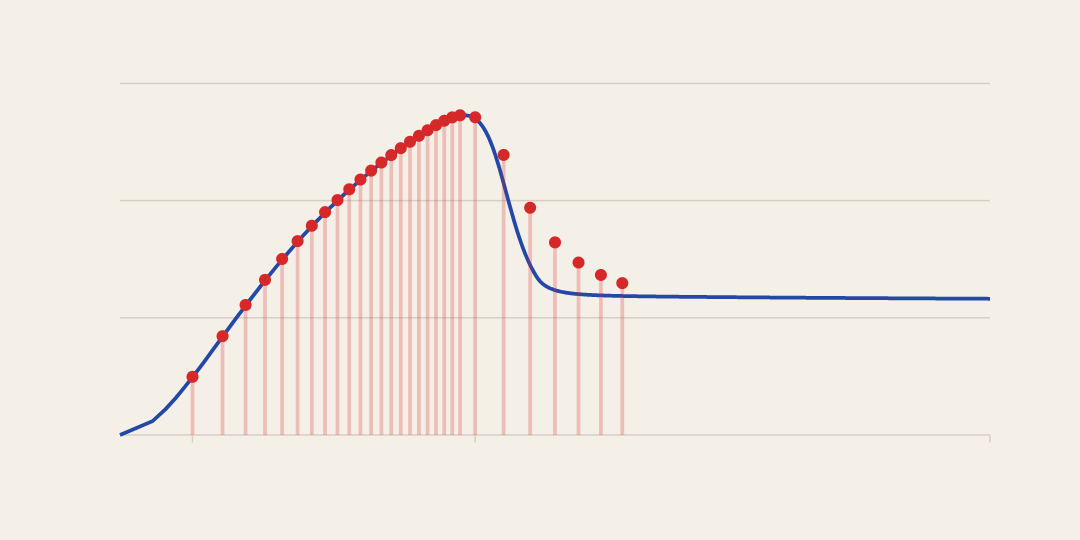
Dough in a wait can't be one sum, because it spreads as it rises and the spreading changes the dough. So the wait proves it in half-hour steps while it's still rising or sinking. Once it has settled, each step is twice as long as the last. Three days of a normal loaf take 37 steps instead of 144 even half-hours, and a fortnight takes 40. A test holds the result within 1 % of six-minute steps, in volume and in footprint. A sunny week is the exception: there even half-hour steps are some 5 % off fine ones, so the test only asks the doubling steps to do no worse.
One spot of the test's loaf (well kneaded, one dose of yeast, one of salt, 20 °C) waiting three days. The line is the rise worked out in six-minute steps; the dots are the steps the game's planner takes. Time runs along a square-root scale, so the early hours get room. What to look for: half-hour steps while the dough rises and sinks, then steps that double once it has settled. The step count depends on the wait and the dough. This is the game's own planner and yeast rule on one spot; the game also spreads the body each step.
This part of the page could not start.
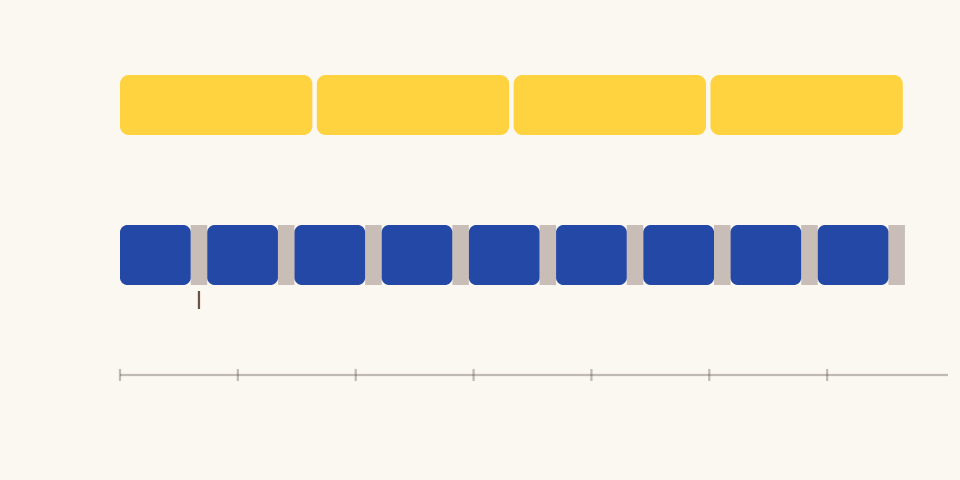
Press "Wait 3 days" and a curtain drops while the painter waits with you. Behind it, the simulation does its sums in the background thread in slices of about 6 milliseconds, letting other messages through in between, so the screen keeps moving. Anything you draw meanwhile waits and lands after the wait. A test stops the wait at every possible point and checks that the result matches doing it in one go to the last digit, down to the next random number, for six kinds of skip on both sheet sizes.
Frames every 16.7 ms on a 60 Hz screen (top); the wait's slices of about 6 ms in the worker (each ends at the first stopping point after 6 ms), with messages handled between them (bottom, blue; grey gaps). The 6 ms is the code's budget, not a measured time.
This part of the page could not start.
None of these is a rule about dough or mould meeting something. Each comes from one system writing a shared number and another reading it.
Shared: salt → conductance
With as much salt as play dough has, it lights a bulb and warms up. A normal bread's salt carries far too little. Pinned by a test.
Shared: gas share → pores
The baked bread drinks it up, because its gas became holes in the wicking layer. Pinned by a test.
Shared: air: spores
New colonies start downwind where the spores land on food. Pinned by a test.
Shared: fizz gas → the yeast's rule
It rises in seconds by the yeast's own rule and bakes full of holes. Pinned by a test.
Shared: smell: sweet
Flies come to it, following the sweet smell the busy yeast gives off. Pinned by a test.
Shared: contact: press
It knocks the gas out, by how hard and how long it presses. Pinned by a test.