How children learn through play
Surprise, self-led play, rewards and guided play. 30 sources, most found after the design, 7 that push back.
Game Tailors
Source: The research behind it
The drawing app where the paper is real. No ads. No accounts. No personal data: only anonymous counts, which you can switch off.
Game Tailors · Schieweg 15Y-40, 2627 AN Delft (NL)
KvK 92437702 · VAT NL866044474B01
info@gametailors.com · +31 6 4227 5919
© 2026 Game Tailors
The research behind it
Professor Oops draws on research about how children play, how to make water, wind and fire behave on a screen, how real animals and kitchens work, and how to treat children fairly. We built the toy first and read much of the learning research afterwards. So every source carries a label: applied directly, informed the design, or found later. Some of it pushes back, and we say where.
It's tempting to say a children's app is "based on research". For Professor Oops that would be too simple, and partly untrue. Research did four different jobs here, at different times, with different strength.
Play. The game is a sheet of paper where everything reacts, with no goals and no way to fail. That came from earlier toys, and the research on how children learn was read afterwards. Much of it fits. Some of it argues against what we may claim.
Simulation. To make wind blow, watercolour dry with a dark rim and drops leave long stains, we read computer graphics and physics papers. A few methods went in by name. Most were cut down to what a tablet can run 60 times a second.
Real facts. Ants, pigeons, a cat and a dog, and a kitchen full of things that melt, brown and burn. Real findings set which way things go. Play sets how fast.
Respect. Before the shop was built, we read the law and the store rules on selling to children. That is where research was applied most directly, line by line.
Surprise, self-led play, rewards and guided play. 30 sources, most found after the design, 7 that push back.
Fluids, watercolour, drop stains, fire and mould. 56 sources, two methods followed by name.
Ant trails, fleeing flies, ignition points and cabbage colours. 67 sources: 57 traced to the code line by line, 10 strong ones not used yet.
No locks or prices in play, a sum for grown-ups, three asks at most. 28 sources, 15 applied directly.
If you count every source by what it really did, the picture is modest. A small share was applied directly. More shaped an idea that we then built our own, simpler way. A large share we found only after building, and we list it as consistent with the game, or not, never as its basis. Some we read and chose not to build, and some strong work we haven't used yet.
The chapters differ a lot. The respect chapter is mostly "applied", because laws and store rules can be followed line by line. The play chapter is mostly "found later", because the toy came before the reading. That difference is the honest shape of how the game was made.
Professor Oops started as a toy, not a lesson. Its first design says it in one line: no goals, scores or failure states. That came from looking at what children already love, such as Kid Pix with its dynamite eraser and falling-sand games, where a few simple rules make endless stories Prior-art 2026. The learning papers came twelve days later, when we wrote pages for parents.
Much of what we then read fits. Even babies learn more about an object that surprised them, and test it in ways that fit what went wrong Stahl 2015. Preschoolers given a muddled toy choose to explore it and sort the causes out in free play Schulz 2007. Children shown one thing a toy can do mostly stick to that one thing Bonawitz 2011. And promised rewards can dull the wish to draw Lepper 1973, Deci 1999. The game has no points, stars or streaks, a rule set before we read any of this.
Some of it pushes back hard. Across 164 studies, explicit teaching beat discovery without help Alfieri 2011, and reviews argue that minimal guidance doesn't teach content Kirschner 2006. A sandbox on its own is discovery without help. So we never say the game teaches science by itself. The help the research favours comes from a grown-up: the website pairs experiments with a version to do for real in the kitchen.
What the game is engineered for is the part a surprise needs: it holds up when you poke it again. Paint a line of water and light the paper beside it, and the fire is held at the line until its heat has boiled the water off, because fire reads how wet each spot is, whatever made it wet. Try again and it's held again.
No rules, no failure, destruction as play, an undo a child can trust, no ads.
"No goals, scores or failure states." The same day: no monsters, giants or black holes, only real things a child could do to paper.
Graphics and physics papers read by one rule: believable beats correct.
Written after consumer law, regulators' guidance and a study of manipulative design in children's apps.
Cited on the website, on a page for parents asking whether children learn anything.
Looked up at its own record and traced to the code it shaped, or didn't.
Our research notes on simulating had one rule: believable beats correct. A dark rim on a dried wash is a signature people recognise. The exact speed of a ripple on three millimetres of water is not, at least not to a child holding a tablet.
Two methods went in by name. The wind is "stable fluids" from computer animation Stam 1999, changed for a page seen from above, where a fan blowing down is a source of air. And every drop stain follows a forensic rule: its width over its length is the sine of the angle it landed at Neitzel & Smith.
Far more shaped an idea we then built more simply. The watercolour took its picture of water, fibres and pigment from one 1997 paper Curtis 1997, and none of its machinery. And some famous work was turned down on purpose. Mould could grow as random walkers Witten 1981, but then "come back in three days" would mean simulating three days. Instead each colony's size is a formula of its age, one sum on any device.
One finding was our own. The first wind leaned: draughts blew about a fifth harder one way than the other, because the classic solver updates cells in reading order. The fix was an old method used carefully, multigrid, built so that a mirrored gust gets a mirrored answer to the last bit.
Before we build an animal or a kitchen substance, we read. Findings like these decide the mechanism: what the animal senses, and which way it moves. The exact numbers are then set by play, on a sheet about 31 by 23 cm, where a cat is the size of a thumb.
Our ants turn toward the side of a trail that smells stronger, by the difference between left and right divided by the total. Researchers measured turns of that same form in Argentine ants Perna 2012, but our code doesn't name the paper, so we call it a match, not an implementation. Real garden-ant scent lasts about 47 minutes Beckers 1993. Ours fades many times faster, so a child can watch a trail go within one sitting.
Every temperature in the game hangs on one real number. Paper catches fire at a point on the game's own scale set to mean 230 °C, inside the published 218 to 246 °C Autoignition, Wikipedia. Checking works both ways. Baking soda in water sits at about pH 8.3 Science Insights, and the released game let it read pH 10, turning cabbage juice teal-green. In the next update next update it stops at 8.3, and the cabbage goes blue, as it does in a kitchen.
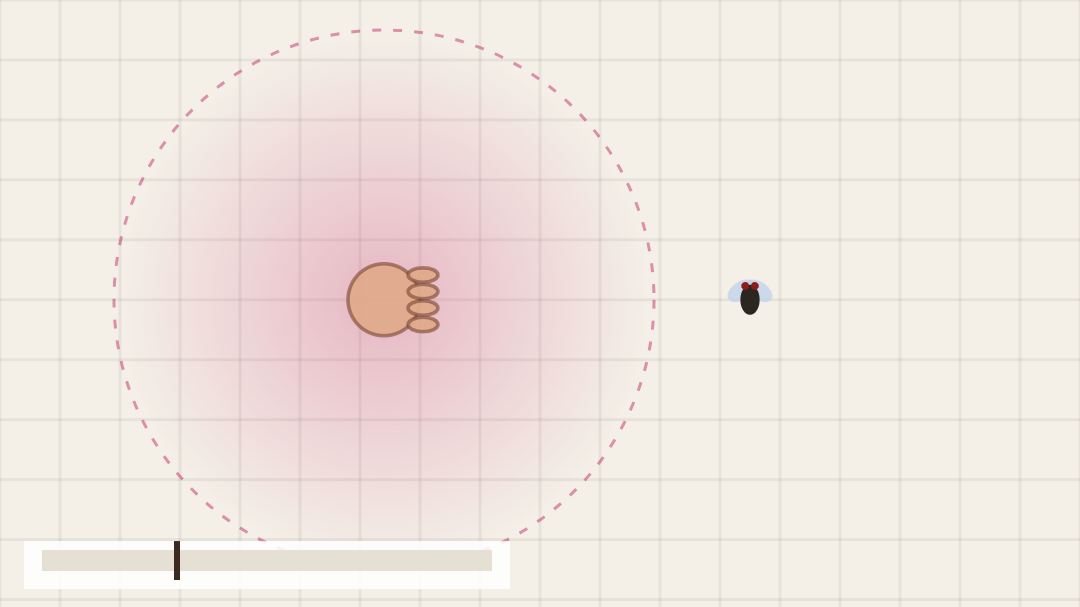
Flies filmed at take-off jump directly away from a looming threat Card 2008. That paper informed one thing in the game: every startled animal flees straight away from what alarmed it. The other half of the demo below is ours, and no paper behind it: slow movement counts for far less than fast movement. That's what lets a cat creep up on a pigeon.
A hand moves in from the left at the speed you set. Drag on the paper to move it yourself, or press Start the hand again. What to look for: at a brisk 120 cells a second the fly darts off about 3 cm before the hand arrives, directly away from it: that is the half the research informed. At 45 or less the hand shows no movement at all and stops right beside the fly. Between about 50 and 65 it shows a little, but the fly gets used to it as it grows. A pigeon ignores a hand below about 120 cells a second and lets it come much closer. This is the game's motion rule, falloff, fading and getting-used-to, for one animal on a 360 × 200 cell page (one cell is about half a millimetre); the field is read at one point instead of across the game's grid, and the flight is simplified.
This part of the page could not start.
This is where research was applied most directly, and it was read before the shop existed. European law lists a direct appeal to children to buy, or to get an adult to buy for them, among practices that are always unfair EU 2005. Researchers who coded 133 apps played by 160 children aged 3 to 5 found about four in five used at least one manipulative design, such as a character asking for money Radesky 2022.
So a child at play meets no locks, no prices and no pictures of what's for sale. Our first warm idea, a locked present the child could see, was dropped once the research named it: pester power by design. Anything a grown-up must decide sits behind a short sum. The game asks a grown-up about the full version at most three times, a week apart, and "don't ask again" means never FTC 2022. There are no ads and no analytics code from another company.
Where we chose softer than the strictest reading, the chapter says so: a quiet "+N" tile for grown-ups at the end of a tab, a sum that won't stop many eight-year-olds. And research found later can still bite. Our pan-fire buttons offer "Put a lid on", as fire guidance says NFPA 2026, but also "Damp tea towel", which one UK fire service now warns against Essex 2024. We'd rather show that than leave it out.
Ideas came first. On the day of the first design, several hundred ideas for messy things a child might do to paper were scored for fun, ease, novelty and "you are never allowed to do that" thrill. Then a rule overrode the scores: only real things a child could really do to paper. That cut the giants and black holes, even the ones that scored highest. The table below has the real scores.
Research came next, where an idea needed it: how the thing behaves, how to compute it cheaply, and how to offer it fairly. The map after the table follows thirteen ideas from start to finish, each with the research it met and the label that research earned.
| # | Idea | Fun | Ease | Unique | Extreme | Score | Outcome |
|---|---|---|---|---|---|---|---|
| 1 | Hammer + fruit smash | 10 | 8 | 6 | 10 | 8.80 | in the game |
| 2 | Giant's footstep | 9 | 8 | 8 | 10 | 8.70 | cut: not real |
| 3 | Muddy dog shake-off | 9 | 8 | 8 | 8 | 8.40 | in the game |
| 4 | Magnifying-glass sunbeam | 8 | 9 | 7 | 9 | 8.30 | in the game |
| 5 | Pigeon: footprints, droppings | 9 | 8 | 8 | 7 | 8.25 | in the game |
| 6 | Giant sneeze | 8 | 9 | 7 | 8 | 8.15 | cut: not real |
| 7 | Ice-cream scoop stack | 9 | 8 | 7 | 7 | 8.10 | in the game |
| 8 | Egg drop, paper fried egg | 9 | 7 | 8 | 8 | 8.10 | in the game |
| 9 | Hungry caterpillar | 8 | 8 | 8 | 8 | 8.00 | not in the game |
| 10 | Volcano lava ooze | 8 | 8 | 7 | 9 | 8.00 | not in the game |
| 11 | Washing-machine tie-dye | 8 | 7 | 9 | 9 | 8.00 | not in the game |
| 12 | Black hole + white hole | 9 | 5 | 9 | 10 | 7.95 | cut: not real |
Each idea was given four scores from 1 to 10 on 17 October 2026; the team's formula weights fun 0.4, ease 0.3, novelty and thrill 0.15 each. It puts a giant's footstep second and a black hole twelfth. With the realism rule they're gone, and Sticky little sibling, Mould garden, Ketchup & mustard move up into the twelve. Several ideas near the top are not in the game, and plenty further down are.
Applied directly. Earlier creative apps and sandbox games: product lessons, not research Prior-art 2026
Built: No goals, scores or failure states, and an undo a child can trust, kept within a fixed memory budget. How we keep it right
Found later. Promised rewards dull the wish to play Lepper 1973, Deci 1999. Pushes back: the harm is narrower Cameron 2001
Built: No rewards of any kind, a rule from before the reading and stricter than the evidence. We call it a choice. How children learn through play
Found later. Children learn from surprises and explore muddled causes Stahl 2015, Schulz 2007
Built: Materials share per-cell layers, so a fire is held at a line of water every time until it has boiled it dry, and finds the thin part first. A test pins it. Built for surprises
Applied directly. Stable fluids Stam 1999
Built: The wind's advection and projection, with a softened pressure correction, solved by mirror-exact multigrid. Air that really moves
Informed the design. Computer-generated watercolour, read in full Curtis 1997, and MoXi's fibre noise Chu 2005
Built: A neighbour exchange of water and dye gated by fibres; the rim comes out 1.3 to 2.5 times as dark as the wash, measured by a test. Water in paper
Considered, not built. Diffusion-limited aggregation, too slow for a time skip Witten 1981
Built: Each colony's radius is a formula of its age, so three days later is one sum per colony. Dough, mould and time
Informed the design. A talk on sending interactions through shared elements Dohta 2017
Built: Dissolved elements and a data-driven reaction table, so rules grow as elements × materials, not materials × materials. Chemistry and pH
In our notes, same form. Turning by difference over sum Perna 2012. Informed the design: trail scent lasts about 47 minutes Beckers 1993
Built: Three feelers that turn the ant by difference over total; scent fades many times faster than real, on purpose. A test pins it. Animals with their own minds
Found later. Paper catches by itself at 218 to 246 °C Autoignition, Wikipedia
Built: Paper catching fire at 230 °C anchors the game's whole temperature scale. Heat and fire
Found later, didn't fit. Baking soda in water is about pH 8.3 Science Insights
Built: Released: it read pH 10, teal-green. Fixed to stop at 8.3, so cabbage goes blue next update. Chemistry and pH
Applied directly. No appeal to children to buy or to nag EU 2005; "ask your parents" coded as manipulative Radesky 2022
Built: No locks, prices or pictures of paid tools in play; the locked present was dropped; one purchase behind a sum. Designed with respect for children
Applied directly. A request with no permanent no is nagging FTC 2022; a fine for countdown pressure ACM 2024
Built: Three asks in all, a week apart, each with "No thanks, don't ask again"; no timer and no "only today". Designed with respect for children
Found later, fits in part. Lid on, heat off, never water NFPA 2026. Cuts against: no damp towel Essex 2024
Built: "Put a lid on" and no water button; water flares the oil and the painter says what a grown-up does instead; a test pins it. The towel button is in question. Heat and fire
None of these was written as a pairing of two things. A finding goes into one shared layer, such as how wet the paper is or what's lying on it, and everything that reads that layer is affected. That's why a fact checked in one chapter shows up in another.
Shared: wet + temp
The fire is held at the line, slips through where it's thin, and in the end boils the rest dry.
Heat and fire · pinned by a test
Shared: wetness + dye per cell
The edge dries 1.3 to 2.5 times darker than the middle.
Water in paper · pinned by a test
Shared: fine dust on the cell
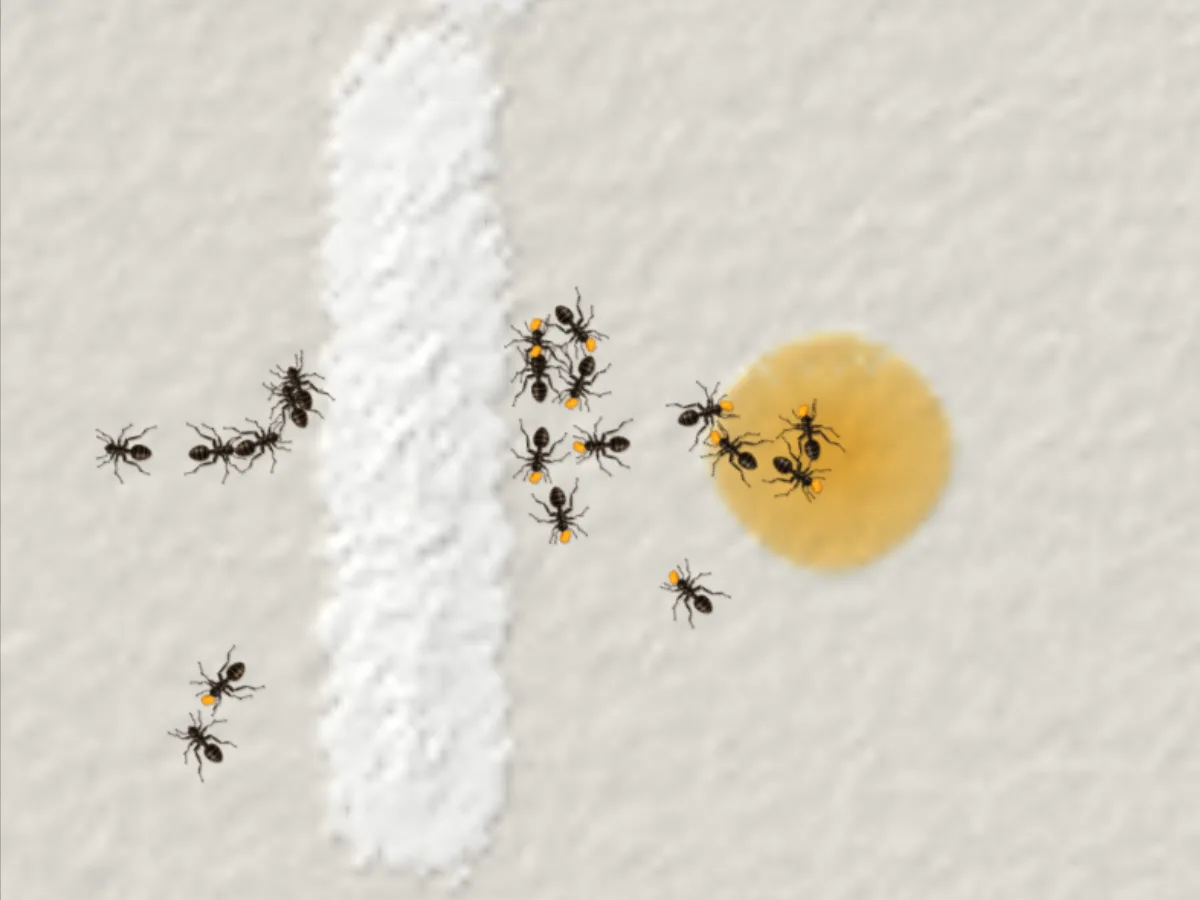
No ant crosses, and the scent under the line is gone.
Animals with their own minds · pinned by a test
Shared: carbonate in the paper → pH
The juice turns blue in a thin ring round the burn. There's no cabbage code in the fire.
Chemistry and pH · pinned by a test
Shared: latent heat, 2,260 J/g
Steam throws the oil up, and the painter says what a grown-up does instead.
Heat and fire · pinned by a test
Shared: noise + motion
The near one flies, and its wings send up the other.
Sound and shaking · pinned by a test